
You’re standing at the airport security checkpoint, fumbling through your carry-on while a line of impatient travelers forms behind you. Your passport is somewhere at the bottom. Your charging cable is tangled around your toiletries. And you know you packed that boarding pass-but where?
This scene plays out millions of times every day. And it’s completely avoidable.
Travel organization isn’t about being obsessive or overly tidy. It’s about reducing friction so you can actually enjoy your trip instead of wrestling with your luggage. When your belongings have designated places, you spend less time searching and more time experiencing.
Over the years-across hundreds of flights, dozens of countries, and more hotel rooms than I can count-I’ve tested every type of travel organizer on the market. Some have been genuinely life-changing. Others were overpriced gimmicks that fell apart after one trip.
This guide cuts through the noise. You’ll learn exactly which organizers actually work, how to build a packing system that saves time and space, and the common mistakes that even experienced travelers make. Whether you’re a weekend wanderer or a full-time digital nomad, these strategies will transform how you travel.
What Is a Travel Organizer?
A travel organizer is any tool, accessory, or system designed to keep your belongings sorted, accessible, and protected while you’re on the move. This category includes physical items like packing cubes, tech pouches, and document wallets, as well as digital tools like itinerary planning apps.
At its core, a travel organizer solves one fundamental problem: chaos. Without organization, your suitcase becomes a black hole where items disappear and reappear at the worst possible moments. With organization, everything has a home-and you know exactly where to find it.
Travel expert Nora Dunn describes a packing cube as “a soft-sided bag of sorts that opens and closes with a zipper that helps you organize the contents of your luggage”. But the concept extends far beyond cubes. A travel organizer can be:
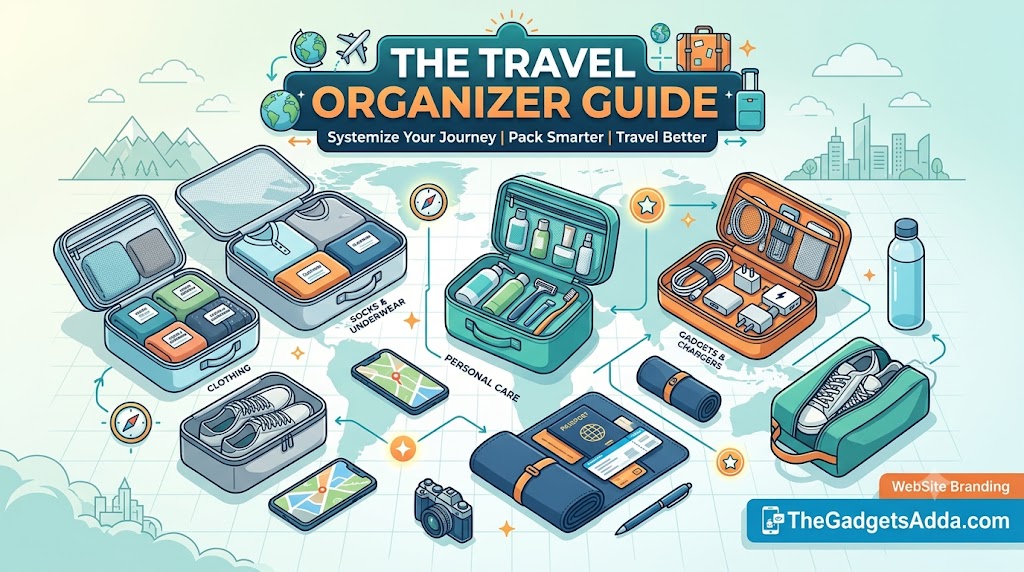
- A packing cube that separates your shirts from your socks
- A tech pouch that keeps cables and chargers from becoming a tangled mess
- A document wallet that holds your passport, boarding passes, and travel insurance
- A toiletry bag that prevents shampoo explosions from ruining your clothes
- A digital app that consolidates your flight confirmations and hotel bookings
The common thread? They all reduce the mental load of travel. When you’re not wasting brain power on “where did I put that?,” you have more energy for what actually matters.
Why Travel Organizers Matter
You might be thinking: Do I really need special organizers? Can’t I just use ziplock bags and hope for the best?
You could. But here’s what happens when you travel without a system.
You waste time. One traveler I know used to spend 15 minutes every morning digging through her suitcase to find a specific shirt. After switching to packing cubes, she cut that time to under 90 seconds. Multiply that across a two-week trip, and you’ve saved hours.
You lose things. When there’s no designated spot for your passport, it ends up everywhere-your pocket, your bag, the hotel safe, under the bed. The anxiety of “where’s my passport?” is completely unnecessary.
You overpack. Without visibility into what you actually have, you throw in “just in case” items that you never use. Packing cubes force you to confront your packing choices.
You damage your belongings. Loose liquids leak. Cables get bent. Shoes scuff clothes. Organizers create barriers that protect your items from each other.
The data backs this up. Compression packing cubes can save you 15 to 20 percent of suitcase space. That’s the difference between checking a bag and traveling carry-on only. It’s the difference between paying baggage fees and keeping your money.
But the benefits go beyond logistics. There’s a psychological component too. When your belongings are organized, you feel more in control. You’re calmer. You make better decisions. Travel is inherently unpredictable-your luggage shouldn’t be.
Types of Travel Organizers
Not all organizers are created equal. Here’s a breakdown of the major categories, what they’re good for, and where they fall short.
Packing Cubes
Best for: Organizing clothes by category or outfit
Packing cubes are the foundation of any travel organization system. These lightweight, zippered pouches come in various sizes and keep your clothing sorted and accessible.
Standard packing cubes don’t compress your clothes-they simply organize them. This is actually a feature, not a flaw. When you open your suitcase, you can pull out one cube at a time without disturbing the rest. Need a fresh shirt? Grab the “tops” cube. Looking for underwear? It’s in the small cube, every time.
What works: Packing cubes are ideal for short trips where keeping items separated matters more than saving space. They’re also excellent for carry-on travelers who need a streamlined system.
What doesn’t: They add slight weight to your luggage and don’t compress bulky items.
Compression Packing Cubes
Best for: Travelers who want organization and space savings
Compression cubes take the standard design and add a secondary zipper that compresses the contents, reducing volume. Most save you around 15 to 20 percent of suitcase space. Some claim even more-up to 30 percent with a dual-zipper design.
The trade-off: Compression makes your clothes smaller but heavier per square inch. This matters on budget airlines with strict weight limits. I learned this the hard way on a Ryanair flight when my perfectly organized carry-on was three kilograms overweight.
When to use them: Compression cubes shine on longer trips or when you’re packing bulky items like sweaters and jeans. They’re also versatile for multi-stop trips since you can easily access items without needing a vacuum to re-pack.
Vacuum Bags
Best for: Bulky items and long-term storage
Vacuum bags-also called space bags-remove air to compress items down to their smallest possible size. They can reduce volume by up to 80 percent.
The catch: You need a vacuum or hand pump to compress and re-compress them. This makes them impractical for multi-stop trips where you’re constantly repacking. Clothes also emerge wrinkled, which matters if you need to look presentable upon arrival.
My take: Use vacuum bags sparingly. They’re excellent for winter coats or storing off-season clothes at home. For active travel, stick with compression cubes.
Hanging Toiletry Kits
Best for: Bathrooms with limited counter space
These organizers unfold and hang from a hook, towel bar, or door. They’re a game-changer in hotel bathrooms where counter space is basically non-existent.
What to look for: Clear compartments so you can see what’s inside. A hook that’s sturdy enough to hold the weight. Water-resistant material that’s easy to wipe clean.
Cable and Tech Organizers
Best for: Anyone traveling with electronics
Few things are more frustrating than a tangled mess of charging cables. A dedicated tech pouch keeps cords, chargers, power banks, and adapters neatly contained.
The best tech organizers have multiple compartments-some for small items like SIM card tools and SD cards, others for bulkier devices like charging bricks. Look for sturdy zippers and durable materials that can withstand being tossed around in your bag.
Document Organizers and Travel Wallets
Best for: Keeping passports, tickets, and cards secure and accessible
A document organizer consolidates all your essential paperwork in one place. The best ones include:
- Dedicated passport slots
- Card pockets
- Cash compartments
- RFID-blocking material to prevent electronic theft
For families, there are organizers designed to hold multiple passports-some accommodating up to eight.
Shoe Pouches
Best for: Keeping dirt and scuffs away from clothes
Shoe pouches are optional but useful, especially if you’re packing multiple pairs. They isolate shoes so dirt, mud, and scuff marks don’t transfer to your clothing. The downside is they take up space in your luggage.
Laundry Bags
Best for: Separating dirty clothes from clean ones
A simple mesh or fabric bag for dirty laundry prevents odors and moisture from contaminating your clean clothes. Bring two thin ones so you can rotate.
Comparison Table: Travel Organizer Types at a Glance
| Type | Primary Purpose | Space Savings | Best For | Downsides |
|---|---|---|---|---|
| Standard Packing Cubes | Organization | Minimal | Short trips, carry-on travelers | Adds slight weight |
| Compression Packing Cubes | Organization + Space savings | 15–30% | Longer trips, bulky clothing | Can increase weight |
| Vacuum Bags | Maximum compression | Up to 80% | Bulky items, long-term storage | Requires vacuum, causes wrinkles |
| Hanging Toiletry Kits | Bathroom organization | N/A | Hotels with limited counter space | Bulky when full |
| Tech Organizers | Cable/device management | N/A | Electronics-heavy travelers | Tiny compartments |
| Document Organizers | Document security | N/A | International travelers | Can be bulky |
| Shoe Pouches | Isolation | N/A | Packing multiple pairs | Takes space |
| Laundry Bags | Separation | N/A | All travelers | Can trap odors |
How to Choose the Right Travel Organizer
With so many options, it’s easy to overthink this. Here’s a decision framework based on your actual travel style.
Consider Your Trip Type
Weekend getaway (1–3 days): Three packing cubes-large for tops, medium for bottoms and underwear, small for tech and accessories. Skip compression; you don’t need it.
One-week trip (4–7 days): Add compression cubes for space savings. Include a hanging toiletry kit and a tech organizer.
Two-week trip or longer: Compression cubes become essential. Add a document organizer for important papers. Consider a laundry bag for dirty clothes.
International travel: Document organizer with RFID protection is non-negotiable. Multiple passport slots if traveling with family.
Business travel: Prioritize wrinkle prevention. Rolling clothes in packing cubes helps. A professional-looking document organizer makes a good impression.
Consider Your Packing Style
The minimalist: You need fewer organizers but higher quality. Compression cubes will serve you well.
The overpacker: Compression cubes are your best friend. They’ll force you to make choices about what actually fits.
The organized-by-outfit traveler: Color-code your cubes by day. Pull out one cube each morning and you’re dressed in 60 seconds.
The digital nomad: Tech organizer is essential. Multiple device charging requires cable management.
Quality Matters More Than Brand
Here’s a truth that will save you money: expensive doesn’t always mean better. I’ve tested $15 no-name sets from Barcelona that outperformed $80 boutique brands.
What actually matters:
- Zipper quality. Cheap zippers break. Look for YKK zippers or similar.
- Material durability. Nylon and polyester hold up better than cheap cotton.
- Stitching. Reinforced seams at stress points.
- Weight. Lightweight materials matter for carry-on limits.
Digital Travel Organizers: Apps That Keep Your Itinerary Sane
Physical organizers handle your belongings. Digital organizers handle your plans. Here are the most effective tools.
TripIt
TripIt automatically organizes your travel confirmations from your email inbox. Forward flight, hotel, and rental car confirmations to plans@tripit.com, and the app builds a master itinerary. You can upload PDFs, photos, boarding passes, and digital passport QR codes.
Wanderlog
This collaborative trip planner uses AI to optimize routes. Add points of interest in any order, and the system organizes them geographically while considering opening hours.
Travefy
If you want to feel like a travel agent, Travefy is the tool. It’s designed for group travel coordination with shared itineraries and expense tracking.
Notion
Not strictly a travel app, but an “all-in-one workspace” for planning, writing, and organizing projects. Many travelers use Notion templates to track every detail of their trips.
Pathly
A simple, intuitive itinerary app that helps you organize travel plans, create schedules, and look back on your journey through photos and notes.
Step-by-Step: Building Your Travel Organization System
Here’s how to implement a complete travel organization system from scratch.
Step 1: Create a Master Packing List
Start with a packing list in your notes app. Organize it into categories: clothing, toiletries, accessories, tech, and documents. Maintain separate versions for different trip types-weekend getaway, work travel, beach vacation, international trip.
” What’s great about a packing list is that you can iterate over multiple trips-it’ll get more customized and help you forget less each time, ” says professional organizer Beata Kozlowski.
Step 2: Gather Your Organizers
Start with the essentials:
- 3 packing cubes (large, medium, small)
- 1 tech organizer
- 1 toiletry kit
- 1 document organizer (RFID-blocking for international travel)
Add compression cubes and specialized organizers as needed.
Step 3: Pack by Category, Not by Random
Decide on your organization system:
- By clothing type: Tops in one cube, bottoms in another, underwear and socks in a third
- By outfit: Each cube contains a complete outfit for one day
- By activity: Work clothes in one cube, gym clothes in another, leisure clothes in a third
Most travelers find the “by type” method most practical.
Step 4: Roll, Don’t Fold
Rolling clothes instead of folding prevents wrinkles and saves space. It also makes it easier to see what’s in each cube at a glance.
Step 5: Pack Your First 24-Hour Bag
Set aside a packing cube or smaller bag with everything you’ll need in the first day of your trip-a change of clothes, toiletries, and any necessities. ” Lost luggage is a terrible way to start a trip, so staying prepared can significantly reduce stress, ” says Kozlowski.
Step 6: Label Everything
Use tape, color-coding, or labels to identify cube contents. This makes unpacking and repacking faster.
Step 7: Digitize Your Documents
Take photos of your passport, visa, travel insurance, and other important documents. Store them securely in a cloud service or digital wallet app. This provides a backup if physical documents are lost.
Step 8: Weigh Your Bag
Before heading to the airport, weigh your packed bag with a handheld scale. Budget airlines are strict about weight limits, and discovering you’re overweight at the gate is a nightmare.
Best Practices from Professional Organizers
Professional organizers have refined travel systems through years of experience. Here are their most valuable insights.
1. Always Use Packing Cubes
” Almost every organizer stressed the importance of packing cubes, ” reports Good Housekeeping. ” Without them, my suitcase falls into disorganization no matter how hard I try, ” says Kozlowski.
2. Plan Outfits Ahead of Time
Instead of packing random items, plan complete outfits. Melissa Klug uses packing cubes to separate outfits by day. ” Plan outfits ahead of time and just pull out that packing cube with everything you need—from underwear to a jacket, ” she advises.
3. Keep a Pre-Packed Travel Kit
Maintain a permanent travel kit with toiletries, tech essentials, and other items you always need. This eliminates the “what did I forget?” anxiety before every trip.
4. Use Pill Organizers for Jewelry
Small items like earrings and rings are easy to lose. A pill organizer keeps them separated and visible.
5. Keep a Centralized Itinerary
When moving between cities, a centralized itinerary is essential. Include flight numbers, hotel addresses, confirmation codes, and contact information.
6. Check Documents Before Every Trip
Confirm that names, dates, flight times, and room categories match your reservation exactly. ” A mix-up can cause big headaches at the airport or hotel-even just a single typo, ” warns one travel expert.
7. Create a Communication Plan for Group Travel
If you’re organizing a group trip, create a clear communication plan with everyone’s contact information. Use a Google Form to collect budget ranges and preferences anonymously to keep things low-pressure.
Common Mistakes and How to Avoid Them
Even experienced travelers make these errors. Here’s how to sidestep them.
Mistake 1: Buying Too Many Organizers
You don’t need 15 different pouches. Start with the essentials and add only what you actually use. Over-organizing can be just as chaotic as under-organizing.
Mistake 2: Ignoring Weight Limits
Compression cubes save space but increase weight. On airlines with strict carry-on limits, this matters. Weigh your bag before you leave.
Mistake 3: Using Cheap Zippers
A broken zipper on a packing cube is annoying. A broken zipper on a document organizer at security is a disaster. Invest in quality zippers.
Mistake 4: Forgetting About Wrinkles
Vacuum bags and over-compression can leave clothes looking like they were slept in. If you need presentable clothes upon arrival, pack a travel steamer or choose fabrics that resist wrinkles.
Mistake 5: Not Testing Your System
Your first trip with a new organization system will reveal flaws. Test it on a short trip before committing to a two-week international journey.
Mistake 6: Overpacking “Just in Case” Items
Packing cubes create visibility into what you’re bringing. Use that visibility to be honest about what you’ll actually use. The “just in case” items rarely get worn.
Expert Tips from Frequent Travelers
After hundreds of flights and countless hotel rooms, here are the lessons that stick.
Carry-on only is achievable. With the right organizers, you can travel for two weeks with a single carry-on. The key is compression cubes and a ruthless packing list.
Budget airlines change the math. Weight matters more than volume on carriers like Ryanair and Vueling. Pack light, not just small.
You don’t need fancy brands. Solid zippers and durable materials matter more than logos.
Label cubes with tape or color. When you’re tired and checking out of a hotel, color-coded cubes make it easy to spot what’s yours.
Pack a portable scale. The best $10 you’ll ever spend. Knowing your bag’s weight before the airport prevents awkward gate-side unpacking.
Bring two thin laundry bags. One for dirty clothes, one for wet items.
Tech organizers are non-negotiable. Tangled cables are a specific kind of travel hell that’s entirely avoidable.
FAQs About Travel Organizer Guide
What are the best travel organizers for carry-on luggage?
For carry-on, focus on compression packing cubes (save space), a tech organizer (keep cables tidy), and a slim document wallet. Three cubes-large, medium, small-are usually sufficient for a week-long trip.
Are expensive travel organizers worth the money?
How do I keep my clothes wrinkle-free when using packing cubes?
What’s the difference between packing cubes and compression bags?
Do I really need RFID-blocking travel documents?
If you’re traveling internationally, yes. RFID-blocking material protects your passport and credit cards from electronic theft. The risk is real, and the protection adds minimal cost.
How many packing cubes do I need for a two-week trip?
Can I use regular ziplock bags instead of packing cubes?
You can, but they won’t last. Ziplock bags tear, don’t compress well, and make your suitcase look like a grocery bag. Packing cubes are a worthwhile investment.
How do compression packing cubes work?
What should I look for in a travel document organizer?
Look for RFID protection, dedicated passport slots, card pockets, a cash compartment, and a durable zipper. For international travel, consider one that can hold multiple passports.
Are there digital alternatives to physical travel organizers?
Yes. Apps like TripIt, Wanderlog, and Travefy organize your itinerary, reservations, and travel documents digitally. They’re excellent complements to physical organizers.
How do I pack toiletries without leaks?
Use a dedicated toiletry bag with waterproof compartments. Place liquids in small containers and seal them in ziplock bags as backup. A hanging toiletry kit keeps everything accessible and off limited counter space.
What’s the best way to organize a family’s travel documents?
Use a family document organizer with multiple passport slots. Keep each person’s documents in separate compartments. Color-code by family member for quick access.
How do I organize electronics for travel?
Should I use packing cubes for shoes?
How do I prevent overpacking with organizers?
Packing cubes create visibility. Lay out everything you plan to bring, then remove items you won’t actually use. If a cube doesn’t close easily, you’re bringing too much.
Key Takeaways
- Start with the basics: Three packing cubes, a tech organizer, a toiletry kit, and a document wallet cover 90% of travel organization needs.
- Compression saves space: Compression packing cubes reduce luggage volume by 15–30%—essential for carry-on travel.
- Quality over brand: Zipper quality and material durability matter more than brand names.
- Roll, don’t fold: Rolling clothes prevents wrinkles and saves space.
- Pack a first 24-hour bag: Prepare for luggage delays with essentials in your carry-on.
- Digitize documents: Store passport and visa photos in a secure cloud or digital wallet.
- Weigh your bag: Budget airlines enforce strict weight limits—know your bag’s weight before the airport.
- Test your system: Try your organization system on a short trip before committing to a longer journey.
Final Verdict
Travel organizers aren’t a luxury-they’re a necessity for stress-free travel. The right system saves time, reduces anxiety, and helps you pack more efficiently. You don’t need to spend a fortune. Focus on quality zippers, durable materials, and a system that matches your travel style.
Start with the essentials: three packing cubes, a tech organizer, a toiletry kit, and a document wallet. Add compression cubes for longer trips. Test your system on a short trip before committing to a longer journey.
The goal isn’t perfection. It’s reducing friction so you can focus on what matters-the experience of travel itself. When you’re not wasting time searching for your passport or untangling cables, you have more energy for the people, places, and moments that make travel worthwhile.
Now pack your bag, zip those cubes, and go explore.