Navigating the skincare landscape used to mean choosing between a rich night cream or a lightweight serum. Now, it requires choosing between handheld tools that emit electrical currents, high-intensity light beams, or thermal energy. The pressure to invest in these high-tech tools is immense, fueled by stunning before-and-after photos across social platforms. Yet, spending hundreds of dollars on an underpowered or unsuitable gadget leaves many people with flat results and empty wallets.
Selecting the right at-home anti-aging tool requires moving past glossy marketing claims to evaluate the raw physics, power outputs, and biological mechanisms of the technology. This analysis breaks down the clinical realities of modern facial devices so you can invest in a tool that truly aligns with your skin’s physiological needs.
What Is an At-Home Anti-Aging Device?
An anti-aging device is a non-invasive, handheld, or wearable tool engineered for home use to address visible structural changes in the skin over time. These changes typically include static and dynamic wrinkles, loss of dermal elasticity, uneven hyperpigmentation, and facial sagging caused by muscular or fat-pad atrophy.
Unlike topical products that primarily target the outermost skin layer (the stratum corneum), these tools deploy targeted physical modalities-such as light energy, sound waves, or electrical currents—to alter deep cellular activity or structural tissue architecture.
Why Investing in Skin Technology Matters
The structural decline of facial skin is a multi-layered process. From the mid-20s onward, the human body decreases collagen production by approximately 1% annually. Concurrently, elastin fibers degrade, and the cellular turnover cycle slows. While topical skincare products like retinoids, vitamin C, and peptides are crucial for cellular health and environmental protection, they face strict biological limits when trying to pass through the skin barrier.
Home devices act as a bridge between daily topical skincare and intensive clinical procedures. They offer a non-invasive method to stimulate deep tissue layers regularly, maximizing cellular repair without the downtime, swelling, or high costs associated with in-office deep chemical peels or surgical alterations.
How At-Home Skin Technologies Work
At-home skin technologies operate on the principle of controlled cellular stimulation or micro-injury. The human body responds to specific energetic inputs by accelerating repair pathways. Depending on the device type, this energetic input presents as light energy, low-voltage electrical currents, or localized heat.
For instance, cellular photoreceptors absorb light photons to boost cellular energy production. Electrical currents stimulate the underlying facial muscles and cell membranes directly. Thermal energy subtly contracts existing structural fibers while signaling the body to synthesize new structural proteins. By working alongside the body’s innate recovery mechanisms, these technologies alter tissue density and elasticity over time.
Benefits of Consistent Home Treatments
The primary advantage of integrating a high-quality home device into a skincare routine is structural support that topicals cannot match.
- Enhanced Fibroblast Activity: Stimulating the specialized cells responsible for producing collagen and structural components.
- Improved Microcirculation: Increasing localized blood flow brings vital oxygen and amino acids directly to the tissue, giving skin a brighter, healthier appearance.
- Cumulative Architectural Lifting: Consistent muscle stimulation tones sagging facial areas, particularly along the jawline and brow.
- Optimized Product Absorption: Certain modalities temporarily alter skin permeability, allowing active topical ingredients to pass deeper into the skin layers.
Limitations of At-Home Skin Tech
It is critical to maintain realistic expectations regarding home devices. No consumer-grade device will deliver the immediate, dramatic restructuring of a surgical facelift or deep clinical injectable treatments.
- Strict Consistency Requirements: Unlike in-office treatments that use high power inputs once every few months, home tools utilize lower, safer power settings. Missing treatments frequently resets progress.
- Power Constraints: To maintain safety clearances for non-professional use, at-home tools are legally limited in energy output compared to clinical machines.
- Delayed Visible Results: Structural remodeling of collagen fibers takes between 4 to 12 weeks of structured use.
- Inability to Treat Structural Volume Loss: Deep volume loss from fat pad migration cannot be corrected via surface-level skin tools.
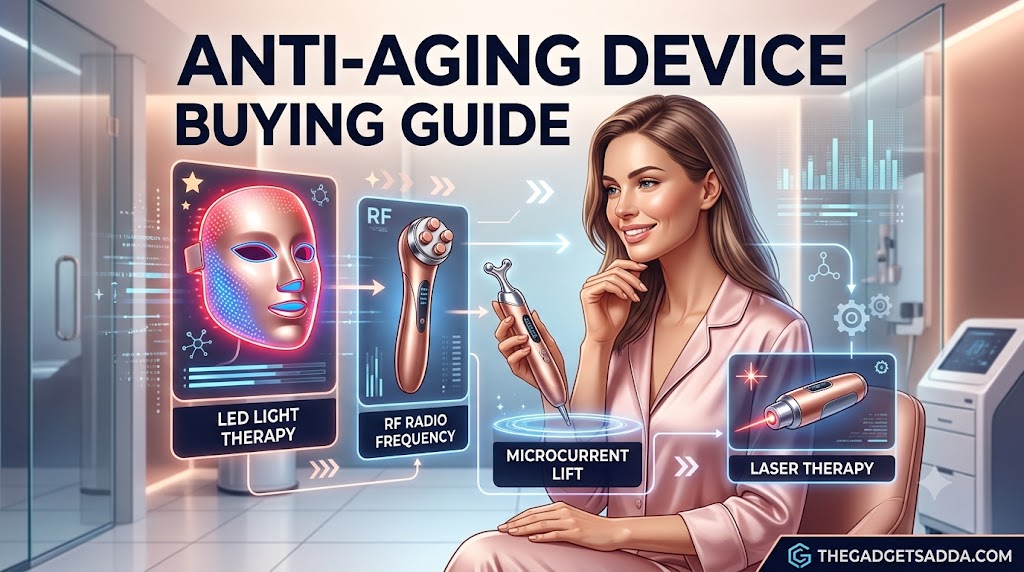
Core Types of Anti-Aging Devices
1. LED Light Therapy (Photobiomodulation)
Uses specific wavelengths of non-thermal light to trigger cellular repair.
- Red Light (630nm to 660nm): Targets the dermal layers to stimulate fibroblasts and minimize fine lines.
- Near-Infrared Light (830nm to 850nm): Penetrates deeper into subcutaneous layers to suppress inflammatory pathways and accelerate deep tissue healing.
- Blue Light (415nm): Destroys acne-causing bacteria within the pores, preventing post-inflammatory hyperpigmentation.
2. Microcurrent Therapy
Delivers low-level electrical currents (measured in microamps) that match the body’s natural electrical frequency. It primarily works on a muscular and cellular level, driving the production of adenosine triphosphate (ATP)-the fundamental energy source for cellular functions. This process re-educates the facial muscles, helping to tone and lift drooping areas.
3. Radiofrequency (RF)
Uses alternating electrical currents to create localized resistance within the dermal layers, generating safe, controlled heat (typically between 40°C and 43°C). This thermal energy forces existing collagen fibers to contract immediately while initiating a wound-healing response that triggers long-term collagen production.
4. Laser and Intense Pulsed Light (IPL)
Deploys concentrated beams of light energy to create microscopic treatment zones within the skin, removing damaged cells and stimulating significant resurfacing. This process is highly effective for reducing stubborn dark spots and flattening rough skin texture.
Modality Comparison Table
| Technology | Primary Mechanism | Target Tissue Layer | Primary Concern Addressed |
| LED Therapy | Photobiomodulation via light absorption | Epidermis to Deep Dermis | Fine lines, dull skin tone, mild inflammation |
| Microcurrent | Low-voltage electrical current (ATP boost) | Facial Musculature & Cells | Sagging contours, loss of definition, drooping brows |
| Radiofrequency | Thermal resistance and fiber contraction | Deep Dermis | Skin laxity, loose skin around the jaw, deep wrinkles |
| Fractional Laser | Microscopic photothermal structural injury | Epidermis and Upper Dermis | Textural roughness, deep acne scars, dark age spots |
Technical Features to Look For When Buying
When evaluating options, focus on verified specifications rather than marketing copy:
- FDA Clearance: Ensure the tool is explicitly cleared by the FDA for home safety and efficacy.
- Wavelength Precision (for LED): Insist on precise numbers like 630nm or 830nm. Avoid brands that simply state “red” or “infrared” without providing numerical data.
- Irradiance/Power Output: LED masks should deliver an irradiance of at least 30 mW/cm² to 50 mW/cm² to provide adequate energy to the skin within a reasonable treatment window.
- Adjustable Intensity Settings: Skin sensitivity varies across different areas of the face. Devices should feature multiple intensity levels to allow safe adjustment around delicate zones like the eyes.
- Power Source Quality: Rechargeable lithium-ion batteries provide consistent power output. Avoid tools that rely on disposable batteries, as their power delivery degrades as the battery loses charge.
Common Mistakes to Avoid
- Skipping the Conductive Gel: Microcurrent and RF tools require a water-based conductive gel to safely transfer energy into the deeper tissues. Operating them dry causes surface skin burns or renders the treatment completely ineffective.
- Overusing the Device: Using a device twice as long or twice as often as instructed does not double your results; instead, it causes chronic tissue inflammation and compromises the skin barrier.
- Neglecting Thorough Cleansing: Oils, heavy sunscreens, or makeup residue block light wavelengths and create electrical resistance on the skin surface.
- Expecting Immediate Structural Shifts: Giving up after two weeks because deep expression lines are still present is a common mistake. Collagen remodeling requires patience and consistent use.
Step-by-Step Guide to Your First Treatment
To safely integrate a new anti-aging device into your regimen, follow this structured deployment sequence:
1.Perform a targeted patch test:24 hours before first use.
Clean a small section of your jawline, apply the required conductive medium (if applicable), and run the device for one full minute on the lowest setting. Monitor the area for 24 hours to ensure no extreme redness, blistering, or irritation occurs.
2.Cleanse the skin completely:Immediately before treatment.
Wash your face with a gentle, oil-free cleanser. Remove all traces of oil, makeup, and heavy skin products, as these elements can block light absorption or create irregular electrical resistance. Dry the skin thoroughly.
3.Apply the appropriate conductive medium:For Microcurrent or RF tools.
Spread a thick, even layer of water-based conductive gel over the target facial section. Work in sections rather than coating the whole face at once, preventing the gel from drying out before the device touches it. Skip this step if you are using an LED mask.
4.Execute the treatment pattern:Follow specified movement lines.
Glide the device slowly upward and outward across your face, following the underlying muscle structures. For LED masks, secure the strap comfortably and keep your eyes closed or protected during the timed treatment session.
5.Clean the tool and apply post-care:Post-treatment maintenance.
Wipe the treatment head clean with a damp cloth or sanitizing wipe according to manufacturer guidelines. Wash any remaining conductive gel off your face, then apply your usual hydrating serums and moisturizers to soothe the skin.
Best Practices for Long-Term Success
- Establish a Device Calendar: Alternate different technologies intentionally. For example, use microcurrent three mornings a week for lifting benefits, and wear an LED mask four evenings a week for tissue repair.
- Support Skin Internally: The body cannot produce high-quality collagen without adequate hydration, vitamin C, and amino acids. Pair your tech routine with a nutrient-rich diet.
- Maintain Strict Sun Protection: Using resurfacing lasers or intense light energy makes skin more sensitive to ultraviolet damage. Always apply a broad-spectrum SPF 30 or higher daily.
Expert Tips
Pro Tip from Clinical Estheticians: If your water-based conductive gel dries out mid-treatment, do not apply more gel. Instead, mist your face with a simple distilled water spray. This reactivates the polymers in the existing gel layer, saving you product and keeping energy transmission smooth.
Real-World Implementation Examples
- Scenario A (Addressing Jawline Laxity): A 45-year-old user experiences early jowling. They opt for a dedicated microcurrent device used five times per week for the first two months, followed by a transition to a three-times-per-week maintenance schedule. They notice an improved, firmer look along the jawline contour by week eight.
- Scenario B (Addressing Fine Lines and Dullness): A 38-year-old user notices fine crinkling around the eyes and an uneven skin tone. They use a flexible silicone red/near-infrared LED mask for ten minutes every evening. By week twelve, skin texture appears smoother and less fatigued.
Key Takeaways
- LED masks require precise wavelengths (630nm to 830nm) and a minimum irradiance of 30 mW/cm² to be effective.
- Microcurrent devices re-educate facial muscles by boosting ATP levels, but require a water-based conductive gel.
- Radiofrequency tools use thermal resistance to contract collagen fibers; they require built-in temperature sensors to prevent surface burns.
- Consistency is the single most important factor determining success with any home beauty device.
Frequently Asked Questions
What is the most effective at-home anti-aging technology?
The effectiveness depends entirely on your specific skin concern. For skin laxity and lifting structural contours, microcurrent is the ideal modality. For surface texture refinement, reducing fine lines, and lowering systemic redness, red and near-infrared LED therapy delivers the best long-term outcomes.
How often should I use an at-home microcurrent device?
Most manufacturers recommend an initial loading phase of four to five times per week for the first 60 days. After this period, you can safely scale back to two or three times per week to preserve your results.
Can I use these devices if I have Botox or dermal fillers?
Yes, but timing is critical. You should wait at least 14 days after receiving injectables before using any home beauty devices. Microcurrent or thermal treatments used too soon can increase localized blood flow and alter the placement or longevity of your injections.
Why do I need a special gel for microcurrent and radiofrequency tools?
The gel acts as a vital conductive medium. Because dry skin has high electrical resistance, trying to pass currents through it can cause superficial skin burns. A water-based gel allows the electrical or thermal energy to travel smoothly and deeply into the target tissue layers.
Should I choose a flexible silicone LED mask or a hard plastic one?
Flexible silicone masks are generally preferred because they lay directly against the contours of your skin. According to the inverse-square law of physics, light energy loses intensity rapidly over distance. Keeping the LEDs close to your skin maximizes energy absorption.
Is radiofrequency skin tightening safe for all skin tones?
Yes. Unlike certain high-energy lasers that target melanin (color pigment) and risk causing hyperpigmentation in darker skin tones, radiofrequency energy targets water molecules within the dermis. This makes it a color-blind technology that is safe for all skin profiles.
When will I start seeing visible results from an LED mask?
While minor skin brightness can occur within days due to increased blood circulation, real structural improvements in fine lines and elasticity require consistent usage for 8 to 12 weeks. This matches the natural timeframe for new collagen synthesis.
Can at-home devices replace professional clinical treatments?
No. Home devices serve as excellent maintenance tools to extend the lifespan of clinical treatments, but they lack the raw power of professional machines. Clinical lasers and RF systems operate at energy levels that are too high to be used safely without professional training.
Are there any specific contraindications for using anti-aging devices?
Yes. You should avoid these devices if you have an active pacemaker, electronic implants, epilepsy, active skin infections, open wounds, or are currently pregnant. Always review the detailed health exclusions provided by the device manufacturer.
Does blue light therapy help with anti-aging concerns?
Blue light (415nm) primarily targets acne-causing bacteria. While it helps clear active breakouts and reduces the marks they leave behind, it does not stimulate collagen production or lift sagging tissue.
Can I use multiple skincare devices on the same day?
Yes, provided you do not overload your skin. A common practice is using a microcurrent tool in the morning to reduce puffiness and lift facial contours, and then using an LED mask at night to support cellular repair.
Do at-home anti-aging devices cause fat loss in the face?
Microcurrent and low-level LED therapies do not cause facial fat loss. However, high-energy home radiofrequency devices must be used strictly according to instructions; overheating the subcutaneous tissue layers excessively can potentially impact delicate facial fat pads.
Final Verdict
At-home anti-aging devices are highly effective, science-backed additions to a skincare routine, provided you prioritize consistency and realistic expectations. For structural skin sagging and poor facial definition, invest in a reliable microcurrent tool. If your primary concerns are overall tone, fine lines, and systemic inflammation, a high-irradiance LED light therapy mask provides the greatest long-term value. Always check for valid FDA clearance and explicit technical specifications before finalizing your purchase.