Buying an inexpensive hearing aid sounds straightforward until you start comparing what the product actually does.
The Audien Atom is a small, rechargeable OTC hearing aid that has attracted attention largely because it costs far less than many traditional hearing aids. But low price is only useful when the device delivers enough hearing benefit for the situations that matter to you.
This Audien Atom review looks at the original model rather than assuming newer Audien products are identical. It examines how the device works, what you get, independent performance evidence, the trade-offs of its simple design, current purchase conditions, and what to consider instead.
There is also an important 2026 complication: Audien’s website still displays the original Atom name and a $99 listing in its catalog, but the associated live product page is now displaying Atom One information.
Preliminary takeaway: the original Atom is best understood as a basic, low-cost OTC hearing aid for someone who prioritizes simplicity and price over advanced sound processing. Independent lab evidence suggests its speech benefit is limited, especially in noisy environments.
Affiliate disclosure: This article may contain affiliate links. If you purchase through a link, thegadgetsadda may receive a commission at no additional cost to you. That commercial relationship does not change the product analysis or the limitations discussed here.
Quick Verdict
Best suited to: Budget-conscious adults looking for basic amplification, particularly in quieter environments.
May not be ideal for: People who need strong speech clarity in restaurants, groups or other noisy places; buyers who want Bluetooth, streaming, app control or sophisticated sound personalization.

Key strength: Very low entry price combined with rechargeable operation and strong feedback-handling results in independent testing.
Key limitation: The original Atom has basic controls and substantially weaker speech-in-noise performance than you would expect from more capable OTC hearing aids.
Current direct price: $99/pair on Audien’s current product listing.
Bottom line
The original Audien Atom’s strongest selling point is its low price and uncomplicated design. Its weakest point is that inexpensive amplification is not the same thing as sophisticated speech enhancement.
HearingTracker’s independent HearAdvisor measurements found limited performance, with scores of 1.0/5 for speech in noise and 2.6/5 for speech in quiet under its test conditions.
For that reason, the $99 price should be viewed as the beginning of the buying decision rather than the whole argument.
What is Audien Atom?
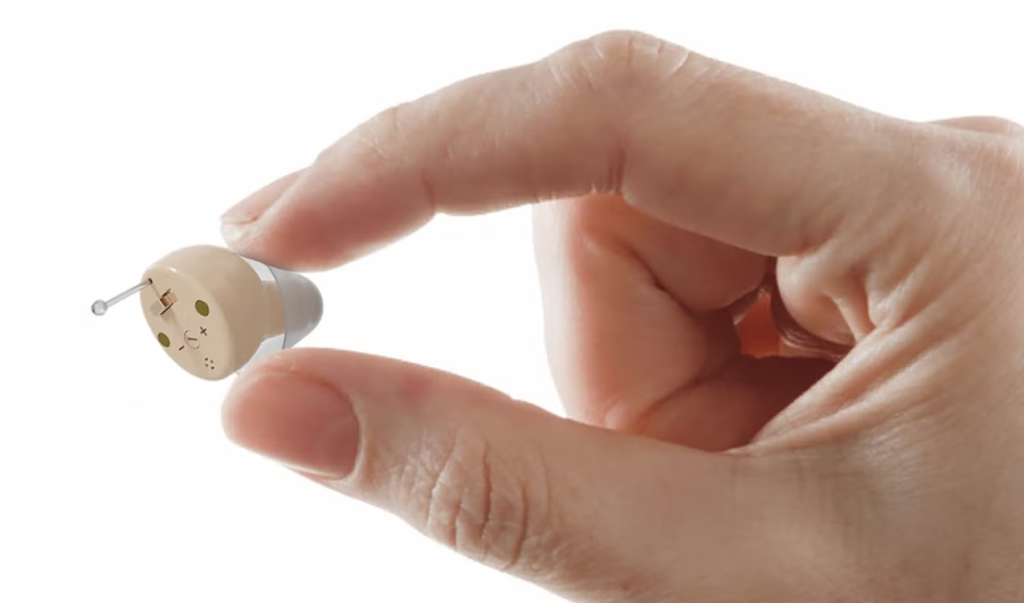
The original Audien Atom is an over-the-counter, air-conduction hearing aid designed for use in the ear canal. It is associated with Audien Hearing, whose legal company name is Budget Hearing Aids, LLC. The model appears in AccessGUDID with primary device identifier 00860003736142.
Unlike prescription hearing aids, OTC hearing aids can be purchased directly by adults in the United States who have perceived mild-to-moderate hearing loss. The FDA established the OTC category for adults 18 and older in 2022.
That does not mean every person with hearing difficulty is a good candidate for an OTC product.
The FDA advises consumers to seek professional assessment when there are warning signs such as ear pain, drainage, significant asymmetry between ears, sudden hearing changes, severe dizziness, or suspected significant wax blockage.
How does Audien Atom work?
The original Atom works by amplifying incoming sound and delivering that amplified sound through an in-ear receiver.
In practical terms, there is no smartphone app doing the personalization and no Bluetooth connection coordinating the two earpieces.
Instead, the wearer uses the device itself.
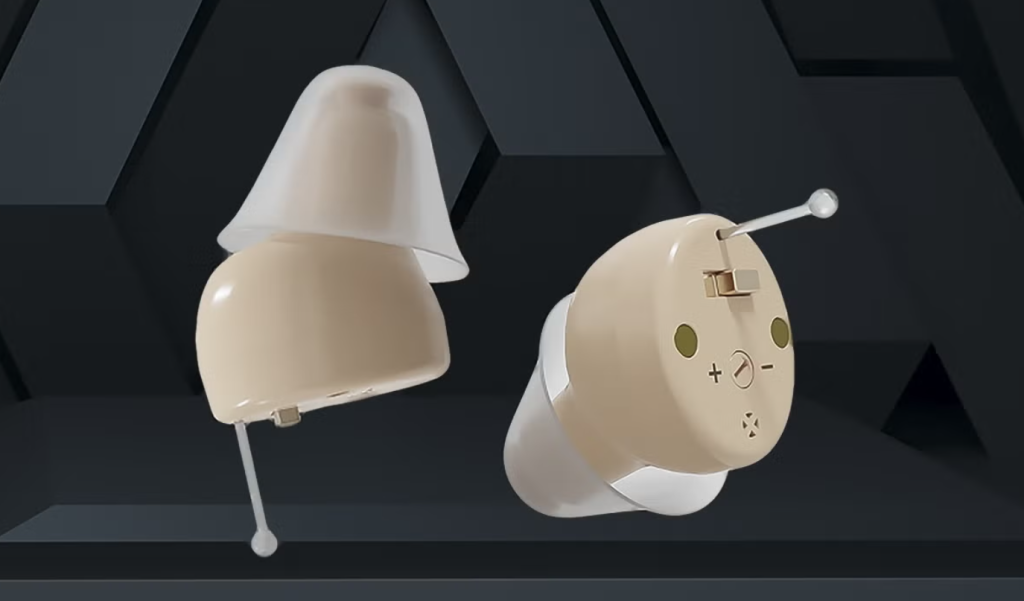
HearingTracker reports that the original Atom has an on/off switch and a small manual volume dial. The dial is adjusted with a small tool such as a flathead screwdriver or the end of the included cleaning brush. Each earpiece has to be adjusted separately because the two hearing aids do not wirelessly communicate with one another.
That design has an obvious advantage: there is very little technology to learn.
It also creates an obvious disadvantage: there is very little flexibility once your environment changes.
A volume setting that works in a quiet living room may not be equally useful in a restaurant or a group conversation.
What does Audien Atom actually do?
It is important to separate simple amplification from advanced hearing assistance.
The original Atom can make sounds louder, and HearAdvisor testing found some speech-enhancement benefit. But HearingTracker says the benefit was limited and considerably below that seen from many other OTC and prescription devices.
The distinction matters because many buyers do not actually struggle with volume alone.
Speech understanding often depends on which frequencies are amplified, how background noise is handled, and how the hearing aids respond as the acoustic environment changes.
HearingTracker’s technical analysis found little to no amplification above approximately 1,500 Hz in its measurements. The publication notes that the 2,000–4,000 Hz region is particularly important for speech intelligibility.
That does not mean the Atom cannot help anyone hear better. It means the device has a narrower performance envelope than a hearing aid with more sophisticated signal processing.
Audien Atom Features
| Feature | What it means for the buyer |
|---|---|
| In-the-ear design | Small, relatively discreet form factor |
| Rechargeable lithium-ion battery | No routine disposable-battery replacement |
| Up to 20-hour battery claim | Designed to cover most of a typical day |
| Manual volume adjustment | Simple, but less convenient than app or touchscreen control |
| No Bluetooth audio streaming | Not designed to stream music or calls |
| No smartphone app | No phone-based sound control |
| Single basic program | Much less customization than advanced OTC models |
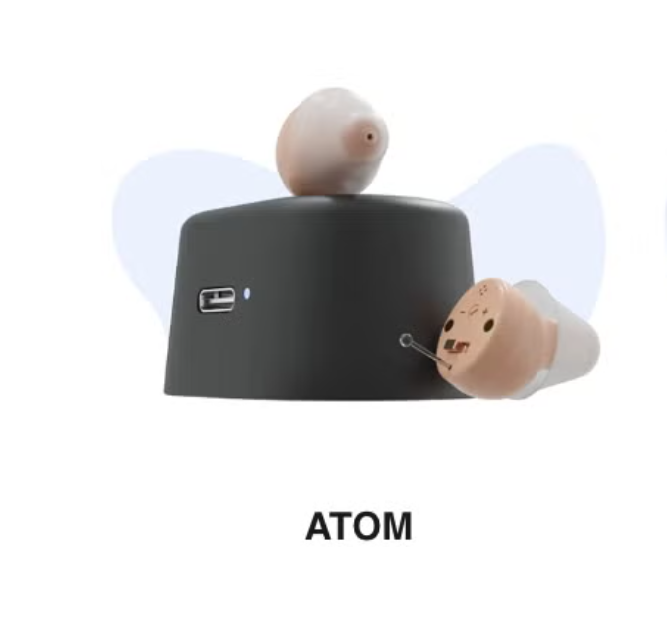
| Charging dock | Devices recharge in the supplied charging base |
| Multiple ear-tip sizes | Gives buyers some ability to experiment with fit |
The battery specification is one of the more straightforward claims. Audien/HearingTracker materials put the Atom’s battery life at up to 20 hours, while HearingTracker says a depleted unit takes about 4–6 hours to recharge in the dock.
The feature that matters most: simplicity
The Atom’s simplicity is both an advantage and a limitation.
A buyer who doesn’t want apps, Bluetooth pairing or complicated menus may find that appealing. The opposite is true for someone who expects modern hearing-aid personalization.
There is no companion app to adjust the sound from your phone and no Bluetooth streaming for calls or music.
What Does Independent Testing Say About Audien Atom?
This is the most important part of the review because it moves beyond the manufacturer’s sales page.
HearingTracker reports independent HearAdvisor laboratory testing of the original Atom. The device earned a 3.3/5 SoundScore in the latest listed evaluation. The testing found some speech-enhancement benefit, but performance was considerably more limited than the average for other OTC and prescription hearing devices.
The individual results show the trade-off clearly:
| Test area | Result |
|---|---|
| Speech in quiet | 2.6/5 |
| Speech in noise | 1.0/5 |
| Feedback handling | 5.0/5 |
| Music streaming | 0/5 |
| Own-voice comfort | 2.1/5 |
That does not mean the Atom provides no benefit.
HearingTracker found some speech enhancement, especially in quieter situations. But the data suggests the device is fundamentally a basic amplification product rather than a highly sophisticated hearing solution.
Why is speech in noise such a problem?
HearingTracker’s analysis points to limited high-frequency amplification and a lack of advanced signal processing. That matters because speech intelligibility depends heavily on higher-frequency information, while busy environments contain competing sounds that more advanced hearing aids attempt to manage.
In practical terms, that means:
Quiet conversation: potentially useful.
Watching TV: potentially useful.
One-on-one conversation at home: potentially useful.
Busy restaurant or crowded group: much less convincing.
That’s a considerably more useful buying distinction than simply calling the Atom “good” or “bad.”
Audien Atom: Benefits That Are Actually Relevant
Very low entry price
The biggest advantage is cost.
Audien currently lists the Atom at $99 per pair, making it dramatically less expensive than many premium hearing-aid systems.
That low price can make experimentation more accessible to somebody who would otherwise delay purchasing a hearing device because of cost.
Rechargeable design
You don’t need to maintain a stock of disposable hearing-aid batteries. The devices recharge in the included dock, with published battery life of up to 20 hours per charge.
No smartphone required
There is no app setup, Bluetooth pairing or wireless-control learning curve. For buyers who simply want basic amplification, that removes a lot of complexity.
Strong feedback handling
This is one place where the independent laboratory evidence is unusually favorable.
HearAdvisor gave the Atom a 5.0/5 feedback-handling score, indicating strong resistance to the whistling and squealing associated with acoustic feedback under its testing conditions.
That doesn’t mean every person’s fit will be feedback-free, but it is a meaningful positive result.
Audien Atom Drawbacks
The controls are dated
The volume dial is tiny and manual.
You have to remove or manipulate the hearing aid to change the volume, and the two devices are controlled independently. HearingTracker also notes that the small control may be difficult for people with limited dexterity or low vision.
Weak performance in background noise
This is the biggest technical drawback.
The independent speech-in-noise result was 1.0/5, well below what many buyers looking for help in restaurants, groups or noisy public areas would probably hope for.
No Bluetooth
The original Atom does not stream phone calls, music or other audio wirelessly. It also does not offer smartphone-based remote control.
Limited customization
The Atom is much less adjustable than modern OTC hearing aids that provide app-based fitting, multiple programs, environmental processing or more individualized amplification.
Moisture is a concern
HearingTracker reports that the original Atom does not offer moisture resistance. Buyers should therefore avoid treating it like a waterproof wearable and be particularly careful around perspiration, showers and water exposure.

How To Use Audien Atom
The basic operating process is simple.
First, charge both hearing aids in the charging dock. HearingTracker reports that full charging can take roughly 4–6 hours.
Next, fit the appropriate ear dome and insert the device securely.
After that, adjust the volume with the supplied tool. The published Atom instructions specify turning the dial clockwise to increase volume and counterclockwise to decrease it.
Start at a comfortable setting rather than immediately increasing the volume as far as possible. Audien’s published troubleshooting information also discusses reducing volume when excessive loudness or feedback occurs.
Is Audien Atom FDA Approved?
This needs careful wording.
The FDA created the OTC hearing-aid category for adults 18 and older with perceived mild-to-moderate hearing loss, and qualifying OTC hearing aids can be sold without a prescription.
HearingTracker reports the Atom as a Class 1 FDA-registered hearing aid. However, the FDA specifically warns consumers that phrases such as “FDA Registered” or “FDA Certified” can be misleading and should not be interpreted as equivalent to FDA approval or certification.
So the responsible wording is:
Audien sells the Atom as an OTC hearing aid, and the FDA regulates the OTC hearing-aid category. But “FDA registered” should not be treated as an FDA approval badge.
Who Should Consider Audien Atom?
The original Atom makes the most sense for an adult who:
- wants inexpensive hearing assistance;
- prefers a simple, app-free device;
- mainly needs help in relatively quiet environments;
- is comfortable adjusting a small manual control;
- wants rechargeable rather than disposable batteries.
The value proposition becomes weaker when the main problem is following speech in busy environments.
Who Should Probably Skip It?
Consider another type of hearing aid when:
- you regularly struggle to understand conversations in restaurants or groups;
- you want Bluetooth streaming;
- you want app-based adjustments;
- you need individualized sound profiles;
- tiny manual controls are difficult to operate;
- you need stronger protection against moisture.
More importantly, OTC hearing aids are intended for perceived mild-to-moderate hearing loss, not severe or profound hearing loss.
When Should You See a Doctor or Hearing Professional First?
An OTC hearing aid isn’t appropriate as a substitute for medical evaluation when there are warning signs.
FDA advises seeking professional evaluation for issues such as ear pain, ear drainage or blood, significant earwax, vertigo, sudden hearing changes, hearing that fluctuates, hearing that is worse in one ear, or ringing/buzzing in only one ear.
This is particularly important because hearing difficulty can have causes other than ordinary age-related hearing loss.

Audien Atom vs Newer Audien Models
One reason the original Atom can be confusing to shop for is that Audien’s current lineup has moved considerably beyond it.
| Model | Current Audien price observed | Main distinction |
|---|---|---|
| Audien Atom | $99 | Basic manual-control model |
| Atom ONE | $98 | Newer basic model with updated positioning |
| Atom Air | $149 | Lightweight, app-free newer model |
| Atom Pro 2 | $289 | More listening modes and UV-cleaning charging case |
| Atom X | $389 | Touchscreen case plus Bluetooth |
The existence of these newer models is a reason to avoid automatically assuming that the cheapest Atom is the newest or most capable device.
The Atom X, for example, adds Bluetooth streaming and hands-free calling, features completely absent from the original Atom.
Audien Atom vs a More Advanced OTC Hearing Aid
The fundamental trade-off is straightforward.
Atom: spend as little as possible and accept basic controls and limited performance in noise.
More advanced OTC model: spend more for greater personalization, better environmental processing, smartphone control, Bluetooth or more sophisticated fitting.
The right comparison is therefore not “Is the Atom cheaper?”
It obviously is.
The better question is:
Are the missing features ones you actually need?
For someone who mostly wants basic amplification at home, the answer may be no. For someone struggling in noisy restaurants, group conversations or phone use, the answer could be very different.
Research methodology: was the Audien Atom independently tested?
Yes—but not by me.
The strongest independent evidence located is HearingTracker’s review, which says the Atom was evaluated through HearAdvisor’s independent lab testing. The review was updated February 6, 2026.
The test results reported were:
Speech in noise: 1.0/5
Speech in quiet: 2.6/5
HearingTracker also notes that HearAdvisor’s testing uses specific programming/testing protocols aimed at a person with mild sloping to moderate hearing loss. Its own disclaimer says those results should not be assumed to represent performance for every hearing-loss pattern or listening situation.
That limitation matters.
A lab result is more useful than a generic marketing claim, but it still does not tell us exactly how every individual will experience the device.
Pros of Audien Atom
Low entry price
The original Atom is consistently associated with a price around $99 per pair in current Audien catalog listings and independent price listings.
That makes the financial barrier much lower than many traditional hearing-aid options.
Rechargeable design
A reported battery life of up to 20 hours is one of the more practical features. The included charging base also avoids the recurring need to purchase disposable batteries.
Straightforward controls
There is no app, account setup for sound adjustments, or smartphone learning curve involved in the original model. The controls are physical and basic.
Small in-ear format
HearingTracker measured the original Atom at about 1.9 grams and described it as a relatively small in-the-ear design.
Cons of Audien Atom
Limited speech performance
This is the biggest issue raised by the independent evidence.
HearAdvisor testing reported 1.0/5 speech-in-noise performance and 2.6/5 speech-in-quiet performance. HearingTracker characterized the overall speech enhancement as limited.
No Bluetooth or app
The original Atom cannot stream calls, music, or other audio directly from a smartphone. There is also no companion app for remote adjustments.
Manual adjustments are fiddly
HearingTracker found that the small volume dials can be difficult to adjust, especially for users with dexterity or vision limitations. The left and right devices also have to be adjusted separately.
Limited environmental flexibility
The original Atom has one program and lacks the advanced signal processing found in more sophisticated hearing aids.
Moisture is a concern
HearingTracker says the original Atom lacks moisture resistance, and Audien’s warranty specifically excludes water exposure and states that its hearing aids are not waterproof.
What I like about Audien Atom
The strongest case for the Atom is that it does not pretend to be complicated.
Someone who simply wants basic amplification and does not want to deal with smartphone controls may appreciate the physical controls and rechargeable design.
The 20-hour battery claim is also practical. A hearing aid that is inexpensive but requires frequent disposable batteries would lose part of its value proposition; the rechargeable design avoids that ongoing task.
I also think the original Atom’s low price should be judged against its actual feature set, rather than compared with expensive prescription systems as though they provide identical functionality.
What concerns me
The first concern is performance in the situations where hearing help is often most valuable.
If the main problem is understanding people in restaurants, gatherings, meetings, or other noisy spaces, the independent speech-in-noise measurement deserves serious attention. The 1.0/5 HearAdvisor score reported by HearingTracker is not evidence that every user will have the same experience, but it is evidence that the device has meaningful performance limitations.
The second concern is model confusion.
Audien’s website currently lists the original Atom name but presents Atom One content on the corresponding live product page. A consumer who simply clicks through could therefore receive information for a different model.
That is why I would verify the model name and device identifier before ordering.
Audien Atom price and value
The most reliable current public listing I found from Audien associates Audien Atom with $99. The company’s current all-products collection contains the same $99 Atom entry.
HearingTracker currently shows an offer around $98 per pair.
But there is an important qualification:
The current Audien page associated with the Atom listing is displaying Atom One material.
Because of that, I would not publish a simple statement such as “Audien Atom currently costs exactly $99” without adding a note that the seller’s live page should be checked for the exact model.
What is included?
Independent documentation for the original Atom reported a package containing two hearing aids, cleaning tool, wax filters, carrying case, charger, USB cable with wall adapter, and user manuals.
Shipping
Audien’s current refund/shipping policy says standard shipping is free within the continental United States. Orders are generally processed in 1–2 business days, and most deliveries are expected within 3–5 business days after shipment, subject to carrier delays.
Return policy
Audien currently offers a 45-day risk-free trial for direct purchases.
However, it is not a completely frictionless “send it back whenever” arrangement. The company says returns must be authorized first, and return requests require either a phone consultation or a video appointment with a hearing specialist. The hearing aids must be returned in original packaging with the accessories and in undamaged working condition, subject to the stated exceptions.
Purchases made through third-party retailers are handled under the retailer’s return policy rather than Audien’s direct-return process.
Warranty
Audien’s current warranty policy states that hearing aids are covered by a one-year limited warranty against defects in materials and workmanship. Water exposure, physical damage, wax buildup/poor maintenance, and unauthorized modifications are excluded.
Is Audien Atom legit?
There is substantial evidence that Audien is a real operating hearing-device business, but product legitimacy and product suitability are two separate questions.
The company identifies itself as Budget Hearing Aids LLC d/b/a Audien Hearing, and its website provides a Scottsdale, Arizona business address and customer-support information.
The Better Business Bureau also has a business profile for Audien Hearing and identifies Budget Hearing Aids LLC as an alternate name.
Most importantly for the specific product, the original Atom appears in the official AccessGUDID database as a model associated with Budget Hearing Aids, LLC and categorized as an OTC air-conduction hearing aid.
Those facts establish that the product and business have identifiable regulatory and commercial records.
They do not automatically establish that the Atom delivers a particular level of hearing improvement for every person.
That is where the independent lab evidence becomes important.
What about Audien Atom consumer reviews?
Be careful with aggregated review numbers.
The current HearingTracker Atom page contains public user reports, but its review section includes comments explicitly referring to Atom One and Atom Pro 2 as well as the Atom family.
Because the product identities are mixed, using its displayed user-review score as a clean “Audien Atom customer rating” would be misleading.
This is a good example of why product reviews should not simply copy a star rating from a retailer or third-party page without confirming that all the reviews refer to the exact same model.
I also did not locate a standalone Consumer Reports review that I could confidently attribute to the original Audien Atom in the sources checked.
How to use Audien Atom
The original Atom was designed to be relatively simple.
First, charge the devices in their charging base. HearingTracker reports a full charge can take approximately 4–6 hours.
Next, place the left and right devices in their respective ears.
The Atom has an on/off control and a small manual volume dial. The dial needs to be adjusted physically, and each earpiece is adjusted independently.
Because it does not offer advanced automatic environmental processing, the goal is to find a comfortable level rather than continually raising the volume.
Keep the devices away from water and excessive moisture. Audien’s current warranty specifically excludes water exposure.
Regularly cleaning the device and maintaining wax filters/domes is also important because Audien states that poor maintenance can affect warranty coverage.
How to order Audien Atom safely
The most important step in 2026 is confirming the exact model before paying.
Audien’s current catalog still uses the name “Audien Atom” at $99, but the current live product page is presenting Atom One information.
For the original Atom, the official device database identifies:
Version/model: Atom
Primary DI: 00860003736142
Company: Budget Hearing Aids, LLC
Device type: Air-conduction OTC hearing aid, canal
A careful buyer should compare the product name and device identifier shown on the listing/packaging with the model they intended to purchase.
Also check:
- the exact model name;
- the current checkout price;
- whether the page says Atom or Atom One;
- what accessories are included;
- the 45-day return conditions;
- whether you are buying directly from Audien or from a third-party retailer;
- warranty terms.
Audien’s policy says third-party purchases must be returned through the original retailer, which makes the purchasing channel an important part of the decision.
Important hearing-health considerations
An OTC hearing aid is not appropriate for every hearing problem.
The FDA says OTC hearing aids are intended for adults 18 and older with perceived mild-to-moderate hearing loss, not severe or profound hearing loss.
Professional evaluation is particularly important when there is ear pain, drainage, sudden hearing loss, rapidly changing hearing, significant one-sided hearing loss, vertigo, or suspected obstruction such as excessive earwax.
Sudden sensorineural hearing loss can be a medical emergency, and NIDCD advises immediate medical evaluation rather than simply trying a consumer hearing device.
For routine hearing concerns, ASHA recommends a complete audiologic evaluation before purchasing an OTC hearing aid, while recognizing that OTC devices can improve accessibility for appropriate adults.
What does the evidence say about value?
The original Atom’s value proposition is straightforward:
You pay substantially less, but you accept substantially less functionality and less evidence of strong speech performance.
That can be reasonable for the right user.
It becomes less compelling when the buyer expects the device to replicate the performance of a sophisticated hearing aid in difficult environments.
Independent testing is especially useful here because it prevents the review from treating “rechargeable,” “small,” and “affordable” as though they automatically mean “good hearing performance.”
The evidence supports the first three characteristics.
The independent testing is considerably more cautious about the fourth.
What I Would Check Before Buying
Before placing an order, verify four things.
1. Exact model: Make sure the page says Audien Atom, not Atom ONE, Atom 2, Atom Pro 2 or Atom X.
2. Final checkout price: The current official price is $99, but promotional and retailer prices can differ.
3. Return route: Know whether you are buying direct from Audien or through a third-party retailer, because the return process differs.
4. Your actual use case: If your main challenge is hearing speech in noisy environments, the original Atom’s independent testing results deserve serious attention before you buy.
Frequently Asked Questions About Audien Atom
Is Audien Atom worth it?
That depends mainly on the type of hearing difficulty and the situations in which you need help. The original Atom is inexpensive and simple, but independent testing found limited speech performance, particularly in noise.
How does Audien Atom work?
It amplifies incoming sound through an in-ear hearing aid. Volume is controlled manually, and the left and right units are adjusted separately.
How much does Audien Atom cost?
Audien’s current catalog lists the Atom name at $99, while HearingTracker currently shows an approximately $98 offer. Because Audien’s live page is currently displaying Atom One content, buyers should verify the exact model and checkout price.
Does Audien Atom work in noisy environments?
Independent HearAdvisor testing reported a 1.0/5 speech-in-noise score under its test conditions, so buyers should have realistic expectations for restaurants, gatherings and other noisy settings.
Is Audien Atom FDA approved?
It is more accurate to say that the original Atom is identifiable in the official U.S. medical-device database as an OTC air-conduction hearing aid. “FDA registered” should not be presented as synonymous with “FDA approved”; the FDA specifically warns about that distinction.
What are the main alternatives?
The current Audien range includes Atom One, Atom Air, Atom 2 and Atom Pro 2, each with different levels of battery life, controls and features. ELEHEAR also offers higher-priced OTC hearing aids with Bluetooth, app controls and advanced noise reduction.
How long does the Audien Atom battery last?
Audien’s published figure is up to 20 hours per charge. HearingTracker says a fully depleted device takes around 4–6 hours to recharge.
Is Audien Atom waterproof?
The independent product review I found says the original Atom does not offer moisture resistance. It should therefore be protected from showers, heavy perspiration and unnecessary water exposure.
Does Audien Atom require a hearing test?
OTC hearing aids can be purchased by US adults 18+ with perceived mild-to-moderate hearing loss without a prescription or medical examination. However, FDA still recommends professional evaluation when there are medical concerns or red-flag symptoms.
Is Audien Atom suitable for severe hearing loss?
OTC hearing aids are not intended for severe or profound hearing loss. If your hearing difficulty is significant, a licensed hearing professional should help evaluate the situation.
Can I return Audien Atom?
Audien currently offers a 45-day trial for eligible direct purchases, but its policy requires authorization, a support interaction and return of the complete product package.
Is Audien Atom worth it?
It can make sense for a budget-conscious buyer who wants simple, rechargeable amplification and primarily uses the device in quieter environments. The case for spending more becomes stronger when speech-in-noise performance, advanced customization or Bluetooth matter.
Final Verdict: Is Audien Atom Worth Buying?
The Audien Atom is best understood as a very inexpensive entry point into basic hearing amplification, not as a substitute for a sophisticated hearing-aid system.
Its low price, rechargeable battery and app-free design are genuine practical advantages. Independent testing also found excellent feedback handling.
The trade-off is equally clear: basic manual controls, no Bluetooth, limited personalization and weak speech-in-noise performance.
So the buying decision comes down to your actual hearing environment.
For a person who mainly wants modest help with everyday listening in relatively quiet settings, the original Atom’s low price may be attractive.
For someone whose biggest challenge is understanding conversation in restaurants, groups or other noisy environments, the independent testing gives a strong reason to compare newer or more capable OTC hearing aids before spending money.
The most important point is not whether the Atom is universally “good” or “bad.”
It’s whether a basic $99 hearing aid matches the type of hearing help you actually need.