
If you are looking at FlightPath because ordinary tees break constantly or you are curious whether a specialized tee can actually change ball flight, there are two separate questions to answer.
First, is FlightPath a real golf product with a meaningful design difference? Yes. It is a purpose-built reusable golf tee with an unusual head shape, directional alignment feature and polymer construction.
Second, does the available evidence prove the much broader claims about added distance, reduced spin and dramatically straighter shots? Not across the board.
An independent MyGolfSpy test found FlightPath produced straighter ball flight than the other tees tested, but it did not find reliable evidence supporting the tee’s other major performance claims. The same test also found four FlightPath tees broke and that setting the ball on the tee was relatively difficult.
That makes FlightPath more interesting than a standard disposable tee, but less straightforward than the marketing copy suggests.
Quick verdict
Best suited to: golfers who want a reusable, distinctive tee and are interested in experimenting with tee design; players who appreciate a directional alignment aid; golfers willing to pay substantially more than they would for basic wooden tees.
Not ideal for: golfers whose main goal is the lowest possible cost per tee; players who want proven, repeatable distance gains; anyone uncomfortable with complicated purchase offers or recurring memberships.

Bottom line: FlightPath has a real design difference and some independent evidence supporting straighter ball flight, but the available evidence does not justify treating it as a guaranteed distance or swing-improvement tool. Its $24.99 price for eight tees is also dramatically higher than ordinary wooden tees.
What Is FlightPath?
FlightPath is a reusable golf tee with a directional head rather than the simple symmetrical platform used by a normal wooden tee.
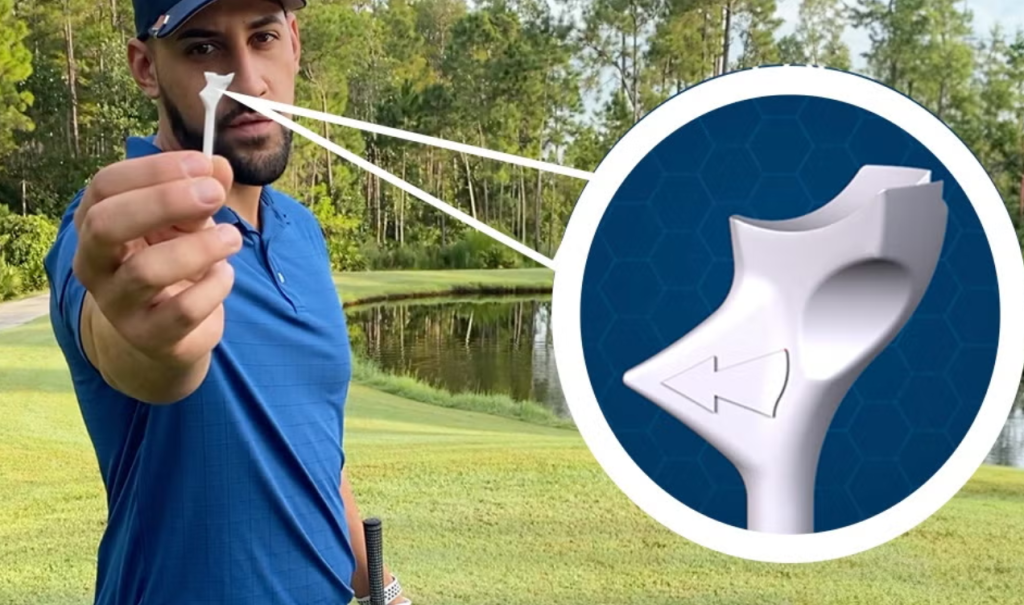
Its design incorporates a front support and rear supports that hold the ball while reducing the amount of tee structure around the impact area. A directional indicator tells the golfer how to orient the tee toward the target. That design is also covered by a US patent for a “performance golf tee.”
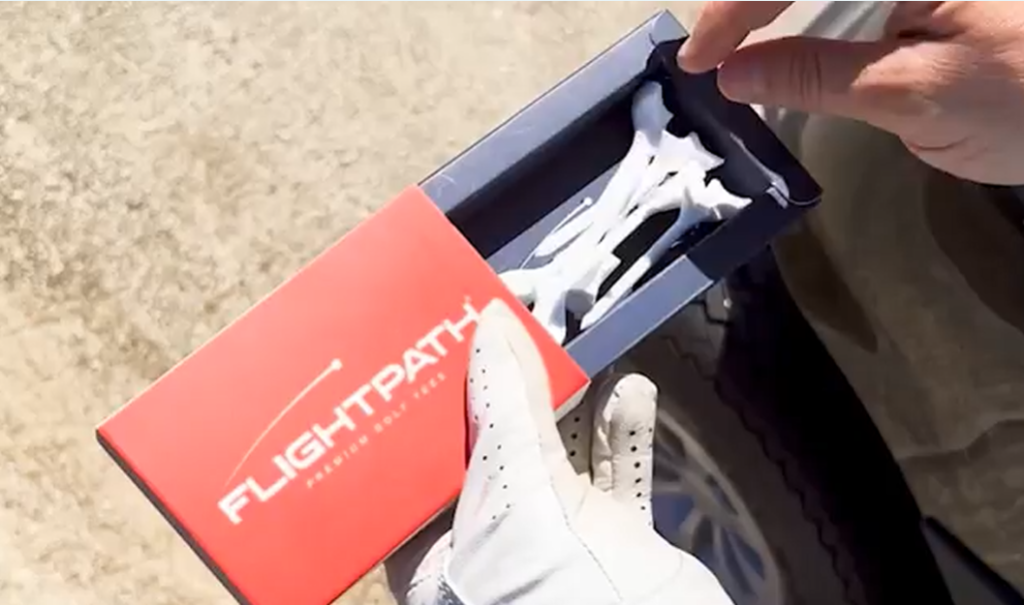
The current product page lists high-performance polycarbonate as the material and offers 3.25-inch and 2.75-inch versions.
The 3.25-inch size is aimed primarily at driver tee shots, while the shorter 2.75-inch option is intended for other clubs.
What makes it different from a wooden tee?
Three things stand out:
- Directional geometry
- Reduced ball-to-tee contact
- Reusable construction
The company says those features are intended to reduce friction and spin.
That is the theory. The real question is how large the effect is in actual golf.
How does FlightPath work?
FlightPath’s basic concept is easy to understand.
A conventional tee supports the ball with a small cup or surface. FlightPath instead uses an angled platform and specially shaped head intended to reduce the amount of contact and resistance around the ball.
The manufacturer says that lower friction can reduce unwanted side spin and that the angled platform can reduce backspin.
There is an additional arrow-point alignment feature. The company instructs users to point the arrow in the intended direction of play.
That feature is worth considering separately from the performance claims. Even if the aerodynamic claims don’t produce a meaningful distance advantage for every golfer, a tee that makes alignment more deliberate could have practical value for some players.
Does FlightPath fix a slice?
No tee can substitute for swing mechanics.
FlightPath itself acknowledges in its FAQ that its tees do not completely fix a slice and instead claims they may help ball flight be straighter.
That distinction matters. A tee can influence launch conditions, but it is not a replacement for instruction, fitting or correcting an out-to-in swing path, face angle or other swing variables.
What does FlightPath actually do?
There are three claims worth separating.
1. It changes tee geometry
Verified from the product documentation: yes.
The tee has a nontraditional angled platform, diamond-style head and directional arrow.
2. It can influence ball flight
Independent evidence: there is some support.
MyGolfSpy’s controlled test found FlightPath launched slightly higher and produced a slightly higher trajectory than wood. It also found evidence suggesting straighter ball flight than the other tees tested.
3. It reliably adds distance and lowers spin
Evidence status: not established strongly enough.
MyGolfSpy specifically said it found no reliable evidence supporting FlightPath’s other performance claims.
FlightPath does cite robotic testing by Golf Laboratories that it says showed improvements in several launch and flight variables, but I could not independently verify a current detailed report containing the underlying data.
So a careful review should not turn that manufacturer statement into “scientifically proven to add X yards.”
FlightPath Features That Actually Matter
Directional Arrow
The arrow is one of FlightPath’s most distinctive features.
The golfer is supposed to point it toward the intended target or fairway. The company says the indicator also provides a visual reference for alignment.
That could be useful beyond the tee itself because it encourages a repeatable setup routine.
The catch is that the arrow also adds a setup step that a wooden tee simply doesn’t have.
Angled Launch Platform
FlightPath’s support geometry is angled rather than behaving like the top of a conventional wooden tee.
The manufacturer associates that design with lower spin and improved launch characteristics.
MyGolfSpy’s testing did find a slightly higher launch and trajectory than wood, which gives the design at least some independent support at that level.
Polycarbonate Construction
The current product page lists polycarbonate construction and says each tee is designed to withstand 100+ hits.
Independent testing supports the broader durability story, but not the idea that the tees can never break.
GolfLink reported never breaking one during its own driver and 3-wood testing. MyGolfSpy, however, broke four FlightPath tees during its controlled test.
That makes “durable” a much safer description than “unbreakable.”
Multiple Heights and Colors
The current product page lists 3.25-inch and 2.75-inch lengths and five colors: white, orange, pink, green and yellow.
That matters more than it sounds.
A bright tee can be easier to spot in grass, while shorter versions can be more practical for clubs where a very high tee isn’t appropriate.
Do FlightPath Golf Tees Really Add Distance?
This is the hardest question to answer honestly.
What FlightPath says
The manufacturer claims the tee’s directional design reduces spin and friction and produces longer, straighter shots. It also promotes robotic testing that reportedly found increased launch angle, lower spin and increased total drive distance.
What MyGolfSpy found
MyGolfSpy put FlightPath head-to-head against other tees and a standard wooden tee.
Its test found:
- slightly higher launch
- slightly higher trajectory
- evidence of straighter ball flight
But the publication also said it found no reliable evidence for FlightPath’s other performance claims.
That’s an important qualification.
What GolfLink found
GolfLink used a Rapsodo MLM2Pro launch monitor for a head-to-head comparison with wooden tees.
The reviewer said he couldn’t separate a meaningful performance advantage from normal swing variation with either driver or 3-wood shots.
What GolfSpan found
GolfSpan’s 2025 comparison produced a more favorable practical conclusion, reporting some additional distance and appreciating the alignment aid, while also noting the tee could be difficult to balance and wasn’t truly unbreakable.
What should a buyer conclude?
The fairest conclusion is:
FlightPath may influence launch and ball flight for some golfers, but current independent evidence does not establish a large, predictable distance gain that every golfer should expect.
That is much more defensible than promising “10 extra yards” or claiming the tee will transform a drive.
FlightPath Durability: One of Its Strongest Arguments
Durability has a stronger practical case than the distance claims.
The company currently says a tee can last 100+ hits.
GolfLink’s reviewer went through driver and 3-wood testing without breaking a FlightPath tee and described the product as highly durable.
But MyGolfSpy broke four tees during its test, which demonstrates why the brand’s “unbreakable” style language should not be taken literally.
So think of FlightPath as reusable and considerably more durable than a typical disposable wooden tee, not as indestructible equipment.
One Problem Buyers Should Know About: Setup
A conventional wooden tee is almost impossible to misunderstand:
Push it into the ground, place the ball on top, and hit.
FlightPath is different.
The seller’s FAQ instructs users to place the ball on the tee before putting it into the ground and tilt it slightly backward. It also tells golfers to point the arrow toward the fairway.
That extra procedure is part of the design.
GolfSpan found the tee difficult to balance, while MyGolfSpy called FlightPath the most difficult tee in its test to set up without the ball falling off.
For some golfers, that will become second nature.
For others, especially in windy conditions, it may be more annoying than helpful.
Can FlightPath Fix a Slice?
No.
That’s worth stating clearly because the product’s reduced-sidespin positioning can easily be misunderstood.
FlightPath’s own FAQ says the tee will not fix a slice entirely.
The tee may influence how the ball interacts with the tee, but it cannot correct the underlying clubface, swing-path and contact issues that produce a persistent slice.
A golfer should therefore treat FlightPath as an equipment experiment-not a substitute for swing instruction.
FlightPath performance: what the independent test found
This is the section I would consider most important for a serious buyer.
MyGolfSpy’s 2020 test compared FlightPath, Martini, 4 Yards More and a standard wooden tee. Each tee was used for 120 drives, with the same driver and balls and a Foresight GCQuad launch monitor.
The researchers found three notable things about FlightPath:
Higher launch and trajectory: FlightPath launched slightly higher than wood.
Straighter flight: the test found evidence suggesting FlightPath produced straighter ball flight than the other tees tested.
No reliable support for the other major performance claims: the researchers did not find reliable evidence supporting FlightPath’s other marketed performance improvements.
There were also practical downsides. Four FlightPath tees broke during the test, and researchers found FlightPath the most difficult tee among those tested to set up without the ball falling off.
That is a considerably more useful conclusion than simply saying “FlightPath works.”
FlightPath Pros and Cons
| Pros | Cons |
|---|---|
| Reusable design | Much more expensive upfront than wooden tees |
| Directional alignment reference | Ball can be harder to balance |
| 3.25″ and 2.75″ options | Requires a specific setup orientation |
| Available in multiple colors | Distance advantage is not consistently established |
| Tournament-conforming according to the manufacturer | Independent testing has shown some breakage |
| Strong durability evidence | Overkill for golfers who simply want inexpensive tees |
FlightPath says its tees conform to USGA and R&A rules and cites USGA decisions 2017-0650 and 2018-0219. Its FAQ says the product has been reviewed by the USGA and received a conformance letter.
FlightPath vs Wooden Tees
| Factor | FlightPath | Standard Wooden Tee |
|---|---|---|
| Upfront cost | $24.99 / 8 currently | Usually only a few dollars for dozens |
| Reusability | Designed for repeated use | Usually disposable |
| Alignment aid | Yes | No |
| Setup | Requires orientation | Extremely simple |
| Distance evidence | Mixed | Baseline |
| Durability | Strong, but not unbreakable | Low |
| Best reason to choose | Reusable engineered design | Simplicity and low cost |
For most golfers, this is the real comparison.
Wood wins on simplicity and purchase price.
FlightPath’s case is based on reusability plus additional design features.
FlightPath vs Martini Golf Tees
Martini takes a different approach.
Its tees use a broad cup-shaped head rather than FlightPath’s directional platform. Martini’s official FAQ says its 3.25-inch Original and Step-Up tees are made from a proprietary polymer resin and conform to USGA and R&A rules.
A current Dick’s Sporting Goods listing shows Martini 3.25-inch tees at $9.99 for five.
That puts Martini substantially below FlightPath’s current $24.99-for-eight price.
The trade-off is that FlightPath offers a more directional, alignment-focused design, while Martini emphasizes easy ball placement and a conventional-feeling teeing process.
Neither design gives every golfer a guaranteed performance improvement.
FlightPath vs Zero Friction
Zero Friction’s ZF Tour 3-Prong tee is another low-contact plastic design.
The official Zero Friction page currently lists it at $7.99, available in 2.75- and 3.25-inch versions, with a three-prong design intended to reduce contact between ball and tee.
The main difference is design philosophy.
FlightPath emphasizes directional orientation and its angled platform.
Zero Friction emphasizes a reduced-contact three-prong structure and broad availability of height and color options.
For a golfer primarily looking for a reusable low-contact tee without paying a large premium, Zero Friction is a relevant alternative to investigate.
Is FlightPath Worth the Money?
At the current listed price, FlightPath sits firmly in the premium golf-tee category.
The question isn’t whether $24.99 is a lot of money in absolute terms. The question is whether its design offers enough practical value compared with buying inexpensive wooden or mainstream plastic tees.
FlightPath makes more sense if you:
- want a reusable premium tee
- like experimenting with golf equipment
- appreciate alignment aids
- don’t mind a slightly more involved setup
- play often enough to benefit from a durable tee
You may want something simpler if you:
- just want inexpensive tees
- frequently lose tees
- don’t want to balance the ball on a specialized head
- expect a dramatic increase in driving distance
- don’t care about directional alignment
The strongest case for FlightPath is therefore not “buy this and gain guaranteed yards.”
It’s:
“Buy this if the combination of reusable construction, directional alignment and unusual ball support is worth paying more for.”
What I like
The biggest strength of FlightPath is that there is an actual product-design idea here.
It isn’t merely a wooden tee with different branding. The head geometry, angled support and alignment arrow give it a different interaction with the ball.
More importantly, there is at least one credible independent test that found a measurable difference in ball flight, specifically straighter flight. That makes the product more interesting than a review based entirely on customer testimonials.
The reusable format is another practical benefit. A player who dislikes breaking conventional tees may reasonably prefer a reusable alternative even if the performance benefit is small.
What concerns me
The biggest concern is the gap between marketing language and publicly verifiable evidence.
The current website uses terms such as “increased drive distance,” “reduced spin,” “increased speed” and “scientifically proven” in its marketing.
But the independent test I found did not validate the full collection of those claims.
There is also inconsistency inside the company’s own documentation.
Some pages describe the material as polycarbonate, while others call it polyurethane. Durability claims range from 100 hits to 100+ rounds and, on one page, 1,000 hits. Manufacturing-location descriptions also differ.
None of that proves that the product is defective. It does mean the website should be treated as a source that needs cross-checking rather than as the final authority on every specification.
FlightPath Price and Cost
As of September 20, 2026, FlightPath’s current official product page lists:
$24.99 for 8 tees.
The current shop also lists a two-pack of 16 tees for $49.98.
FlightPath currently advertises a “Buy 3 Get 2 Free” promotion on its site, but promotions can change, so buyers should verify the actual offer displayed at checkout rather than relying on a static article claim.
The company justifies the premium price by claiming 100+ hits per tee. That durability claim should be treated as a manufacturer claim, supported directionally by some independent testing but contradicted by the literal “unbreakable” language when tested by MyGolfSpy.
FlightPath Shipping and Returns
FlightPath’s FAQ currently says orders are shipped within 48 hours and normally arrive in 3–5 days.
The refund-policy page gives a more specific condition: the package must be unopened, the customer pays to ship it back, and the policy describes a 30-day money-back guarantee.
That’s something to check before purchasing.
The product page uses broader “30-day Satisfaction Guarantee” language, so buyers should read the current refund terms rather than assuming an opened product automatically qualifies for a full refund.
What About Customer Feedback?
Customer feedback is useful, but it should not be treated as equivalent to controlled testing.
Trustpilot currently shows a 3.5/5 TrustScore from 239 reviews for Flightpath Golf. The review mix includes positive comments about products and customer service as well as complaints involving delivery delays, product quality and order issues.
Recent verified reviews include both positive delivery/product experiences and negative feedback about product markings and other quality issues.
The practical takeaway is not that customer reviews prove or disprove FlightPath’s performance.
They show that real-world buying experiences can vary, particularly around fulfillment and individual product experiences.
Is FlightPath Legit?
There is clear evidence that FlightPath is a real golf-product business rather than a nonexistent product listing.
The company operates an active storefront, publishes product information, maintains a return policy, provides customer support information, and has a documented US patent associated with the performance-tees design.
That answers the basic legitimacy question.
The more important question is how much of its performance marketing is independently established.
On that point, the evidence is mixed, which is why buyers should avoid interpreting the manufacturer’s performance claims as guaranteed results.
How To Use FlightPath
According to the manufacturer’s instructions:
- Place the golf ball onto the tee before inserting it into the ground.
- Tilt the tee slightly backward so the ball remains balanced.
- Point the directional arrow toward your intended target.
- Use the arrow as an additional alignment reference before your shot.
The 3.25-inch version is positioned for driver shots, while the 2.75-inch version is intended for lower tee heights and other clubs.
Who Should Consider FlightPath?
FlightPath makes the most sense for a golfer who views a tee as more than a disposable peg.
It is particularly relevant for players who:
- like experimenting with golf accessories
- want a reusable tee
- appreciate a built-in directional reference
- play enough rounds for durability to matter
- are willing to spend more to try a specialized design
Who Should Probably Skip It?
A conventional tee is likely more sensible for someone who values:
- the lowest purchase price
- fast setup
- easy ball placement
- no alignment routine
- no need to experiment with equipment
And golfers expecting a guaranteed distance jump should also temper their expectations.
Where can you buy FlightPath?
The most straightforward purchase route is the company’s current official store at FlightPathGolf.com, where the product pages and current pricing are displayed directly.
Before submitting payment, verify:
- the exact tee height;
- the number of tees in the package;
- the final shipping charge;
- the refund conditions;
- whether any membership or recurring offer has been added to the order.
That last point is especially important because the company currently advertises a separate recurring membership program.
What about the FlightPath reviews online?
There are two very different categories of online evidence.
The official FlightPath store displays numerous positive customer testimonials, including claims of longer or straighter drives. These are useful as examples of customer-reported experience, but they are not independent controlled tests.
Third-party evidence is more mixed. MyGolfSpy’s test provides the strongest controlled evidence located during this research and reached a much more limited conclusion: straighter flight was supported, while the broader performance claims were not reliably supported.
The supplied Buyers Reviews page also presents a positive review of FlightPath, but I would not use it as independent proof of performance because its underlying testing evidence is not sufficiently transparent from the material I could verify.
The supplied Fast-Fit reference is explicitly labeled “Advertorial” and includes promotional testimonials and aggressive performance claims, so it should be treated as advertising rather than independent research.
What does “USGA approved” mean here?
FlightPath’s current site says the tees conform to USGA and R&A rules and cites USGA Decisions #2017-0650 and #2018-0219.
The USGA’s equipment rules state that a tee cannot be longer than 4 inches, cannot be designed or manufactured to indicate the line of play, cannot unduly influence ball movement, and cannot otherwise assist the player in making a stroke.
FlightPath says its specific tee design has received conformance decisions, but I was unable to locate those two individual historical decision documents directly in the USGA search results. For a tournament player, the safest approach is to verify the current conformance documentation rather than rely solely on marketing copy.
Frequently Asked Questions About FlightPath
Does FlightPath really add distance?
The manufacturer says it does, but independent evidence is mixed. MyGolfSpy observed some launch and straightness differences, while GolfLink could not distinguish a meaningful performance difference from wooden tees in its launch-monitor test.
Is FlightPath legal in tournaments?
FlightPath says its tees conform to USGA and R&A rules and cites USGA decisions 2017-0650 and 2018-0219.
How long do FlightPath tees last?
The manufacturer says 100+ hits, but actual durability varies. GolfLink reported excellent durability in its test, while MyGolfSpy broke four tees during its testing.
Is FlightPath better than a wooden tee?
That depends on the buyer’s priorities. FlightPath offers reusability and directional design, while wooden tees are cheaper and much simpler to use.
Is FlightPath difficult to use?
It can take some practice. The ball has to be balanced on the specialized platform and the arrow needs to point toward the target. Independent testing has also identified setup difficulty as a weakness.
Is FlightPath worth it?
It depends on what you expect. Independent testing found evidence of straighter ball flight, but did not reliably support the broader distance and spin claims.
Does FlightPath really add distance?
The manufacturer says it does, but the independent MyGolfSpy test did not find reliable evidence supporting FlightPath’s broader distance claims.
Is FlightPath legit?
Flightpath Golf LLC is listed as an active Florida LLC, and the company operates an identifiable e-commerce site with customer-support information. That establishes the business entity; it does not guarantee a particular customer’s purchasing experience.
What are the alternatives to FlightPath?
Lower-cost alternatives include standard wooden tees such as Pride Professional Tee System tees and reusable performance-oriented options such as Zero Friction tees.
Can FlightPath be used in tournaments?
FlightPath says its tees conform to USGA and R&A rules and cites USGA Decisions #2017-0650 and #2018-0219. Players in organized competition should verify the current conformance documentation before play.
Final verdict
FlightPath is a real golf tee with a genuinely different design, and the available evidence suggests there may be a ball-flight consistency advantage, particularly around straighter flight.
But the evidence does not support presenting FlightPath as a guaranteed distance booster or a solution to swing problems.
The current official price of $24.99 for eight tees is substantial compared with ordinary wooden tees, so the purchase is easiest to justify for someone who specifically wants the reusable design, alignment feature or the experience of experimenting with a different tee.
The biggest positive is the unusual design backed by at least some independent testing evidence.
The biggest drawback is the combination of premium pricing, mixed independent performance evidence and inconsistencies across FlightPath’s own product descriptions.
Before ordering, check the exact package, price, return restrictions and checkout screen for membership enrollment or other recurring charges.