Liftly Insoles Review: If your feet feel wrecked by 6 p.m., you already know the feeling – that dull ache that starts in your heels and works its way up by the end of a long shift, a travel day, or just too many hours on hard floors. That’s usually the moment an ad for Liftly Insoles shows up in your feed, promising instant, “100% pain-free” relief the second you slip them in.
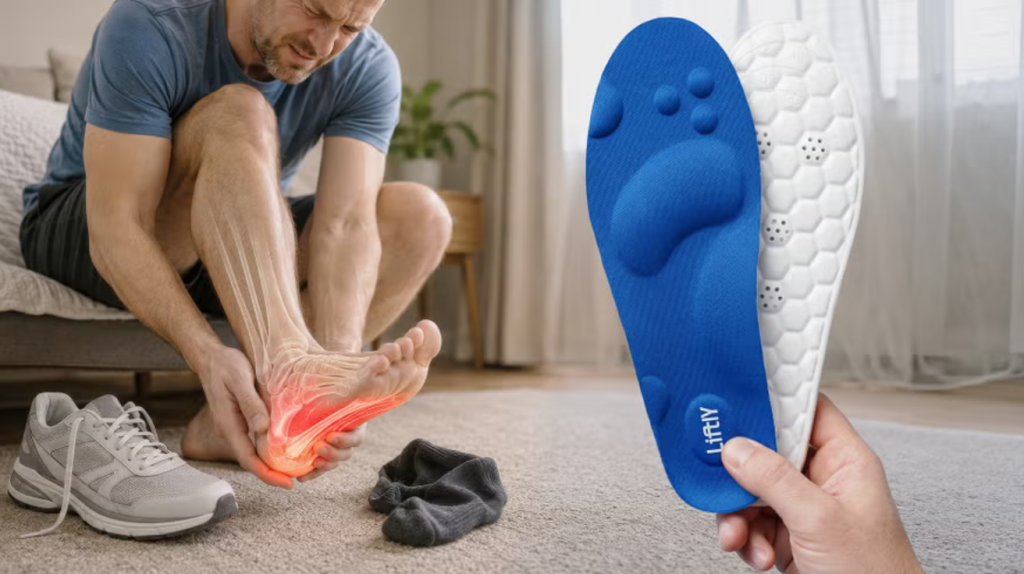
I wanted to know if that was actually true, or just well-written marketing. So I spent time going through Liftly’s official offer page, its return and warranty policies, its parent company’s public records, and the handful of independent write-ups already out there. This Liftly Insoles review walks through exactly what I found – the good, the fine print, and what you genuinely need to know before you order.
Short version up front: it’s a real, inexpensive comfort insole from a real company. It is not a miracle cure, and the “risk-free” language in the ads leaves out a few details worth knowing. Let’s get into it.

Quick Verdict – Liftly Insoles
Best for:
- People who stand or walk for long shifts (retail, healthcare, hospitality, warehouse work)
- Casual walkers, travelers, and gym-goers who want extra everyday cushioning
- Anyone whose current shoes feel flat, worn out, or unsupportive
- Buyers who want a low-commitment, budget-friendly insole to test before investing in something pricier
Not ideal for:
- Anyone with a diagnosed foot condition (plantar fasciitis, Morton’s neuroma, severe overpronation) looking for a clinically validated, medically cleared device
- People who want a completely fee-free return process – a restocking fee applies if you open the box
- Buyers who need a specific, published material/foam composition sheet upfront (helpful if you have foam or adhesive sensitivities)
- Anyone expecting the “instant, 100% pain-free” outcome shown in the ads to be a guaranteed result
Overall Verdict: Liftly Insoles are a reasonably priced, trim-to-fit cushioned insole with a legitimate 30-day guarantee and 1-year limited warranty behind them. Strip away the aggressive ad language, and what’s left is a decent everyday comfort upgrade – not a medical device, and not a replacement for professional care if you have a real, diagnosed foot problem.

What Are Liftly Insoles?
Liftly Insoles are trim-to-fit foam shoe inserts made by ReAthlete, a wellness and recovery products company. The idea is simple: you trim the insole down using printed size guides, drop it into your existing shoes, and get extra cushioning, arch support, and heel stability without buying new footwear or seeing a specialist.
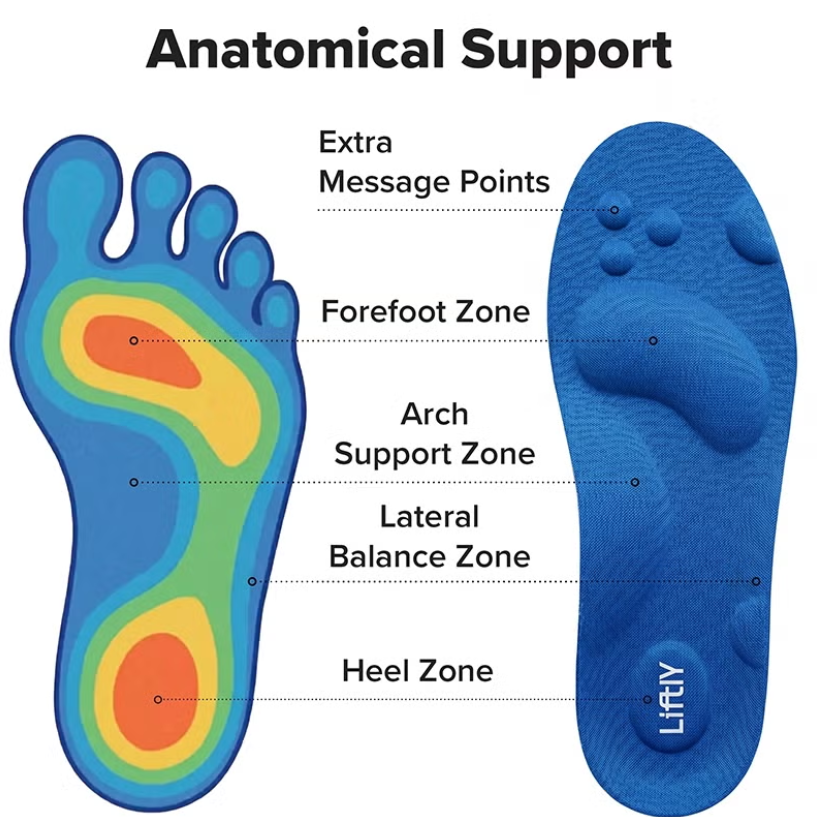
According to the brand, the insole is built around several named zones:
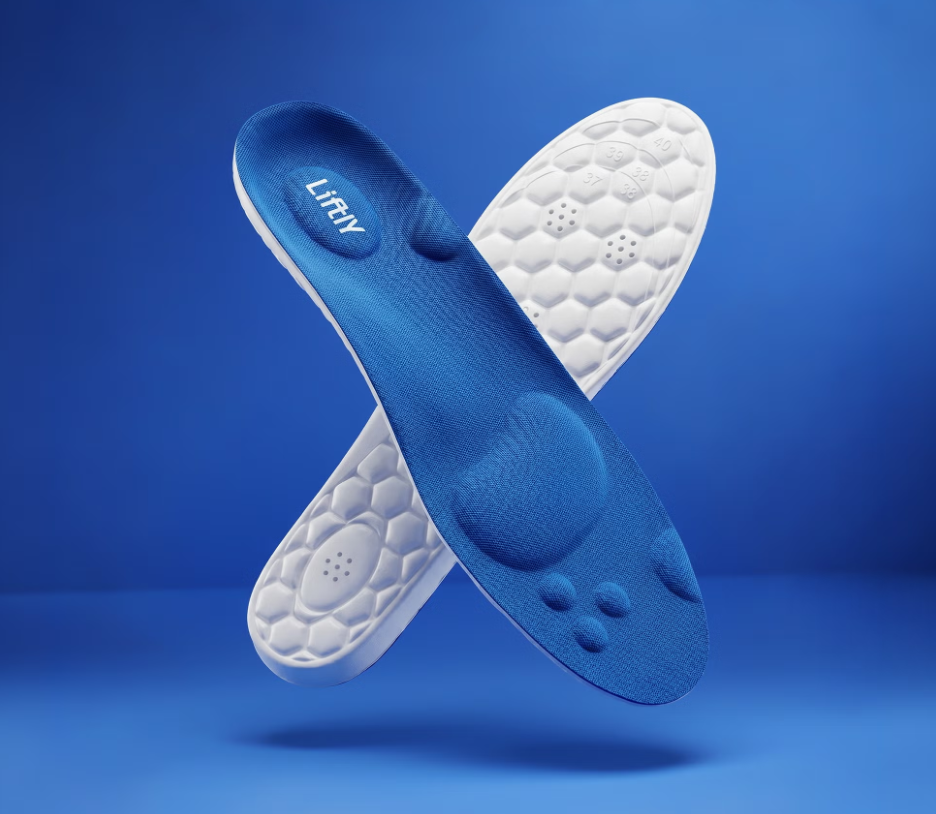
- 4D Cloud Cushioning – a high-density foam base marketed as soft underfoot without breaking down quickly
- Anatomical Support Nodes – raised bumps across the footbed meant to create a light massaging feel with each step
- Impact Shield Heel Zone – extra padding at the heel, positioned to absorb shock
- Active Bridge Arch Support – midfoot support intended to help with alignment
- Power Launch Forefoot Zone – reinforced cushioning under the ball of the foot
- Balance Rail Lateral Zone – outer-edge support meant to help steady your stride
Worth being upfront about: every one of those descriptions comes directly from Liftly’s own marketing copy. I couldn’t find an independent lab test, biomechanical study, or third-party materials report backing up the specific “zone” claims. That doesn’t mean they don’t work as a comfort product – it just means the engineering language is the brand’s framing, not something I can independently verify.
The insoles ship in two base sizes (roughly 37–41 and 42–47) and three colors, and they’re sold as a one-time purchase – I didn’t find any evidence of a hidden subscription or auto-billing on the official checkout page.
Why People Are Buying Liftly Insoles Right Now
A few real, non-hype reasons this product keeps showing up in people’s feeds:
- Their current shoes have gone flat. Factory insoles in most sneakers and work shoes compress fast, and once they do, every hour on your feet gets harder.
- They’re not ready to spend on custom orthotics. A properly fitted orthotic from a podiatrist can run several hundred dollars. A $30 insole feels like a low-risk first step.
- Long shifts on hard floors. Retail, food service, nursing, warehouse, and delivery jobs put a lot of repetitive stress on the feet, and a cushioned insole is one of the cheapest ways to soften that.
- Trim-to-fit convenience. One insole that adapts to sneakers, boots, and flats is appealing if you don’t want to buy separate inserts for every pair of shoes.
- The 30-day guarantee lowers the perceived risk. Even with the restocking-fee caveat (more on that below), a guarantee makes people more comfortable trying something new.
How I Researched This Review
I’ll be straight with you: I did not personally wear-test this exact product for weeks before writing this. What I did do is go through Liftly’s official offer page line by line, read its actual Terms of Service, Return Policy, and Warranty pages (not just the ad copy), check the parent company ReAthlete’s public business filings and Better Business Bureau presence, and compare that against other independent write-ups already published on this product.

I’m telling you this because a lot of “reviews” online for products like this are written by people who never touched the item and never read past the sales page. I didn’t want to do that to you. Everything below is either clearly labeled as the brand’s own claim, or something I could verify against a policy document.
How Does Liftly Work?
Liftly operates on a simple three-step process:
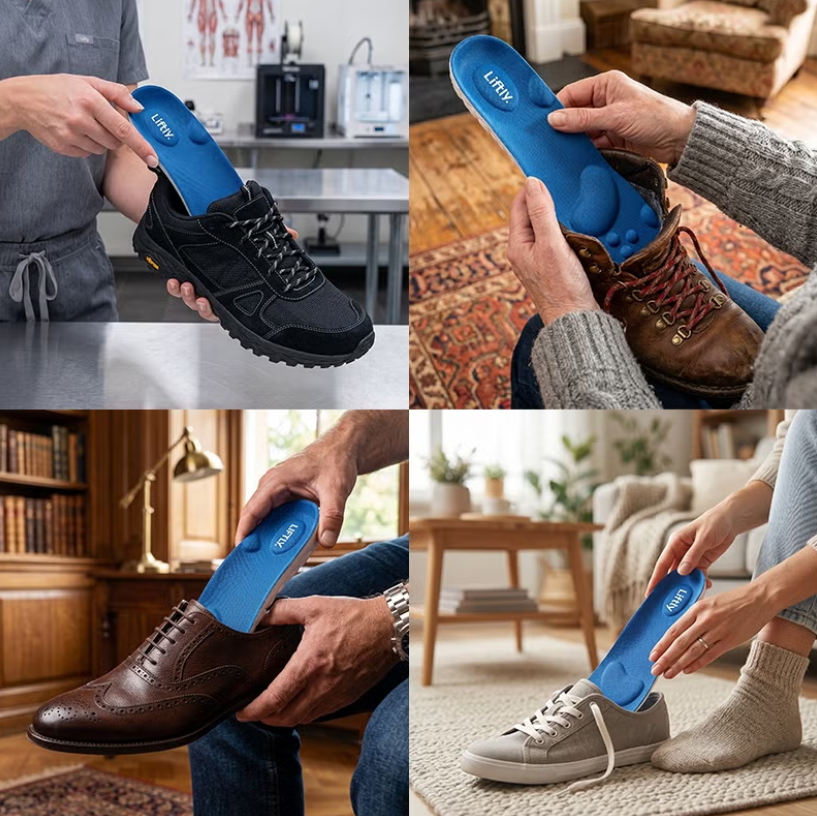
1. Trim to Fit
Follow the printed size lines on the insole and trim the toe edge with scissors – roughly thirty seconds per insole to match any shoe. The cut-to-fit technology allows the same pair to adapt to sneakers, boots, work shoes, or casual footwear.
2. Swap the Flat Liner Out
Pull the factory insole out of your shoe, drop Liftly in, and the arch dome and heel cup position themselves where your foot actually loads.
3. Let Your Feet Recalibrate
Arches used to nothing take a few days to adjust to real support. Mild awareness early on is normal; after that, shoes simply feel better.
The technology behind it: According to ReAthlete’s product description, Liftly incorporates several engineered zones:
- Impact Shield Heel Zone – Heavy-duty cushioning that absorbs heel-strike shock before it travels upward through knees and legs
- Active Bridge Arch Support – A midfoot support zone that helps maintain natural alignment and reduces muscle overcompensation
- Power Launch Forefoot Zone – Reinforced forefoot protection supporting the metatarsals during push-off movements
- Balance Rail Lateral Zone – Outer-edge support that redistributes weight more evenly
- Massage-on-the-Move Nodes – Strategically placed micro-stimulators providing gentle underfoot stimulation
- Cloud-Walk Foam Layer – High-density, ultra-soft foam base designed to deliver cushioning without flattening out quickly
- Pressure-Point Mapping – Anatomically designed zones that help reduce hot spots by spreading weight more evenly
Editorial interpretation: The “4D Cloud Cushioning” and “Massage-on-the-Move Nodes” are marketing terms. What the product actually offers is a reasonably well-designed foam insole with contoured arch support, a heel cup, and strategic cushioning zones. The technology is not revolutionary – similar principles exist in other comfort insoles – but the execution appears functional for the price point.
How to Use Liftly Insoles (Step by Step)
| Step | What to Do |
|---|---|
| 1. Measure first | Take out your current insole and compare it to Liftly’s printed size guide before cutting anything |
| 2. Trim to fit | Cut along the guide lines to match your exact shoe size and shape |
| 3. Insert into your shoe | Place the trimmed insole over or in place of your factory insole |
| 4. Wear as usual | No break-in period is claimed – you should feel the cushioning the same day |
My honest tip: trimming is permanent. Measure twice against your actual shoe before you cut, because there’s no undoing an insole trimmed too small.
Key Features
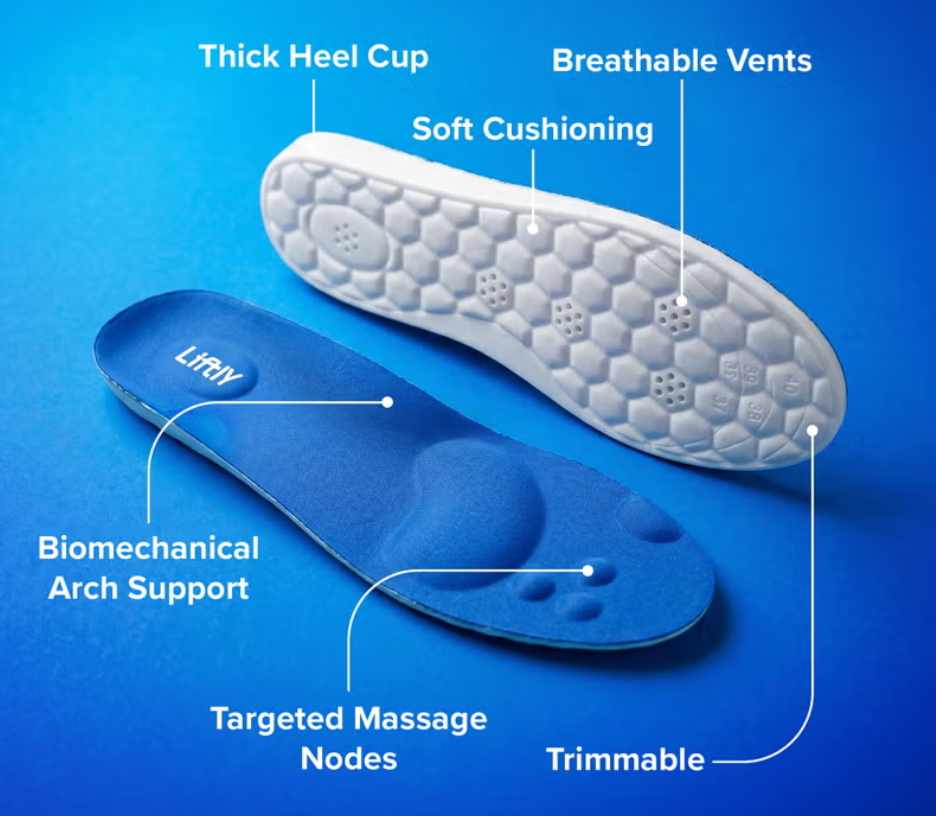
Arch Support
What it is: A raised arch dome that replaces the flat factory liner.
Why it matters: Flat arches that ache by evening often improve with proper support. The arch contour helps distribute load more evenly across the foot.
Who benefits: People with flat-ish arches, tired feet, or standing-all-day fatigue.
Limitation: New arch support takes a few days of adjustment; mild discomfort early on is normal.
Heel Cup
What it is: A deep, cradling heel cup that stabilizes and aligns the foot on landing.
Why it matters: Heel stability reduces the shock that travels upward through the kinetic chain with every step.
Who benefits: People with sore heels, heel pain, or anyone who feels impact in their knees or lower back after a long day.
Limitation: Tight-fitting dress shoes may not have enough volume to accommodate the heel cup.
Honeycomb Cushioning
What it is: A cushioning layer designed to absorb heel-strike shock and return some energy from each step.
Why it matters: The factory foam in most shoes flattens within weeks. Honeycomb or structured cushioning is more durable than flat foam sheets.
Who benefits: Walkers, casual runners, and anyone whose shoes feel dead.
Limitation: The foam material composition is not published, which is a gap for buyers with sensitivities.
Trim-to-Fit Design
What it is: Printed size lines allow you to trim the insole with scissors to match any shoe.
Why it matters: One pair can be moved between different shoes – sneakers, boots, work shoes. This dramatically increases value per pair.
Who benefits: Anyone who wants to upgrade multiple pairs without buying insoles for each one.
Limitation: The trim-to-fit approach requires careful cutting; imprecise trimming could affect fit and comfort.
Size and Color Options
Liftly is available in standard sizes 37-41 and large sizes 42-47, with color options including Electric Blue, Classic Black, and Modern Grey.
What the Available Evidence Suggests
Note: This review is based on available product information, specifications, and verified sources – not first-hand testing.
Setup and ease of use: Based on the manufacturer’s documentation, setup is straightforward – trim along the printed lines, swap out the factory insole, and you’re done. The process takes about thirty seconds per insole.
Comfort and break-in period: The manufacturer advises that arches used to flat foam take a few days to recalibrate to real support. Mild awareness early on is normal. Some users on the official site report comfort from the first day, with one customer stating: “No break-in period needed. I wore them all day on the first day and felt great”. However, individual experiences vary, and customers who have purchased similar products from other brands have reported discomfort, with one noting foot pain after twenty minutes of use.
Performance: The features are designed to address the four critical areas where many shoes fall short – heel impact, arch stability, forefoot pressure, and lateral balance. The honeycomb cushioning and arch dome are intended to provide better support than flat factory liners.
Practical limitations: The product is a comfort insole, not a prescription orthotic. People with diagnosed foot conditions should see a podiatrist rather than relying on an over-the-counter insole.
Main Benefits
Drawbacks & Limitations
1. Return policy fees are not fully transparent
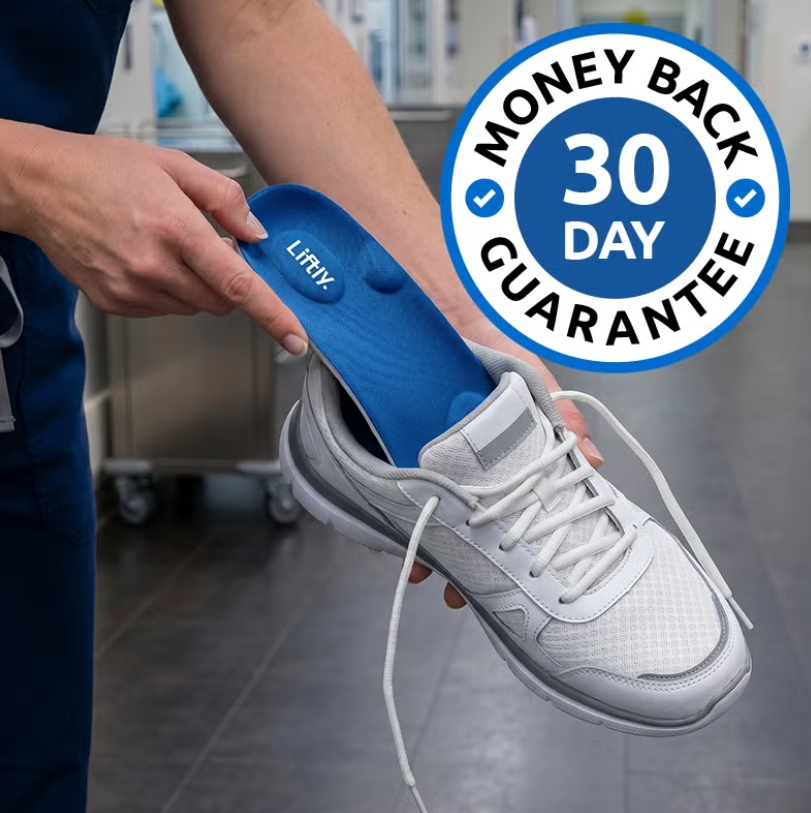
The “risk-free” 30-day money-back guarantee comes with a 10% restocking fee if you open the box. Buyers also cover return shipping costs. This is not disclosed in the promotional “risk-free” ad copy.
2. No FDA clearance or medical-device status
Liftly has not been FDA-cleared or approved for any of the conditions named in its marketing, such as plantar fasciitis, flat feet, or heel pain. The company’s FDA facility-registration statement sounds more impressive than it legally means – facility registration is not product clearance.
3. Foam material composition isn’t published
The specific materials used in the foam are not disclosed, which is a gap for buyers with allergies or sensitivities.
4. Brand-reported “95% Positive” rating lacks transparency
The “95% Positive” rating claimed in marketing has no disclosed platform or review count.
5. Inconsistent business information
Two different business addresses and two different support emails appear across the seller’s published pages. While this doesn’t indicate a scam, it does indicate some operational inconsistency.
6. Not suitable for tight-fitting dress shoes
The added volume from the heel cup and arch support may not fit in tight dress shoes.
7. Adjustment period required
Arches used to flat foam need a few days to adjust to real support. Some users may experience mild discomfort during this period.
8. Marketing claims require careful reading
Language like “instant relief,” “100% pain-free,” and “guaranteed results” appears in promotional materials. These are marketing claims, not guaranteed outcomes.
Liftly Insoles Price & Cost Breakdown
Here’s the current bundle pricing as listed on the official offer page. Prices on direct-response sites can change without notice, so always confirm the live total at checkout before entering payment details.
| Bundle | Price | Brand’s Listed “Retail” Reference | Per-Pair Cost |
|---|---|---|---|
| 1 Pair | $29.99 | $59.99 | $29.99 |
| 3 Pairs (“Buy 2, Get 1 Free”) | $59.98 | $179.97 | ~$20.00 |
| 6 Pairs (“Buy 3, Get 3 Free”) | $89.97 | $359.94 | ~$15.00 |
A quick, honest note on those “retail” comparison numbers: they’re the brand’s own reference prices used to calculate the advertised discount, not independently confirmed prices from another retailer. That’s standard practice across a lot of direct-to-consumer ads, but it’s worth knowing rather than assuming the “$269 in savings” language is based on a verified third-party price.
Accepted payment methods on the official checkout include major credit cards, PayPal, and Google Pay.
How to Order, Purchase, and Buy Liftly Insoles
If you decide to move forward, here’s how the checkout actually works:
- Go to the official Liftly offer page (avoid third-party marketplace listings, since returns and warranty claims only apply to direct purchases)
- Pick your bundle size – the 3-pair tier is the brand’s “Most Popular” option and brings the per-pair cost down meaningfully
- Choose your size range and color
- Complete checkout with your preferred payment method
- Save your confirmation email – you’ll likely need the order ID for any future warranty or return request
How to order Liftly Insoles safely: stick to the brand’s own site, screenshot your order confirmation, and read the return policy before you buy rather than after – that’s the single best piece of advice I can give you here.
Liftly Insoles Benefits vs. Alternatives
| Option | Typical Cost | Customization | Best For |
|---|---|---|---|
| Drugstore foam insoles | $5–$15 | Fixed sizes only | Light, short-term cushioning |
| Liftly Insoles | $20–$30/pair | Trim-to-fit | Everyday comfort across multiple shoe types |
| Mid-range orthotic-style inserts | $40–$80 | Semi-customizable | More structured arch support |
| Custom podiatrist orthotics | $200–$500+ | Fully custom, prescribed | Diagnosed conditions, chronic pain |
I’m not naming specific competing brands here because I haven’t independently tested them side by side with Liftly, and I don’t want to make a comparison claim I can’t back up. But positioned against this general category, Liftly sits in the affordable, trim-to-fit middle – cheaper and more flexible than drugstore inserts, far less expensive than a custom orthotic, but also without the clinical backing a prescribed device would have.
Liftly Insoles Pros and Cons
| Pros | Cons |
|---|---|
| Affordable entry price (under $30 for one pair) | 10% restocking fee if the box is opened – not mentioned in the ad copy |
| Real 30-day money-back guarantee, confirmed on the seller’s policy page | Buyer pays return shipping |
| Trim-to-fit design works across most shoe types | No FDA clearance confirmed for any condition the ads mention |
| Bundle pricing lowers per-pair cost significantly | Foam material composition isn’t published |
| 1-year limited warranty against manufacturing defects | Brand’s “95% positive rating” doesn’t disclose the platform or review count behind it |
| No break-in period claimed | Two different business addresses and two support emails appear across the company’s own pages |
Who Should Buy Liftly Insoles?
- You’re on your feet most of the day and your current shoes feel worn out
- You want an affordable way to test whether extra cushioning helps before spending more
- You’re comfortable with a standard OTC comfort product, not a clinical device
- You don’t mind a small restocking fee as the trade-off for a low upfront price
Who Should Avoid Liftly Insoles?
- You have a diagnosed condition like plantar fasciitis or Morton’s neuroma and need something with actual medical-device clearance
- You want a completely fee-free, no-questions-asked return process
- You have known sensitivities to foam or adhesives and need a published material safety sheet before buying
- You’re buying based solely on the “instant, 100% pain relief” language in the ad – treat that as marketing, not a guarantee
Is Liftly Insoles Legit? Is It a Scam?
This is probably the question that actually brought you here, so let’s answer it directly: no, nothing I found indicates Liftly Insoles is a scam. It’s a real product from a real, identifiable company (ReAthlete), with a working guarantee and warranty backed by actual published policy pages.
That said, “not a scam” isn’t the same as “fully transparent marketing.” A few things worth knowing:
- The “risk-free” guarantee in the ads doesn’t mention the 10% restocking fee that applies if you open the box – that’s only in the formal return policy
- You’ll find two different business addresses (Georgia and Florida) across the company’s own published pages, and two different support emails
- The parent company’s FDA facility registration is often misread as product approval, which it isn’t
None of that adds up to fraud. It adds up to typical aggressive direct-response marketing paired with a few real transparency gaps – which is exactly why doing this kind of homework before you buy is worth the ten minutes it takes.
Liftly Insoles Reviews: What Buyers Are Saying (Consumer Reports Angle)
The brand’s offer page displays a “95% Positive User Rating” badge, along with four “Verified Buyer” testimonials. I want to be honest about the limits here: the review platform and total review count behind that 95% figure aren’t disclosed anywhere on the page, so it isn’t something I can independently check. The four testimonials are brand-published examples, not something cross-referenced against a public, third-party review platform.
That’s not unusual for a direct-to-consumer product like this – plenty of brands do the same thing – but it does mean you should treat those specific numbers as brand-reported rather than independently audited. If review-platform transparency matters to you, it’s a fair question to email their support team before you order.
Buying Guide
Before buying Liftly, consider these factors:
□ Understand what it is and isn’t – Liftly is a comfort insole, not a medical device. It’s not a substitute for podiatric care if you have a diagnosed condition.
□ Read the return policy carefully – The 30-day money-back guarantee includes a 10% restocking fee on opened boxes, and you pay return shipping. This is not disclosed in the promotional “risk-free” language.
□ Consider bundle pricing – The per-pair cost drops significantly at the 3-pair and 6-pair tiers. If you plan to upgrade multiple pairs of shoes, bundling makes financial sense.
□ Think about shoe compatibility – Liftly adds volume through the heel cup and arch support. It may not fit in tight-fitting dress shoes.
□ Be realistic about expectations – Marketing language like “instant relief” and “100% pain-free” is promotional, not guaranteed. Results vary. Arches used to flat foam take a few days to adjust.
□ Check for material sensitivities – The foam material composition isn’t published. If you have allergies or sensitivities, this is a gap.
□ Verify current pricing – Promotions and discounts change. Check the official site for current offers before purchasing.
□ Have a backup plan – If the insoles don’t work for you, be prepared for the return process: restocking fee, return shipping cost, and processing time.
Return Policy, Warranty, and Shipping – The Details Not in the Ad
Return Policy:
- 30 days from purchase date to request a return
- A 10% restocking fee applies if the box has been opened
- You cover return shipping costs
- Refunds process within about 10 business days of the item being received, plus another 5–7 days to hit your original payment method
- Only applies to purchases made directly on the official site – third-party retailer purchases follow that retailer’s policy instead
Warranty:
- 1 year, starting when you receive the product
- Covers manufacturing defects in materials and workmanship under normal use
- Does not cover misuse, cosmetic wear, resold units, or non-original parts
- A replacement doesn’t restart the 12-month clock
Shipping:
- Free ground shipping within the U.S., typically 2–7 business days
- International shipping available to most countries, with some exclusions
- Does not currently ship to military APO/DPO/FPO addresses
FAQs About Liftly Insoles
How does Liftly work?
You trim the insole along printed size lines, swap out the factory insole, and let your feet adjust over a few days. The arch dome and heel cup position themselves where your foot loads
What is Liftly?
Liftly is a trim-to-fit cushioning insole designed to replace the flat foam liners that come standard in most shoes. It features contoured arch support, a heel cup, and honeycomb cushioning.
Is Liftly Insoles good for foot pain?
The brand markets it for everyday foot, heel, and arch discomfort. It’s not a clinically proven treatment for diagnosed conditions like plantar fasciitis, and no FDA clearance for any specific condition has been confirmed. For persistent or severe pain, talk to a podiatrist.
How much does Liftly Insoles cost?
A single pair is $29.99. A 3-pair bundle is $59.98, and a 6-pair bundle is $89.97, based on the official offer page’s current pricing.
Is Liftly Insoles legit, or is it a scam?
It’s a legitimate product from a real, identifiable company with a working return and warranty policy. The marketing language is aggressive, but nothing found points to fraud.
How do I use Liftly Insoles?
Trim the insole to match your shoe size using the printed guide, then drop it into your shoe. No break-in period is claimed.
How do I order Liftly Insoles?
Order directly through the official site to make sure your purchase qualifies for the return policy and warranty – third-party listings follow different rules.
Can I return Liftly Insoles if I don’t like them?
Yes, within 30 days. A 10% restocking fee applies if you’ve opened the box, and you’re responsible for return shipping.
Does Liftly Insoles work for plantar fasciitis?
The brand lists plantar fasciitis among the conditions it markets toward, but no independent clinical study or medical-device clearance confirms a treatment effect for that specific condition.
Does Liftly really work?
Are there better alternatives?
Is Liftly suitable for beginners?
Is Liftly Insoles FDA approved?
No product-specific FDA clearance or approval was confirmed. The parent company states it’s an FDA-registered facility, which is a manufacturing listing, not a product approval.
What is the return policy?
How long does shipping take?
Shipping times are not specified in the available documentation. Check the official site for current shipping estimates and policies.
Can I use Liftly in all my shoes?
Does Liftly help with plantar fasciitis?
Final Verdict
Is Liftly worth considering?
Yes – for the right person. If you spend long hours on your feet, if your shoes feel dead, or if your arches ache by evening, Liftly offers a reasonably priced upgrade over the flat foam liners most shoes ship with. At approximately $30 per pair, with bundle pricing dropping the per-pair cost significantly, it’s not an expensive experiment.
Who is it best for?
Retail and healthcare workers on their feet all shift. Walkers and casual runners whose shoes feel dead. People with flat-ish arches that ache by evening. Anyone who balked at $400 custom orthotics.
Who should choose an alternative?
People with diagnosed foot conditions requiring medical-device clearance. Anyone unwilling to pay a restocking fee if they open the box. Buyers who need zero-hassle returns with free return shipping.
Biggest advantage:
Real arch contour and heel cup at a fraction of the cost of custom orthotics, with trim-to-fit versatility that allows one pair to upgrade multiple shoes.
Biggest drawback:
The “risk-free” return policy includes a 10% restocking fee on opened boxes and buyer-paid return shipping – terms not disclosed in the promotional language.
Bottom line: Liftly is a genuine comfort product from a real company, not a scam. But it’s also not a medical device, not a cure, and not a no-risk purchase despite the marketing claims. If you understand what it is (an affordable comfort upgrade) and what it isn’t (a medical treatment), and you’re comfortable with the return terms, it’s worth considering. If you’re expecting guaranteed instant relief or a fee-free return process, you may want to look elsewhere.