
React ChargeHub is not a conventional car charger. It combines a USB car charger and 2200mAh power bank with an LED flashlight, red emergency signal, audible SOS alarm, seat belt cutter and tempered-glass breaker.
That combination is the reason the product is interesting-but also the reason it needs a closer look.
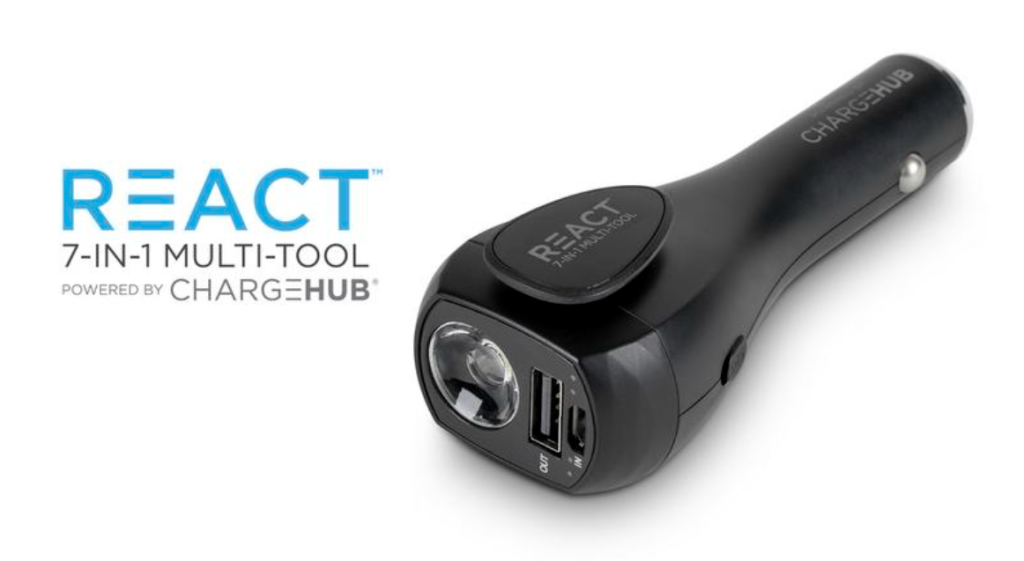
The most important thing to understand before buying is that React is a compact emergency multi-tool, not a complete roadside emergency kit and not a jump starter. Its glass breaker also has a specific limitation: Limitless Innovations says it works on tempered glass, not windshields or laminated glass.
This React ChargeHub review looks at what the product is designed to do, what the manufacturer’s documentation actually confirms, what independent testing has reported, where the product falls short, and which type of driver is likely to get the most value from it.
React ChargeHub: Quick Verdict
Best for: Drivers who want a compact combination of everyday phone charging and basic emergency tools.
May not be ideal for: Buyers who only want a simple escape tool, need modern fast-charging standards such as Qualcomm Quick Charge 3.0, or want a complete roadside emergency kit in one purchase.
Key strength: Several everyday and emergency functions are combined into one device.
Key limitation: The emergency tools have important usage restrictions, while the 2200mAh battery is modest compared with a dedicated power bank.

Value: The $49.99 price makes more sense when you value the charger, battery, flashlight and signaling features-not if you only need a seatbelt cutter and window breaker.
Bottom line: React is a legitimate, documented product with a useful all-in-one concept, but buyers should understand what the glass breaker can actually do, when the device should be unplugged, and what happens after emergency use.
What is React ChargeHub
React, officially listed as the React 7-in-1 Vehicle Emergency Multi-Tool, is made by Limitless Innovations, Inc. and sold under the ChargeHub/React branding.

The manufacturer’s product page lists model CRG-RCT-001, with a 2200mAh lithium-ion battery, 12–24V DC input, USB charging output and an integrated set of emergency functions.
How Does React ChargeHub Work?
React plugs into a vehicle’s 12–24V power socket and can also be recharged through its included Micro USB cable. The manufacturer specifies a 2200mAh lithium-ion battery, a 5V/2A car-charger USB output on the product page, and a 5V/1.5A output for the power-bank function.
There is also a useful detail that gets lost in the marketing: the manufacturer says React should not simply remain plugged into the car whenever the vehicle is parked. Its FAQ recommends unplugging the device when not in use because it may drain the vehicle battery.
The unit does have a power button and automatically powers off after approximately 30 seconds of being idle.
One specification is worth double-checking
There is a small documentation inconsistency. The current product page lists the car-charger USB output as 5V/2A, while the manufacturer’s FAQ says the React has one port with a 2.4A output. Until Limitless clarifies the discrepancy, it is safer to describe the device as having a single USB output rather than advertise 2.4A as an unquestioned specification.
What Are the Potential Benefits of React ChargeHub?
The strongest argument for React is consolidation.
Instead of carrying a separate charger, small power bank, flashlight and dedicated escape tool, one device combines several of them. The manufacturer also designed it to sit in a vehicle power socket, which can make it easier to locate than equipment buried in a glovebox.
That matters because NHTSA itself recommends carrying a roadside emergency kit containing a phone and charger, flashlight, jumper cables, tire-pressure equipment and other basic supplies. React can cover a few of those functions, although it does not replace a complete emergency kit.
A useful independent perspective comes from a Chron/Yahoo review, which reported using the everyday functions including charging, the power bank, flashlight, beacon and siren. The reviewer explicitly said they did not have to use the glass breaker or seatbelt cutter, which is an important limitation when interpreting independent performance evidence.

React ChargeHub Limitations and Drawbacks
This is the section buyers should read before ordering.
The glass breaker is not for windshields
This is probably the biggest misconception to avoid. React is designed for tempered glass, not laminated windshield glass.
The escape functions are not intended for repeated use
Limitless recommends replacing the entire product after a single emergency use of the seatbelt cutter or window breaker.
It is not a modern multi-port fast charger
React has one USB charging port, and the manufacturer explicitly says it does not support Qualcomm Quick Charge 3.0.
The battery is relatively small
At 2200mAh, the internal battery is useful as backup power, but it should not be treated like a high-capacity travel power bank.
You should not leave it connected indefinitely
The manufacturer recommends unplugging the React when the vehicle is not in use because it may drain the car battery.
It needs protection from heat and moisture
The manual warns against extended direct sunlight, temperatures above 212°F, moisture, water, rain, snow and other extreme conditions.
That is especially relevant for US drivers who routinely leave electronics inside hot vehicles.
React ChargeHub Specifications
| Specification | Published information |
|---|---|
| Battery | 2200mAh lithium-ion |
| Product size | 4.5 × 1.6 × 1.25 inches |
| Product weight | 3.2 oz |
| DC input | 12–24V |
| Micro USB input | 5V / 800mA |
| Car charger output | Manufacturer lists 5V / 2A |
| Power-bank output | 5V / 1.5A |
| Flashlight | 1W, 130–140 lm |
| Charging time | About 2–3 hours |
| Flashlight modes | Low, High, Red Flashing |
| Warranty | 1-year limited |
| Included | React, Micro USB cable, user manual |
All technical specifications above come from the manufacturer’s published product page and manual. One exception deserves explicit caution: the manufacturer FAQ separately states 2.4A for the single charging port, conflicting with the 5V/2A technical specification.

Who Should Consider React ChargeHub?
React is most relevant to buyers who want several functions in one small device.
It may make sense for:
Daily commuters: The charger gives the device a reason to remain useful even when there is no emergency.
Road-trip drivers: The flashlight, power bank, signal and escape tools add preparedness beyond simple phone charging.
Parents and families: Having an accessible emergency tool can be more convenient than storing one somewhere difficult to reach.
Drivers with limited storage: Combining several small tools into one device can reduce clutter.
Who Should Probably Skip It?
You may be better served by another option when:
You only need an escape tool. A dedicated 2-in-1 tool such as ResQMe can cost substantially less. Current Walmart listings show individual ResQMe tools around the low-teens depending on the seller/listing.
You want advanced charging. React does not support Qualcomm Quick Charge 3.0, and its USB-C/modern fast-charging capabilities are not positioned like a dedicated current-generation charger.
You want a complete emergency kit. React does not provide jumper cables, tire-inflation equipment, first-aid supplies, food, water, warning devices or other emergency-kit essentials recommended by NHTSA.
Is React ChargeHub Legit?
Yes, the product itself appears legitimate.
There is strong evidence that React is a genuine consumer product:
- Limitless Innovations maintains an official React product page.
- The company publishes a user manual, returns policy and warranty.
- React is listed through US retail channels.
- Limitless publishes corporate/customer-service information.
- Trademark records associate the product branding with Limitless Innovations.
The more important question is whether every advertising claim deserves equal confidence.
Here the answer is no.
The core specifications are well documented by the manufacturer. Some claims-especially certification language and generalized performance statements-remain manufacturer-sourced unless supported by independent evidence.
That is why this React ChargeHub review does not treat marketing copy as equivalent to laboratory or hands-on verification.

React ChargeHub Pros and Cons
| Pros | Cons |
|---|---|
| 7 functions in one device | More expensive than a basic escape tool |
| 2200mAh backup battery | Small battery by power-bank standards |
| Flashlight + red beacon + siren | One USB charging port |
| Tempered-glass escape function | Not designed for windshields |
| Seatbelt cutter | Manufacturer recommends replacing after emergency use |
| 1-year limited warranty | Should be unplugged when vehicle is not in use |
| 30-day satisfaction guarantee | Documentation has a 5V/2A vs 2.4A output discrepancy |
Warranty and return terms are documented by Limitless Innovations.
React ChargeHub vs Alternatives
React vs resqme vs Scosche GoBat Pro
| Feature | React | resqme | GoBat Pro |
|---|---|---|---|
| Escape tool | Yes | Yes | Yes |
| Seat belt cutter | Yes | Yes | Yes |
| Window breaker | Yes | Yes | Yes |
| Power bank | 2200mAh | No | 2000mAh |
| Car charging | Yes | No | Yes |
| Flashlight | Yes | No | Yes |
| Red alert light | Yes | No | Yes |
| Audible SOS alarm | Yes | No | No listed siren |
| Charging connector | Micro USB | N/A | USB-C |
| Main appeal | Multi-function consolidation | Simple escape tool | Modern compact multifunction option |
React vs resqme
resqme is a very different philosophy.
The official resqme product is a small 2-in-1 seatbelt cutter/window breaker listed at $9.95. It is designed to be carried on a keychain and requires no internal battery.
That makes it much simpler than React.
React gives you considerably more functionality, but resqme is far smaller and substantially cheaper.
So the question isn’t “Which is universally better?”
It’s:
Do you want a dedicated escape tool, or do you want an escape tool built into a charger/power-bank/light combination?
React vs Scosche GoBat Pro
Scosche’s GoBat Pro is a closer alternative because it combines a 2000mAh rechargeable power bank, USB-C charging, flashlight, window breaker and seatbelt cutter. Crutchfield currently lists it at $39.99.
That gives GoBat Pro an important advantage for buyers who prefer USB-C.
React, however, adds an audible alarm and red emergency signaling function and is built around the ChargeHub ecosystem.
This comparison is better understood as a question of feature priorities rather than a universal winner.
React vs a complete car emergency kit
This isn’t really a direct substitute.
AAA recommends a broader set of emergency equipment, including a car charger, flashlight, first-aid supplies, warning devices, jumper cables or a jump pack, basic tools, water and other supplies.
React covers some of those needs very efficiently-but not all of them.
For road trips, severe-weather travel or remote driving, a complete emergency kit plus a dedicated jump starter may make more sense than relying on React alone.
Independent Testing: What Has Actually Been Reported?
A useful independent data point comes from SFGate/Chron’s car-emergency-gear coverage, which reported hands-on testing of React alongside other products.
That testing found the flashlight useful for roadside tasks, the red beacon visible, the siren attention-getting and the power bank useful for recharging a phone. The reviewer also explicitly said the seatbelt cutter and glass breaker were not used in an actual crash, meaning that portion was not independently crash-tested.
That’s a much more appropriate way to interpret testing evidence.
It supports everyday usefulness.
It does not prove that React will perform successfully in every real-world collision or entrapment scenario.

Is React ChargeHub Worth It?
The answer depends on what you want the $49.99 purchase to accomplish.
If your goal is simply “I need a seatbelt cutter and a way to break a tempered side window,” a dedicated escape tool is much cheaper and simpler.
If you want a charger + small power bank + flashlight + emergency signaling + escape functions in one device, React becomes easier to justify.
The important point is not to buy it because of the dramatic “life-saving” language used in promotional advertorials. Buy it because the actual combination of functions matches your needs.
That distinction matters because the official documentation is much more specific than the marketing language: tempered glass only, one USB charging port, no Quick Charge 3.0, and replacement recommended after emergency use of the escape tools.
React ChargeHub Price: How Much Does It Cost?
The latest manufacturer listing I found shows:
$49.99 for one React.
Recent US retailer listings have shown lower prices:
- Walmart Business: $39.99
- Home Depot: $39.99
- Office Depot: $47.99, with availability varying
Prices and inventory can change, so a review should avoid publishing a permanent “sale price” unless it is checked immediately before publication.
Is the price reasonable?
The value comes from consolidation.
You are paying for multiple functions in one device rather than simply buying a $10 escape tool.
But that value drops if you already own:
- a good USB-C charger,
- a large power bank,
- a reliable escape tool,
- a flashlight,
- and a dedicated jump starter.
At that point, React becomes more about convenience than filling an obvious equipment gap.

React ChargeHub Price, Warranty and Returns
The current Limitless Innovations product listing shows $49.99 for one React and says shipping is calculated at checkout.
The manufacturer offers a 30-day money-back guarantee. Returned items must be sent within 30 days of delivery, in original packaging and without damage; the customer is responsible for return shipping, and shipping charges are non-refundable.
React also comes with a 1-year limited warranty from Limitless Innovations.
The current dedicated React offer page advertises free shipping on bundles, while the supplied advertorial currently promotes a “buy 2, get 1 free” deal. Because promotions can change, verify the final price, shipping and bundle terms on the checkout page before ordering.
How To Use React ChargeHub
For normal charging, insert the device into the vehicle’s 12–24V power socket, wait for the battery indicator to illuminate, and connect your USB-chargeable device to the USB output.
For the power-bank function, turn on the power button and connect your device through the USB port.
For the flashlight, the manual uses the power button to cycle through its available modes.
The glass breaker and seatbelt cutter are emergency-only tools. The manual provides specific safety instructions and warns users not to use them casually or as general-purpose cutters or glass tools.
React ChargeHub Return Policy and Warranty
Limitless states that purchases may be returned within 30 days of delivery.
Important restrictions include:
- Original packaging required
- Product must be free from damage
- Return shipping is the customer’s responsibility
- Shipping and handling charges are non-refundable
- Refunds are issued to the original payment method after the return is received
The manufacturer also provides a 1-year limited warranty for defects in materials and workmanship, subject to exclusions for misuse, water exposure, unauthorized modification and other conditions.
Where to Buy React ChargeHub
The manufacturer sells React directly through Limitless Innovations, and US retail listings have also appeared at Walmart, Home Depot and Office Depot.
For this article, the supplied affiliate URL is a tracked advertorial URL on techetc.co, not the direct Limitless Innovations product URL. I was not able to independently fetch its final destination during research.
That means the article should not call the affiliate URL “the official React website” unless you verify the redirect yourself.
Check the current offer
Check the current React ChargeHub offer
Before purchasing, confirm the final checkout page shows the expected product, seller, price, shipping cost and return terms.
Frequently Asked Questions About React ChargeHub
Is React ChargeHub worth buying?
It can be, particularly for drivers who want a compact combination of everyday charging and emergency tools. It is less compelling if you already own dedicated emergency equipment or need a jump starter.
Does React ChargeHub really work?
The functions are documented in the manufacturer’s manual and product page, and independent shopping coverage has reported useful everyday performance from its charger, light, beacon and siren. Product-specific emergency performance should still be treated cautiously because real crash conditions vary and the escape tools were not validated here through real-world crash testing.
Can React ChargeHub break a windshield?
No. Limitless says the breaker is intended for tempered glass and is not designed for windshields or laminated glass.
Is React ChargeHub legitimate?
React is a real product currently listed by Limitless Innovations, with an SKU, technical specifications, user manual, support documentation and warranty terms. That confirms the product’s existence, but it does not mean every third-party advertising claim has been independently proven.
Does React ChargeHub break a windshield?
No. According to the manufacturer, the breaker is designed for tempered glass and is not designed for windshields, laminated glass or plated glass.
Can you leave React plugged into the car?
The manufacturer recommends unplugging it when the vehicle is not in use because leaving it connected may drain the car battery.
How do you recharge React?
It can be recharged through the included Micro USB cable or by connecting it to a vehicle’s 12V power socket.
Is React reusable after breaking a window or cutting a seatbelt?
The manufacturer recommends replacing the product after a single emergency use involving the window breaker or seatbelt cutter.
Can you use React outdoors?
Yes, but Limitless advises keeping it away from liquids and extreme temperatures, while the manual gives more extensive warnings about water, rain, snow and high heat.
Is React rechargeable?
Yes. The manufacturer says it can be recharged through the vehicle’s 12–24V socket or with the included Micro USB cable.
Can you take React on a plane?
The manufacturer’s support documentation says to carry it in carry-on baggage. FAA guidance separately says spare lithium-ion batteries and power banks must be carried in carry-on baggage and are subject to watt-hour limits.
Does React need to remain plugged into the car?
No. Its internal battery allows portable use. In fact, the manufacturer recommends unplugging it when not in use because leaving it connected may drain the vehicle battery.
Is React ChargeHub a full emergency car kit?
No. It handles only some of the functions recommended for vehicle emergency preparedness. AAA’s broader checklist includes items such as jumper cables/jump packs, first aid, water, warning devices, tools and other supplies.
Final Verdict: Should You Buy React ChargeHub?
React ChargeHub makes the most sense as a multi-function vehicle preparedness gadget, not as a miracle rescue device.
Its real appeal is the combination of everyday and emergency functions. The manufacturer documents a 2200mAh battery, flashlight, red signal, alarm, USB charger, seatbelt cutter and tempered-glass breaker, plus a 30-day return policy and 1-year limited warranty.
The limitations are just as important. It does not break windshields, it does not support Quick Charge 3.0, it has one USB output, it should not remain plugged in when the vehicle is unused, and the manufacturer recommends replacing it after a qualifying emergency use of the escape tools.
For a buyer who wants one compact gadget covering charging, lighting, signaling and basic escape functionality, the concept is practical. For someone who only wants the lowest-cost escape tool, a dedicated alternative is likely a better fit financially.
That is the key purchasing decision: are you paying $49.99 for a single escape tool, or for the convenience of having seven functions together?