Shopping for an insole can get confusing quickly. A lot of products replace the entire footbed, while Soul Insole takes a very different approach: its Shoe Bubble is a small, adhesive arch-support insert designed to work inside the shoes you already own.
The current Shoe Bubble Max Support sells for $29.99 directly from Soul Insole and comes as a left/right pair. It is washable, reusable and available in three sizes.

The interesting question isn’t whether a tiny gel insert sounds clever. It’s whether that design fits your particular shoes and support needs.
Based on the available product documentation, customer feedback and independent evidence on foot orthoses, Soul Insole makes the most sense for someone who wants targeted arch support without giving up much space inside the shoe. It makes less sense for someone specifically looking for a full-length, structured footbed.
Quick Verdict
Best for: People who want low-profile arch support, especially when a conventional full-length insole makes shoes feel tight.
May not be ideal for: Buyers who want full heel-to-toe cushioning, a deep heel cup, or a highly structured orthotic.
Key strength: Very small footprint and the ability to move the insert between shoes.

Key limitation: It does not provide the same full-foot structure as a conventional full-length orthotic.
Current listed price: $29.99 for the Shoe Bubble Max Support.
Evidence note: Research supports foot orthoses as one possible tool for plantar-fasciitis pain, but that evidence should not be treated as clinical proof that the specific Soul Insole product will work for every user. A 2026 systematic review found pain reduction but no significant improvement in foot function or walking ability.
What Is Soul Insole?
Soul Insole is a US foot-support brand that started with the Shoe Bubble, a small orthotic insert launched through Kickstarter in 2016. The company describes itself as a small, women-owned business based in San Diego, California.
Unlike a conventional full-length insole, the Shoe Bubble is intended to sit around the arch area rather than replace the shoe’s entire footbed.
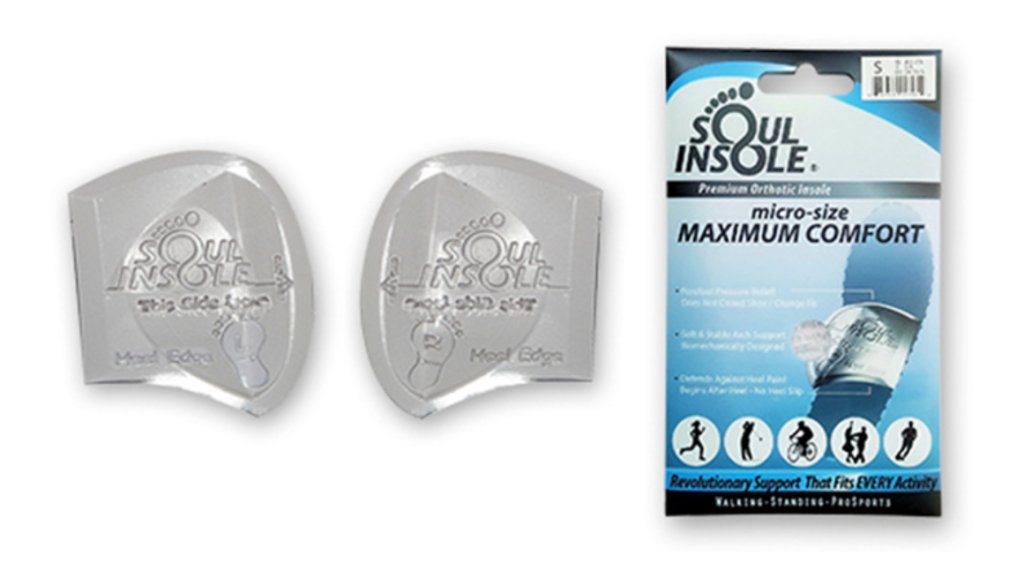
Soul Insole says the design uses a flexible gel construction and a self-adhesive surface. The company describes the material as non-porous, skin-friendly and medical-grade gel. Those are manufacturer-provided specifications, rather than independent laboratory findings verified for this review.
That small footprint is the main reason someone might choose it.
A traditional orthotic can take up significant vertical and horizontal space inside a shoe. Soul Insole is designed to leave the heel and toe areas largely unobstructed.
How Does Soul Insole Work?
The basic concept is straightforward.
The Shoe Bubble is placed inside the shoe beneath the arch area. Its shaped gel support is intended to raise and support the arch while redistributing some pressure away from areas such as the heel and forefoot.
The company says the design can be used alongside the shoe’s existing insole rather than requiring the original liner to be removed.
That’s an important distinction.
You are not buying a complete replacement footbed. You are adding a targeted support component to your existing footwear.
Soul Insole also says the insert can be washed with cool water and allowed to air-dry so the adhesive can regenerate. The company specifically advises against using a dryer, dishwasher or direct sunlight for drying.
What the design does not tell us
A shaped gel insert can provide support, but the existence of an arch-support mechanism does not by itself prove that it will eliminate a specific medical condition.
The independent evidence is broader: research on foot orthoses suggests they can help some people with plantar-fasciitis pain, but outcomes vary and the effect is not equivalent to a cure.
That’s the distinction worth keeping in mind when reading aggressive marketing language around foot-pain products.
What Does Soul Insole Actually Do?
There are two separate questions here.
What is physically verifiable?
The product is a small, flexible, adhesive arch-support insert. It attaches inside the shoe, can be washed and reused, and is sold in three size ranges for the Shoe Bubble Max Support.
What is claimed about its health effects?
Soul Insole says the Shoe Bubble is designed to support or relieve issues including plantar fasciitis, heel pain, Morton’s neuroma, metatarsalgia, over-pronation, arch pain and arthritis.
Those claims should not be confused with independent proof that the product treats each condition.
That’s particularly important for foot pain. Plantar fasciitis, for example, can have different contributing factors, and treatment often involves supportive footwear, stretching, activity modification, physical therapy and other measures. Mayo Clinic notes that both store-bought and custom arch supports can help distribute pressure, but they are only one part of conservative treatment.
A 2026 systematic review and meta-analysis of randomized controlled trials found that foot orthoses reduced pain in people with plantar fasciitis, but did not show significant improvements in foot function or walking ability and concluded that orthoses should be viewed as an adjunct rather than the sole treatment.
That broader evidence supports the idea that orthotic support can be useful for some people. It does not prove that Soul Insole’s specific design will produce the same result.
Soul Insole Features That Actually Matter
Micro-size design
This is the product’s defining feature.
Instead of covering your entire foot, the Shoe Bubble focuses on the arch region. That can be useful in footwear where a normal insole makes the shoe too tight.
Adhesive placement
The insert is designed to stick inside the shoe rather than float around freely. Soul Insole says it can be repositioned and transferred between shoes.
That could be particularly convenient for someone with several pairs of work shoes, sneakers or dress shoes.
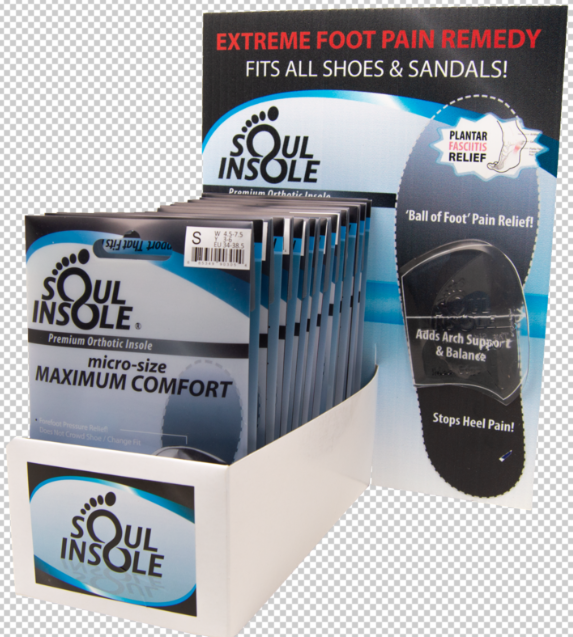
Washable and reusable
The company says the inserts can be rinsed under cool water, dried indoors and reused.
This is one of the more practical aspects of the design because it avoids treating the insert as a disposable one-shoe accessory.
Three sizes
The current product page lists:
| Size | Current US shoe-size guidance |
|---|---|
| Small | Women’s 5–8 / Men’s 5–6.5 / Youth 3–6 |
| Medium | Women’s 8.5–11.5 / Men’s 7–10.5 |
| Large | Women’s 12+ / Men’s 11+ |
One caution: another official Soul Insole landing page contains a slightly different Small-size range. Because the site isn’t perfectly consistent across pages, buyers should check the current product-page sizing chart at checkout rather than relying on an older marketing page.
Sizing: One of the Most Important Buying Decisions
The current Shoe Bubble Max Support is offered in:
Small: Women’s 5–8 / Men’s 5–6.5 / Youth 3–6
Medium: Women’s 8.5–11.5 / Men’s 7–10.5
Large: Women’s 12+ / Men’s 11+
Soul Insole says the sizes become progressively longer, wider and thicker. It generally advises customers between sizes to choose the smaller size for the Max Support, particularly for a first purchase.
That’s not a trivial detail.
The amount of arch support a person feels depends not only on foot size but also on the internal geometry of the shoe. Soul Insole itself acknowledges that a narrower shoe with existing support can make the insert feel substantially higher in the arch than a flatter, wider shoe.
Practical takeaway: don’t choose purely by your sneaker size. Consider the shoe you’ll actually use it in.
Potential Benefits of Soul Insole
The most realistic benefits are related to fit and targeted support, not promises of guaranteed medical relief.
Less shoe crowding
This may be the strongest argument for the product.
A full-length insole can change how a shoe fits. A small arch insert takes up considerably less space.
Easier to move between footwear
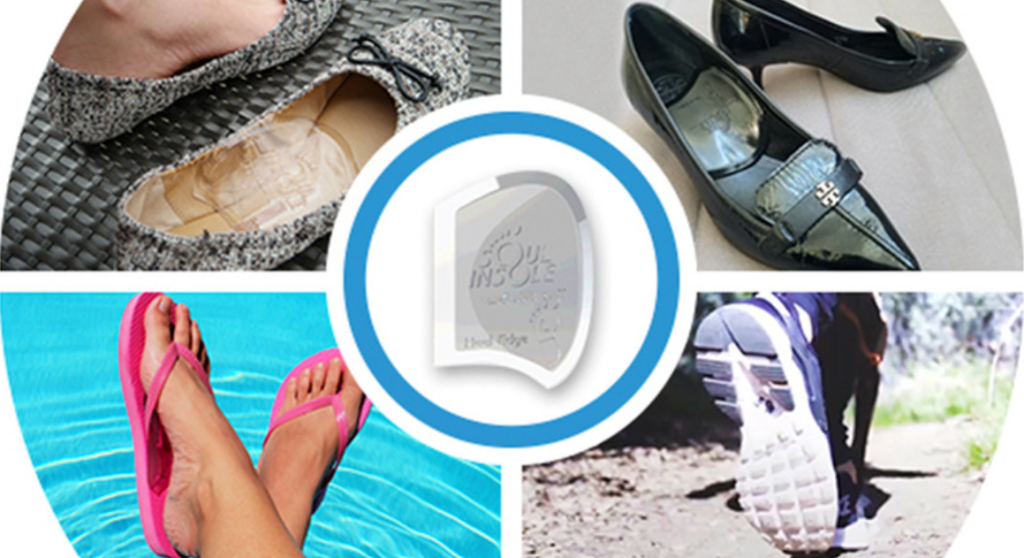
The company designed the Shoe Bubble to work across different types of footwear, including shoes and sandals.
That means one pair can potentially be moved rather than requiring a separate full-length insert for every pair of shoes.
Targeted arch support
For someone who specifically wants additional arch support without substantially changing heel or toe space, the design makes logical sense.
Washability
The reusable design is another practical advantage compared with disposable cushioning pads.
Lower upfront cost than many structured orthotics
At the currently listed $29.99, Soul Insole sits below many well-known structured insole products. PowerStep’s current Pinnacle 3/4 is $44.95, while its standard Pinnacle is $54.95. Superfeet’s All-Purpose Support High Arch is currently $59.99.
That doesn’t automatically make Soul Insole better value. It means the buyer is paying for a different design.
What Are the Limitations?
This is where a lot of Soul Insole reviews become less useful.
It is not a full-length insole
If your priority is cushioning from heel through toe, Soul Insole simply isn’t designed to provide the same coverage as a traditional full-length product.
A compact support insert cannot provide the same physical structure as a full-foot orthotic.
Shoe fit still matters
Soul Insole itself explains that the same insert can feel different depending on the shoe’s construction. A narrow shoe with an existing supportive midsole can make the arch support feel much more pronounced than a wide, flatter shoe.
So “works in any shoe” should not be interpreted as “will feel identical in every shoe.”
Evidence is not product-specific clinical proof
This is probably the most important qualification.
There is research supporting the use of foot orthoses for some plantar-fasciitis pain. A 2026 meta-analysis of eight randomized controlled trials found significant pain improvement, but not significant improvements in foot function or walking ability. The authors concluded that orthoses should be considered an adjunct rather than the only treatment.
That research does not establish that the Soul Insole Shoe Bubble itself produces the same outcomes.
Marketing claims are broader than the evidence
Soul Insole’s website mentions conditions including plantar fasciitis, Morton’s neuroma, metatarsalgia, heel pain, arthritis and others.
Those are manufacturer claims about intended use. They should not be confused with independently demonstrated treatment outcomes for each condition.
Anyone with persistent, severe or unexplained foot pain should have the underlying problem evaluated rather than relying exclusively on an insole.
How to Use Soul Insole
For the Shoe Bubble Max Support, the process is uncomplicated:
- Clean the inside of the shoe and remove dust or shoe powder.
- Peel away the protective film.
- Position the adhesive side inside the shoe where support is needed.
- Wear the shoe and assess how the support feels.
Soul Insole says the Shoe Bubble can be placed on top of or underneath a removable shoe liner, depending on the shoe and desired fit.
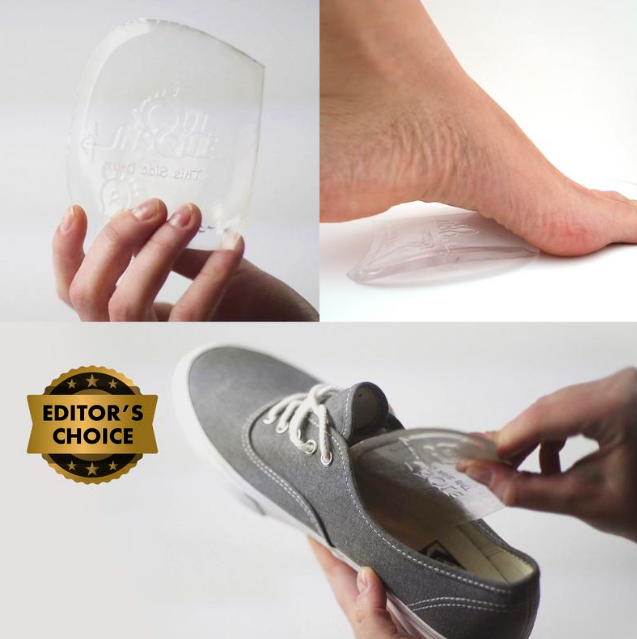
The company also notes that some synthetic shoe materials may not hold the adhesive as well. In those cases, it suggests putting the insert underneath a removable liner or using its double-sided tape as a more permanent option.
This is an important limitation because “works in any shoe” is a much broader marketing statement than “adheres reliably to every shoe material.”
Cleaning and Maintenance
The reusable adhesive system is one of the more interesting features.
Soul Insole says to remove the insert, rinse it under cool water, rub away dust or debris and let it air dry indoors. The company says the adhesive regenerates after drying. It specifically warns against using hand soap because lotions in some soaps can reduce stickiness.
It also warns that oils, foot powders and certain soaps can interfere with the adhesive.
How long should they last?
Soul Insole says its insoles can last anywhere from six months to ten years, depending on use and care.
I would treat that as a manufacturer durability estimate, not a guaranteed service life. There is not enough independent standardized testing available to state that a typical purchaser should expect ten years of performance.
Soul Insole Customer Reviews: What Do Buyers Say?
Public customer feedback is useful, but it needs context.
Trustpilot currently shows 400 reviews and a 4.7/5 rating for Soul Insole. Recent verified reviews include customers who say the insoles improved comfort and support, while at least one recent customer reported little pain relief after significant foot surgery.
That mixed pattern is exactly what you’d expect from a product that interacts with individual feet and footwear.
Positive reviews can tell you that the product worked well for particular customers. They cannot establish a universal medical effect.
Negative reviews deserve attention for the same reason, but a single customer’s experience also shouldn’t be treated as proof that the product fails generally.
The most useful takeaway from the public feedback is variability.
Soul Insole vs Full-Length Alternatives
The right comparison depends on what you want an insole to accomplish.
| Product | Current listed price | Design | Where it makes sense |
|---|---|---|---|
| Soul Insole Shoe Bubble Max Support | $29.99 | Micro-size gel arch insert | Tight shoes, targeted support, moving between footwear |
| PowerStep Pinnacle 3/4 | $44.95 | 3/4-length structured support | Low-profile shoes needing more structured support |
| PowerStep Pinnacle | $54.95 | Full-length structured insole | Buyers wanting heel-to-toe support |
| Superfeet All-Purpose Support High Arch | $59.99 | Full-length, high-arch support | Buyers wanting a more traditional structured insole |
Current prices and product descriptions are from the manufacturers’ US sites.
The important trade-off
Soul Insole: less bulk, less coverage.
3/4-length insole: more structure while preserving some toe room.
Full-length insole: greater overall support and coverage, but greater impact on shoe fit.
So the choice isn’t simply “which product is best?”
It’s which design matches the problem you’re trying to solve?
Who Should Consider Soul Insole?
Soul Insole is worth investigating when:
- your shoes already fit well and you don’t want to replace their existing footbeds;
- conventional insoles make your shoes feel cramped;
- you want targeted arch support rather than full-foot cushioning;
- you want to move one insert among multiple pairs of footwear;
- you prefer a washable/reusable design.
The product’s compact format is particularly relevant for footwear where vertical space is limited.
Who Should Probably Skip It?
A different product may make more sense when:
- you specifically need heel-to-toe cushioning;
- you want a deep heel cup;
- you need a structured orthotic for heavy daily use;
- you want a replacement for the entire factory footbed;
- you have persistent foot pain that has not been medically evaluated.
For those buyers, a 3/4-length or full-length orthotic is likely to be a more appropriate product category to investigate. PowerStep, for example, currently sells both 3/4-length and full-length models with structured arch and heel support.
Soul Insole Pros and Cons
Soul Insole Pros
Compact design
This is the clearest design advantage.
Rather than replacing the entire footbed, the Shoe Bubble targets the midfoot area. That can make it easier to use in shoes that don’t have enough internal volume for a thick full-length orthotic.
Reusable adhesive
The ability to wash the insert and reuse the adhesive can make one pair more versatile than disposable pads.
Multiple footwear types
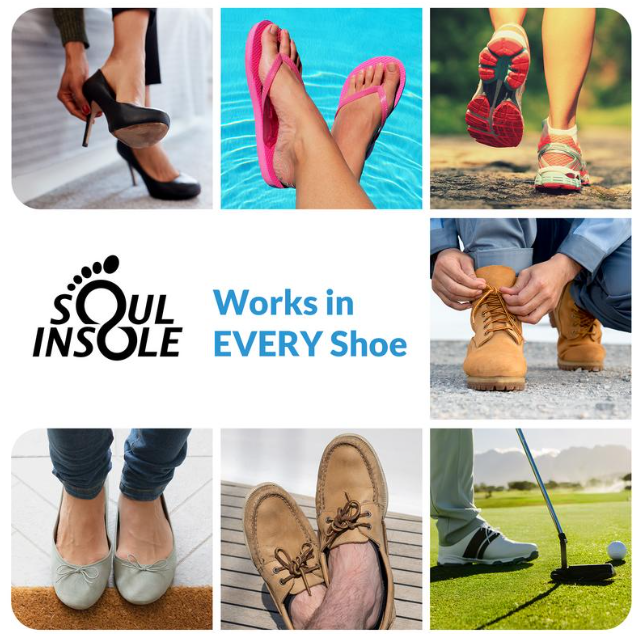
The company specifically markets the product for sneakers, boots, dress shoes, sandals and other footwear. The product’s small form factor gives that claim a logical design basis, although actual fit still depends on the shoe.
Relatively low entry price
At $29.99, the Max Support is less expensive than PowerStep Pinnacle at $54.95, while costing more than basic Dr. Scholl’s plantar-fasciitis orthotics currently listed around $17.96.
Soul Insole Cons
It is not a full-length cushioning insole
This is the biggest trade-off.
The same minimalist design that keeps the shoe less crowded also means you aren’t getting a full-length cushion beneath the entire foot.
If your main goal is heel cushioning, forefoot cushioning, or whole-foot shock absorption, a traditional full-length insole may be a better fit.
Adhesive performance depends on the shoe
Soul Insole explicitly acknowledges that some synthetic materials don’t hold the adhesive particularly well.
Limited independent product-specific clinical evidence
General research supports the use of orthoses for some foot-pain problems, including plantar-fasciitis pain, but that isn’t the same thing as a randomized clinical trial showing that this particular Soul Insole model produces all of the benefits advertised.
Marketing language is sometimes stronger than the evidence
Phrases such as immediate relief, preventing pain “for good,” correcting alignment and training the natural arch are strong claims. I would not treat them as guaranteed outcomes.
Is Soul Insole Worth It?
For the right use case, the value proposition is fairly straightforward.
You’re paying $29.99 for a compact support insert that is designed to add arch support without replacing the entire shoe footbed.
That can be a sensible proposition for someone whose main problem is limited shoe space.
It becomes less compelling when you’re comparing it with a full-length orthotic because the two products are solving different problems.
The bigger issue is expectations.
Soul Insole should not be approached as a guaranteed treatment for foot pain. The broader research around foot orthoses is encouraging in some circumstances, but it is not evidence that a particular gel insert will eliminate pain, correct a condition or work for every person.
What I Like
The most convincing part of Soul Insole isn’t the bold medical language on its sales pages.
It’s the product architecture.
A micro-size midfoot support solves a real consumer problem: some people need additional arch support but don’t want to completely change how their shoes fit.
That’s especially relevant for someone who rotates among several types of footwear.
The reusable adhesive system is also practical. The company provides explicit cleaning instructions and acknowledges the materials that can interfere with adhesion rather than pretending every shoe will behave identically.
The company itself is also reasonably traceable. There is an identifiable founder, a documented business history, an operating ecommerce store, public contact information and patent records associated with its orthotic technology.
What Concerns Me
The biggest issue isn’t whether the product exists. It clearly does.
It’s how much confidence buyers should place in the health claims.
Soul Insole markets the product for multiple conditions, yet the product-specific evidence I found is much thinner than the marketing language might suggest.
This distinction matters because foot pain has many potential causes.
A person with ordinary discomfort from prolonged standing may reasonably experiment with a non-prescription arch support. Someone dealing with persistent pain, recent foot surgery, significant swelling, numbness, or a diagnosed structural problem should not assume that a retail orthotic substitutes for appropriate medical evaluation.
Mayo Clinic advises seeking professional evaluation when symptoms persist or don’t improve with conservative treatment.
Soul Insole Price and Value
The current official orthotics collection lists:
| Product | Current listed price |
|---|---|
| Shoe Bubble Pro-Lite | $27.99 |
| Shoe Bubble Max Support | $29.99 |
| Instant Custom Soft Orthotic | $59.99 |
That creates an important value distinction.
$29.99 Shoe Bubble Max Support
You’re paying for compact, targeted support rather than a full-length cushion.
$27.99 Pro-Lite
The Pro-Lite is the thinner design. Soul Insole says it’s approximately two-thirds the thickness of the original/max-support design and is intended for gentler support or shoes that already have some support.
$59.99 Instant Custom Soft Orthotic
This is a completely different proposition: a full-length foam-based orthotic with built-in support plus two washable gel ramps that can be positioned for additional customization.
So a buyer should not compare $29.99 and $59.99 simply as two versions of the same product.
They solve different problems.
Shipping, Returns and Warranty
The current official store says orders are prepared and dispatched within 1–2 business days, with typical U.S. delivery in 2–5 business days. It also says U.S. orders over $35 qualify for free shipping.
The current official returns page says:
- 90-day money-back guarantee
- Return shipping is the customer’s responsibility
- Original purchase amount is reimbursed, excluding shipping
- Wrong-size exchanges are available, with the customer paying to ship the original back
- The company pays to ship the replacement size
What about a warranty?
I could verify the 90-day money-back guarantee, but I did not find a clearly stated, separate long-term product warranty on the current official pages I reviewed.
That distinction should be preserved in the article.
Is Soul Insole Legit?
Based on the evidence I could verify, there is substantial evidence that Soul Insole is a real operating brand rather than an anonymous product storefront.
The evidence includes:
- an established official ecommerce site,
- identifiable founder/CEO information,
- a documented company history,
- public customer-support contact details,
- a current catalog,
- patent records associated with Laina Gossman,
- and public third-party customer feedback.
There is also independent evidence that Soul Insole has operated as a small business in San Diego; Amazon’s own small-business spotlight previously listed Soul Insole among participating businesses.
That said, “legit company” and “proven medical treatment” are two different questions.
The public evidence supports the existence and traceability of the company and product. It does not establish that the strongest health claims on the sales pages are guaranteed for every customer.
What Do Soul Insole Reviews Say?
Public customer feedback is mixed, although the balance displayed on Trustpilot is strongly positive.
When recently crawled, Trustpilot showed approximately 400 reviews, a 4.7/5 TrustScore, 83% five-star reviews and 3% one-star reviews.
The written feedback includes reports of:
- improved arch support,
- easier ordering and delivery,
- satisfaction with different Soul Insole models,
- customers using multiple pairs for different shoes.
There are also negative reports. One U.S. reviewer described little pain relief following major foot surgery, while Soul Insole’s response pointed to its satisfaction guarantee.
That range is exactly why customer reviews should be treated as consumer experience evidence, not clinical proof.
There is also an important source-quality issue with the supplied reference material. One 2026 promotional story presents a dramatic first-person account of a farmer claiming major improvements after using Soul Insole. That’s useful as an example of how the product is marketed, but it is not independent clinical evidence and should not be presented as proof of effectiveness.
Soul Insole and “Consumer Reports”
I found no verified Consumer Reports test, rating or product review for Soul Insole during this research.
That means an article shouldn’t imply that Consumer Reports has endorsed, tested or ranked the product.
For readers specifically searching for “Soul Insole Consumer Reports,” the accurate answer is that I could not verify a Consumer Reports evaluation.
What Should You Check Before Ordering?
First, identify the exact Soul Insole model. “Soul Insole” can mean several products.
Second, check the size chart against the shoe you actually intend to use.
Third, look at the interior material of your shoes. Adhesion can vary.
Fourth, decide whether you need targeted arch support or full-length cushioning.
Fifth, review the refund terms at checkout because promotional pages can display different guarantee periods from the current main store. The current official returns page states 90 days.
Finally, if you’re purchasing because of significant or persistent pain rather than ordinary comfort concerns, consider whether you need medical advice rather than another consumer orthotic.
Where Can You Buy Soul Insole?
The official Soul Insole store is the clearest place to verify the current product, sizing, shipping and return terms.
Check the current Soul Insole offer:
View the current offer
Important buying note: the provided affiliate destination is an advertorial-style third-party page rather than the main Soul Insole product page. A currently indexed version of that advertorial presents a personal story and references a 60-day offer, while Soul Insole’s current official policy states 90 days. Verify the actual terms shown at checkout before relying on an offer mentioned in the advertorial.
Frequently Asked Questions About Soul Insole
Is Soul Insole worth it?
It depends on what you’re buying it for. Its compact design gives it a clear functional difference from traditional full-length insoles. It makes more sense for someone seeking targeted arch support than for someone wanting full-foot cushioning.
Does Soul Insole really work?
It can provide additional arch support and pressure redistribution, and customer feedback includes many positive experiences. But there is not enough product-specific clinical evidence to claim that Soul Insole will reliably relieve every type of foot pain. Broader research suggests foot orthoses can reduce plantar-fasciitis pain for some patients.
Is Soul Insole good for plantar fasciitis?
The manufacturer specifically markets the Shoe Bubble for plantar fasciitis.
Independent evidence suggests foot orthoses can reduce plantar-fasciitis pain, although results vary and orthoses should generally be viewed as one component of care rather than a guaranteed standalone treatment.
Is Soul Insole a scam?
The available evidence points to an established commercial brand rather than an anonymous storefront: the company has an official US site, a history dating back to its 2016 Kickstarter launch, and a substantial public customer-review history.
That doesn’t mean every marketing claim should automatically be accepted.
How do you use Soul Insole?
Clean the shoe area first, remove the protective film, place the adhesive side down where arch support is needed, and press it into place. For cleaning, Soul Insole recommends cool water and air-drying indoors.
Can Soul Insole be washed?
Yes. The manufacturer says the Shoe Bubble can be rinsed with cool water, allowed to air-dry and reused.
Does Soul Insole replace my existing insole?
Not necessarily. Soul Insole says its Shoe Bubble can be used with the existing shoe liner, either above or below it.
What size Soul Insole should I get?
Use the current size chart on the product page. When between sizes, the company generally recommends the smaller size.
How much does Soul Insole cost?
The current official price I verified for the Shoe Bubble Max Support is $29.99 per pair. The Pro-Lite is $27.99 and the Instant Custom Soft Orthotic is $59.99.
Where can I buy Soul Insole?
The most transparent purchasing route is the brand’s current official store at soulinsole.com. The company also has had products distributed through other retailers, but the official site gives the clearest current model, pricing and return information.
Is Soul Insole legit?
The evidence I found supports the existence of a real operating company, identifiable founder, product catalog, customer-support infrastructure and patent history. That does not mean every health claim has been independently proven.
What are the main drawbacks?
The Shoe Bubble doesn’t provide full-length heel-to-toe cushioning, adhesive performance depends partly on the shoe material, and the strongest pain-relief claims have less independent evidence than the marketing language suggests.
Does Soul Insole have a money-back guarantee?
The current official policy says 90 days. Customers are responsible for return shipping, and the original shipping charge is excluded from the reimbursement.
Is Soul Insole a full orthotic?
No. The Shoe Bubble is a compact arch-support insert. It does not provide the same full-foot coverage as a conventional full-length orthotic.
Who should avoid buying it?
Anyone expecting a small gel insert to replace diagnosis or treatment for persistent foot pain should reconsider. It is also a poor category match for someone specifically seeking full heel-to-toe cushioning or substantial structured support.
Final Verdict
Soul Insole is a real, established foot-support brand with a distinctive product design, and the Shoe Bubble Max Support is meaningfully different from the typical full-length insole.
Its strongest advantage is its small, midfoot-focused design, which can be attractive for footwear where conventional orthotics take up too much space.
Its other practical advantages include reusable adhesive, washable construction, three size ranges and a relatively modest $29.99 entry price.
The main drawback is equally clear: the product is not a conventional full-length cushion or a prescription orthotic, and the evidence available publicly does not justify treating all of Soul Insole’s health claims as established facts.
The broader research is encouraging about foot orthoses for some plantar-fasciitis pain, but it also shows that results vary and that orthoses should not automatically be treated as a stand-alone treatment.
So the most accurate way to frame Soul Insole is:
A specialized, compact arch-support product that may be worth considering for people who value low-profile support and footwear flexibility, but whose product-specific medical claims should be viewed more cautiously than the advertising suggests.
Before ordering, confirm the exact model, size, current price and return terms on the official store.