
Few things introduce unneeded stress to a morning commute or a family road trip quite like the sudden illumination of the Tire Pressure Monitoring System (TPMS) dashboard light. It usually happens at the most inconvenient moment-during a cold snap, miles away from a service station, or when you are already running late.
Relying on gas station air compressors has become increasingly problematic. Many are broken, out of service, or require exact change or digital micro-payments just to deliver a few minutes of weak airflow. A reliable portable tire inflator changes this dynamic entirely, shifting you from a position of vulnerability to one of complete self-reliance.
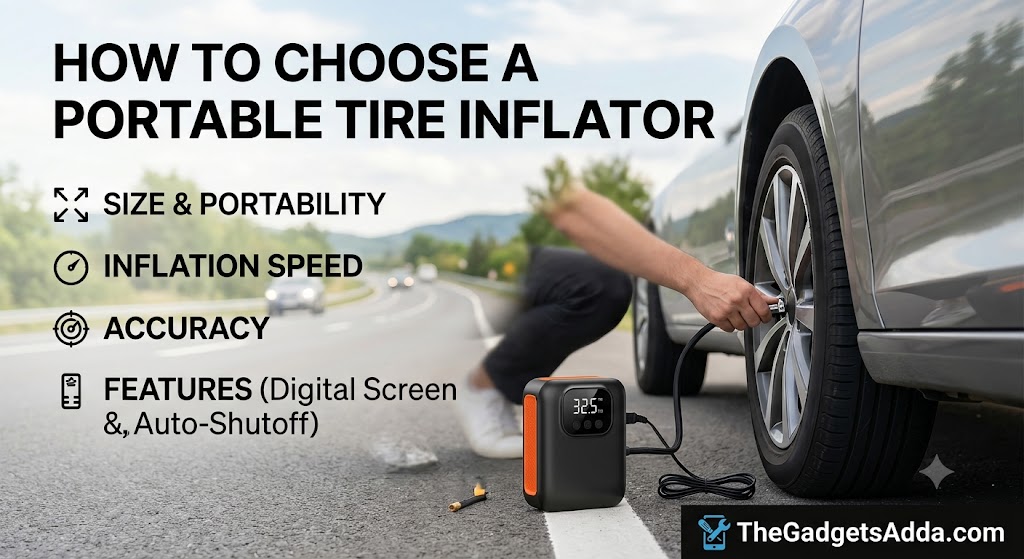
Selecting the right tool requires looking past the generic marketing claims printed on the box. Air compressors operate on basic mechanical and electrical principles. Understanding specs like duty cycles, air volume delivery, and power draw will ensure you do not end up with an underpowered device that overheats before inflating a single tire. This guide breaks down the technical details, practical limitations, and essential features to help you select an inflator that delivers when it matters most.
What Is a Portable Tire Inflator?
A portable tire inflator is a compact, self-contained air compressor engineered specifically to inflate vehicle tires, bicycle tires, sports equipment, and small inflatables. Unlike large workshop compressors that feature massive steel storage tanks and heavy induction motors, a portable inflator relies on a small electric motor, a reciprocating piston mechanism, and a compact cylinder to compress air on demand and drive it directly into the tire stem.
These devices bypass the need for an intermediate air storage tank. Because they compress air in real time and send it straight through the air hose, their performance is dictated entirely by the efficiency of their internal motor and the power supply feeding it.
Why Having Your Own Inflator Matters
Maintaining the correct tire pressure is not just about turning off a dashboard warning light; it directly affects vehicle safety, tire longevity, and fuel economy. According to the National Highway Traffic Safety Administration (NHTSA), driving on underinflated tires significantly compromises vehicle handling, increases braking distances, and elevates the risk of a catastrophic tire blowout due to excessive heat buildup.
- Fuel Efficiency: Underinflation increases the rolling resistance of your vehicle. For every 1 pound per square inch (PSI) drop in pressure across all four tires, fuel economy drops by roughly 0.2%. Correctly inflated tires keep your engine from working harder than necessary.
- Tread Wear: Operating a tire even 5 PSI below its recommended rating alters the tire’s contact patch with the road. This forces the outer shoulders of the tread to bear the weight, causing rapid, uneven wear that shortens the lifespan of the tire by thousands of miles.
- Emergency Preparedness: A slow leak from a nail or a sudden temperature drop can leave a tire flat overnight. Having a compact inflator in your trunk allows you to top off the tire safely in your driveway or on a highway shoulder, providing enough pressure to drive safely to a repair shop.
How Portable Tire Inflators Work
At the core of every portable tire inflator is a simple mechanical process. When the device is switched on, the electric motor spins a small crankshaft. This crankshaft drives a piston up and down inside a sealed cylinder.
During the downward stroke, the piston creates a partial vacuum, drawing ambient air into the cylinder through a one-way intake valve. On the upward stroke, the intake valve snaps shut, and the piston compresses the trapped air into a smaller volume. Once the pressure inside the cylinder exceeds the pressure inside the tire hose, a one-way discharge valve opens, forcing the pressurized air out through the air hose and into the tire valve stem.
Because compressing air generates substantial kinetic thermal energy, these small components get hot quickly. The absence of a large cooling fan or substantial metal heat-sinking means that portable units must balance air production with thermal dissipation.
Benefits and Limitations
Investing in a dedicated portable air compressor offers clear advantages, but it is equally critical to understand the mechanical constraints of these compact tools.
Key Benefits
- Unmatched Convenience: Check and adjust tire pressures at home, in a parking lot, or at a remote campsite without hunting down an operational gas station pump.
- Precision Management: Modern digital inflators allow you to set a precise target pressure. The unit shuts down automatically when it hits that metric, eliminating the guesswork of cheap stick gauges.
- Multi-Purpose Utility: Most portable models come packed with adapter nozzles, transforming them into tools capable of inflating high-pressure bicycle tires, camping mattresses, soccer balls, and roadside emergency rafts.
Mechanical Limitations
- Thermal Restrictions (Duty Cycle): Small portable inflators cannot run indefinitely. Most compact 12V units have a 10% to 20% duty cycle, meaning they can only run continuously for 10 to 15 minutes before requiring an equal or greater amount of off-time to cool down.
- Reduced Inflation Speed: Compared to a massive garage compressor with a 20-gallon storage tank, a portable unit takes longer to fill a tire from scratch. Topping off 5 PSI takes a minute or two; seating a bead or filling a completely flat truck tire can take 8 to 15 minutes.
- Power Constraints: Cordless battery units depend entirely on their charge level. If left in a freezing trunk for months, the battery may self-discharge, leaving you without power when an emergency strikes.
Types of Portable Tire Inflators
Portable inflators are generally categorized by how they receive electrical power. Each configuration has distinct advantages and trade-offs that make it ideal for specific vehicular applications.
12V DC Powered (Cigarette Lighter Plug)
These models plug directly into your car’s auxiliary 12V DC power outlet. They are the classic roadside safety tool.
| Pros | Cons |
| Never runs out of battery power as long as your vehicle’s engine is running. | Limited by the length of the power cord; reaching the rear tires of long trucks or trailers can be difficult. |
| Highly affordable and boasts an exceptionally long shelf life in a trunk. | Limited amperage draw (typically capped at 10A to 15A) restricts the size and speed of the motor. |
Cordless Lithium-Ion (Battery Powered)
Handheld, battery-operated units that mirror the form factor of modern power tools. They rely on internal or detachable rechargeable lithium-ion packs.
| Pros | Cons |
| Complete physical freedom with no wires to untangle or stretch around the vehicle. | Batteries lose efficiency and charge capacity when exposed to extreme summer heat or winter cold in a trunk. |
| Incredibly fast setup and highly portable for cyclists and motorcyclists. | Once the battery dies, the tool is useless until plugged into a wall charger or alternative source for hours. |
Dual-Power / Hybrid (12V DC + Lithium-Ion or 120V AC)
These versatile inflators give you options, featuring both an internal rechargeable battery and a backup 12V power cord, or a 120V AC residential wall plug.
| Pros | Cons |
| Maximum flexibility; use battery power for quick checks, or fall back on the 12V cord if the battery drains. | Notably larger, heavier, and more expensive than single-source alternatives. |
| Can be used inside a home garage via a wall outlet or on the road via the car battery. | More moving parts and circuitry present a slightly higher risk of long-term component failure. |
Core Features to Evaluate Before Buying
To find an inflator that matches your specific vehicle profile, you need to weigh several mechanical metrics. Avoid focusing solely on maximum pressure numbers; look instead at how the tool moves air under load.
1. PSI vs. CFM: The Real Performance Indicators
Marketing materials frequently place a massive “150 PSI” sticker on the box. While maximum pressure (PSI, or Pounds per Square Inch) matters for high-pressure bicycle tires that require 80 to 110 PSI, it is mostly a distraction for standard passenger cars. Most car tires sit between 30 and 35 PSI; large truck tires typically range from 50 to 80 PSI.
The metric that dictates how fast your tire fills is CFM (Cubic Feet per Minute) or LPM (Liters per Minute), which measures the volume of air the pump delivers.
- A cheap, low-CFM pump might offer 150 PSI max pressure but deliver only 0.5 CFM. It will take 10 agonizing minutes to fill a standard sedan tire.
- A heavy-duty portable pump delivering 1.5 to 2.5 CFM will fill that same tire in less than two minutes because it moves a far larger volume of air with every stroke of the piston.
2. Duty Cycle and Heat Management
The duty cycle represents the percentage of time a compressor can operate within a specific period (usually calculated over a 60-minute window) before it must stop to cool down.
- 10% Duty Cycle: Can run for 6 minutes, needs 54 minutes of cooling. Common in lightweight, budget-tier handheld inflators.
- 33% Duty Cycle: Can run for 20 minutes continuously before needing 40 minutes of rest. Found in mid-tier and high-quality 12V compressors.
- 100% Duty Cycle: Can run continuously at a specific pressure and temperature without stopping. Reserved for high-end, hard-mounted overlanding systems.
If you drive a large SUV, a commercial van, or a heavy pickup truck with 33-inch or larger tires, a low-duty-cycle pump will overheat and trigger its thermal shutdown before you finish inflating a single flat tire.
3. Pressure Gauge Accuracy and Display Types
An inaccurate gauge can cause you to unintentionally overinflate your tires, leading to a harsh ride and compromised braking grip.
Digital gauges are generally preferred for modern consumer inflators, provided they carry an accuracy rating within $\pm1 \text{ PSI}$.
4. Hose and Power Cord Length
A portable inflator is useless if it cannot reach your valve stem. If you choose a 12V DC model plugged into the dashboard, measure your vehicle’s wheelbase. A compact sedan can easily manage with a 9-foot cord and a 2-foot air hose. A long-bed crew-cab pickup truck or a dual-axle travel trailer will require at least a 15- to 20-foot power cord combined with an extended, heavy-duty rubber air hose.
5. Valve Connectors: Screw-On vs. Quick-Connect
How the hose attaches to your tire valve matters during extreme weather conditions:
- Screw-On Connectors: Thread directly onto the brass threads of your tire’s Schrader valve. They create an airtight seal that will not pop off under high pressure, but you will invariably lose a tiny bit of air as you unscrew the connector.
- Quick-Connect (Thumb-Lock) Levers: Clamp down instantly over the valve stem. They are exceptionally fast to attach and detach, but cheaply made plastic levers can leak air or wear out over time.
Common Mistakes to Avoid When Choosing
Selecting the wrong tool usually stems from prioritizing a low price tag over mechanical realities. Avoid these common missteps during your search:
- Buying for a Truck Based on a Car’s Specs: Heavy-duty truck tires require sustained volume under pressure. Buying a tiny, budget pocket inflator designed for a commuter hatchback and expecting it to inflate a light-truck (LT) tire will result in a burned-out motor.
- Ignoring the Fuse Amperage Rating: High-volume 12V DC inflators pull significant current, often around 15 amperes (A). Many older passenger cars feature auxiliary outlets fused at only 10A. Plugging in a powerful 15A compressor will instantly blow your car’s interior fuse. Always verify your vehicle’s outlet capacity or choose an inflator that connects directly to the battery terminals via heavy-duty alligator clips.
- Neglecting Battery Maintenance: Purchasing a cordless model and tossing it into the trunk for a year without checking its charge level is a recipe for failure. Lithium-ion batteries naturally lose voltage over time and degrade faster when subjected to freezing or boiling trunk temperatures.
Step-by-Step Guide: How to Assess and Select Your Ideal Inflator
To narrow down the massive sea of online options, follow this logical evaluation sequence based on your specific automotive reality.
1.Check Your Tire Sidewall Markings:Step 1.
Look at the sidewall of your vehicle’s tires to find the maximum cold inflation pressure (e.g., 35 PSI, 50 PSI, or 80 PSI). Check the placard inside the driver’s door jamb for the manufacturer’s recommended operational pressure. This establishes your baseline target performance.
2.Determine Your Power Source Constraints:Step 2.
Decide if you want the wire-free simplicity of lithium-ion or the endless run-time of a 12V DC plug. If opting for 12V DC, check your vehicle manual to see if your internal outlets support a 15A draw. If capped at 10A, look for a unit that hooks directly to your battery terminals.
3.Evaluate Required Hose and Cord Reach:Step 3.
Measure from your dashboard power outlet to your rear tires. Ensure the combined length of the DC power cord and the flexible air hose exceeds this total distance by at least 2 to 3 feet to prevent excessive stretching or tipping the unit over.
4.Match CFM and Duty Cycle to Tire Size:Step 4.
For compact cars, a 0.5 to 1.0 CFM pump with a 10-minute duty cycle is perfectly adequate. For midsize SUVs or minivans, aim for 1.0 to 1.5 CFM. For large trucks, commercial vans, or RVs, do not consider anything below 1.5 CFM with at least a 33% duty cycle.
Best Practices and Expert Tips for Field Use
Owning the tool is only half the battle; knowing how to deploy it safely and efficiently ensures a long service life for both the tool and your vehicle’s electrical system.
- Keep Your Vehicle Engine Running: When operating a 12V DC inflator, always start your vehicle’s engine first. Running a high-draw air compressor solely on accessory power can quickly drain your car’s starter battery, leaving you with full tires but a dead engine. Furthermore, an alternator increases system voltage to roughly $14.2 \text{ V}$, allowing the compressor motor to run faster and cooler than it would on a static $12.6 \text{ V}$ battery charge.
- Let It Rest (Respect the Duty Cycle): If your compressor feels excessively hot to the touch or if you have been running it continuously for 10 minutes, shut it down and give it a full 10-minute break. Running a small motor past its thermal limits degrades the internal piston seals, permanently lowering its output efficiency.
- Set the Pressure “Cold”: Tire pressure specifications are calculated for “cold” tires—meaning the car has been parked for at least three hours or driven less than a mile. Driving generates heat, which expands the air inside the tire and artificial raises the pressure reading by 3 to 5 PSI. If you must add air to hot tires, inflate them 3 to 4 PSI above the door placard recommendation, then verify the reading the following morning before driving.
Real-World Scenarios and Contextual Examples
To visualize how these technical metrics translate to everyday operation, consider these three distinct use cases:
Scenario A: The Daily Commuter
- Vehicle: Compact sedan or crossover (tire size: 205/55R16, running at 32 PSI).
- Optimal Match: A handheld cordless lithium-ion inflator or a budget-friendly 12V plug-in model delivering 0.8 CFM.
- Why it works: The volume of air inside a small passenger tire is relatively low. Top-offs require less than 90 seconds per tire, meaning the unit will never approach its thermal duty cycle limit. The compact size allows it to fit neatly under the seat or in a spare tire well.
Scenario B: The Family Road-Tripper and Boat Tow-Vehicle
- Vehicle: Full-size SUV or half-ton pickup truck (tire size: 275/65R18, running at 35 to 50 PSI), occasionally towing a utility trailer.
- Optimal Match: A heavy-duty dual-power (hybrid) inflator or a robust 12V unit that connects directly to the vehicle battery terminals via alligator clips, delivering at least 1.5 CFM.
- Why it works: Pulling air straight from the battery avoids blowing fragile interior dashboard fuses. A higher CFM output ensures that adjusting pressures across large vehicle tires and trailer tires does not turn into an hour-long ordeal on the side of an interstate.
Scenario C: The Dedicated Backcountry Overlander
- Vehicle: Lifted 4×4 truck or SUV with 35-inch all-terrain tires (running at 15 PSI off-road for traction, needing re-inflation to 45 PSI for highway travel).
- Optimal Match: A high-output portable compressor housed in a rugged utility case, pulling 2.5+ CFM with a 33% to 45% duty cycle.
- Why it works: “Airing up” four massive, deflated off-road tires requires moving a colossal volume of air against building resistance. A standard consumer-grade pump would overheat and fail before completing two tires. A heavy-duty overlanding unit can handle the prolonged thermal load without breaking a sweat.
Key Takeaways
- Prioritize Volume (CFM) Over Maximum Pressure (PSI): High PSI ratings look impressive on retail packaging, but volume delivery dictates how quickly your tires will actually fill.
- Match the Tool to Your Tire Mass: Large tires require robust duty cycles. Do not cut corners with a pocket-sized handheld unit if you drive a full-size truck or large SUV.
- Check Your Car’s Fuse Capacity: Ensure your vehicle’s 12V accessory port can safely handle the amperage draw of your chosen compressor to avoid blowing fuses during a roadside emergency.
- Keep the Engine Humming: Always run your vehicle’s engine while operating a plug-in compressor to maximize performance and protect your car battery from draining.
Frequently Asked Questions
What is a good CFM rating for a portable tire inflator?
For standard passenger cars and small crossovers, a CFM rating between 0.8 and 1.2 is highly efficient. If you are inflating large truck tires, off-road setups, or RV tires, seek an inflator with a CFM rating of 1.5 to 2.5 to avoid prolonged inflation times and overheating.
Can a portable tire inflator charge a dead car battery?
No. A portable tire inflator contains only an air compressor mechanism and its associated power electronics. It cannot jump-start or charge a car battery. If you want a multi-functional emergency tool, look for a combination jump-starter pack that features an integrated air compressor circuit.
How long does it take a portable inflator to fill a completely flat tire?
Inflation time depends heavily on the tire’s total volume and the compressor’s CFM rating. A standard sedan tire can typically be filled from 0 to 32 PSI in roughly 3 to 5 minutes with a standard 12V unit. A massive truck or SUV tire can easily take 8 to 15 minutes to fill completely from a flat state.
Why does my tire inflator get incredibly hot during use?
Air compression naturally generates heat as molecules are forced into a smaller space. Additionally, friction from the internal piston moving rapidly inside the cylinder creates substantial thermal energy. This is entirely normal behavior, which is why observing the manufacturer’s specified duty cycle is critical.
Can I use a portable tire inflator for bike tires?
Yes, almost all portable inflators can accommodate bicycle tires. Most come equipped with an adapter kit containing a Presta valve adapter alongside standard sports ball needles. Because bike tires hold a small volume of air at relatively high pressures, digital models with auto-shutoff features are recommended to prevent overinflation.
Should I choose a digital or analog pressure gauge?
Digital gauges are generally superior for consumer roadside use. They offer backlighting for nighttime visibility, show precise fractional readings, and support auto-shutoff thresholds. Analog dial gauges are rugged and require no battery power, but they can be difficult to read accurately down to the individual PSI.
How long will a cordless tire inflator hold its charge in a cold trunk?
Most lithium-ion cordless inflators will lose roughly 3% to 5% of their charge per month through natural self-discharge. However, exposure to extreme winter freezing can accelerate temporary capacity drops. It is best practice to bring cordless units indoors to check and top off their charge cycle every 3 to 4 months.
Is it safe to operate an air compressor in rain or snow?
Standard portable tire inflators are rarely waterproof. Operating them in heavy rain or standing snow introduces a risk of shorting out internal electronics or drawing moisture into the intake valve. If you must use the device in inclement weather, position the compressor unit inside the vehicle cabin or under the cover of an open door or hood while routing the air hose outside to the tire.
What is the difference between an air compressor and a tire inflator?
A tire inflator is simply a specialized subcategory of air compressors. While industrial air compressors use large motors to store immense amounts of pressurized air inside a structural tank for pneumatic tools, a portable tire inflator is a tankless system built to deliver continuous, lower-volume air straight to a tire valve stem.
Can a portable tire inflator be used to inflate air mattresses or pool floats?
Yes, provided you use the wide plastic adapter nozzles included with the unit. However, because tire inflators are engineered for high pressure rather than high volume, filling a massive family camping mattress can take quite a while. For large pool toys, a dedicated low-pressure high-volume air pump is often a faster alternative.
Final Verdict
Selecting the perfect portable tire inflator comes down to respecting the relationship between air volume and electrical power. For light passenger vehicles and daily neighborhood commuting, a compact cordless model offers exceptional speed and convenience. However, if your vehicle profile includes full-size trucks, heavy towing applications, or off-road exploration, prioritizing a hardwired 12V battery-clamp connection with a robust CFM delivery rating is the most reliable way to handle roadside emergencies. Take the time to audit your vehicle’s specifications before purchasing, and you will secure a critical safety tool that performs flawlessly whenever called upon.
If you are ready to assemble a complete safety kit for your vehicle, consider exploring our hands-on product reviews and real-world testing updates to see which specific tools earned top spots for speed, accuracy, and thermal longevity in the field.