Every day, the average adult breathes in roughly 11,000 liters of air. While we are highly conscious of the quality of the water we drink and the food we eat, the air inside our homes rarely receives the same scrutiny. Yet, modern residential construction is designed to be airtight for energy efficiency, which unintentionally seals in a concentrated cocktail of airborne particles, volatile organic compounds (VOCs), pet dander, mold spores, and outdoor pollution that migrates indoors.
Navigating the market for an air purifier can feel overwhelming. The industry is saturated with dense marketing acronyms, conflicting performance metrics, and wildly varying price points. A unit that works perfectly for a small home office will fail completely in an open-concept living room, while an unvetted technology could introduce secondary pollutants like ozone into your breathing space.
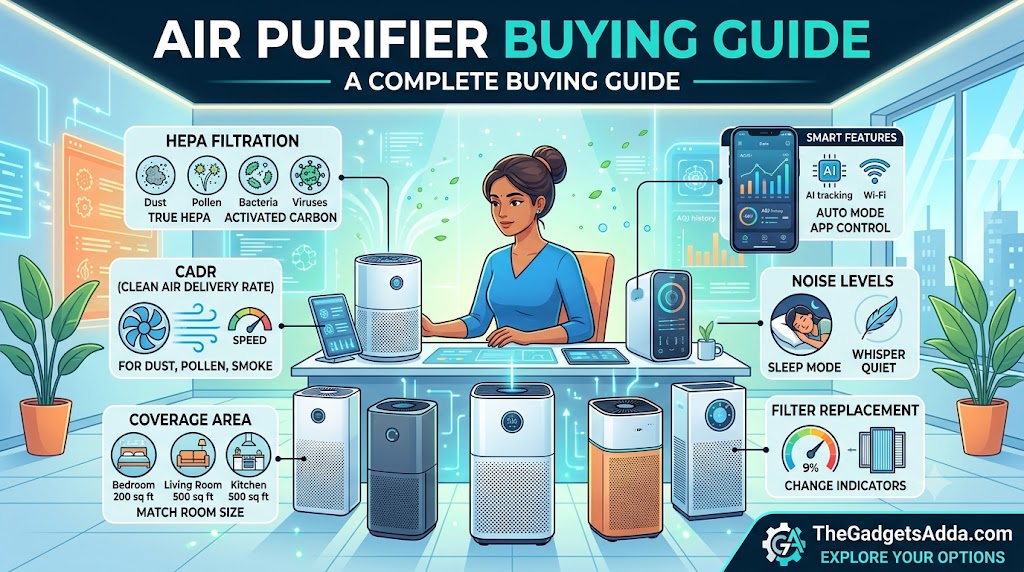
This guide strips away the marketing hype to provide a clear, evidence-based framework for selecting an air purifier. You will learn the mechanical engineering principles behind high-efficiency particulate air (HEPA) filtration, how to calculate the precise CADR (Clean Air Delivery Rate) your space requires, and how to balance upfront costs against long-term filter replacements.
What Is an Air Purifier?
An air purifier is a portable or stationary household appliance engineered to remove microscopic contaminants from the air within a designated indoor space. Unlike standard HVAC furnace filters, which primarily exist to protect the heating and cooling machinery from large dust clumps, a dedicated air purifier utilizes an integrated fan system to continuously pull ambient air through specialized, high-density filtration media designed to capture sub-micron particles and gas-phase pollutants.
Why Indoor Air Quality Matters
The U.S. Environmental Protection Agency (EPA) reports that indoor air can be two to five times more polluted than outdoor air. For individuals who spend up to 90% of their lives indoors, this atmospheric load presents a direct impact on respiratory health, sleep quality, and long-term systemic well-being.
The primary culprit is particulate matter, specifically PM2.5-particles less than 2.5 micrometers in diameter. These particles are small enough to bypass the human respiratory system’s natural filtration defenses, traveling deep into the lungs and entering the bloodstream. Common indoor sources include:
- Combustion byproducts: Cooking, wood-burning fireplaces, and candles.
- Biological allergens: Dust mite feces, pet dander proteins, mold spores, and pollen.
- Chemical off-gassing: Formaldehyde, benzene, and toluene evaporating from synthetic carpets, engineered wood furniture, paints, and common household cleaners.
How Air Purifiers Clean the Air
Mechanical air purification relies on fluid dynamics and structural particle capture. A motorized fan creates a localized low-pressure zone, drawing air into the unit. The air is forced through a series of increasingly dense physical barriers before being expelled back into the room.
True HEPA filters do not act like simple kitchen strainers where particles larger than the holes get stuck. Instead, they leverage three distinct microscopic mechanisms governed by the physics of aerosol dynamics:
1. Interception
Mid-sized particles traveling in the air stream follow the path of least resistance around the glass fibers of the filter. If the particle passes within one particle radius of a fiber, it makes contact and becomes permanently trapped by natural adhesive forces.
2. Inertial Impaction
Larger, heavier particles possess too much momentum to navigate the twisting paths around the filter fibers. They travel in a straight line, crash directly into the structural grid of the filter medium, and remain embedded.
3. Diffusion
The smallest particles (under 0.1 microns) do not travel smoothly; they are violently buffeted by gas molecules in a random, zig-zag pattern known as Brownian motion. This erratic movement dramatically increases the probability that these tiny particles will wander into a filter fiber and stick to it.
Benefits and Limitations of Air Purifiers
To make an informed purchase, you must understand exactly what an air purifier can and cannot achieve. Setting realistic expectations prevents buyers from experiencing post-purchase dissatisfaction.
Documented Benefits
- Substantial Reduction in Allergy and Asthma Triggers: By continuously removing airborne pollen, pet dander, and mold spores, purifiers lower the allergen load that triggers immune responses.
- Mitigation of Seasonal Smoke Hazards: During wildfire events, a high-quality HEPA filter is highly effective at capturing dangerous PM2.5 smoke particles.
- Gas and Odor Neutralization: Units equipped with heavy, pelletized activated carbon can break down chemical fumes, cooking smells, and volatile compounds.
Structural Limitations
- No Impact on Settled Dust: Air purifiers can only clean particles that are actively suspended in the air. Heavy dust, pet hair, and dust mites that have already settled into carpets, mattresses, and furniture fabrics will remain there until physically vacuumed or washed.
- No Fresh Oxygen Production: Air purifiers recirculate and clean existing air; they do not remove carbon dioxide ($CO_2$) or introduce fresh outdoor oxygen.
- Ineffective Against Structural Microbes: If you have active mold growing behind your drywall due to a plumbing leak, an air purifier will catch the airborne spores, but it cannot cure the root cause of the structural mold infestation.
Types of Air Purification Technologies
Different filter types target completely different categories of pollutants. A high-performing unit typically layers multiple technologies together.
| Filter Type | Primary Target | Mechanism | Lifespan |
| Pre-Filter | Hair, large dust clumps, insect debris | Coarse mesh (nylon or foam) | Washable or 6 months |
| True HEPA | PM2.5, pollen, mold spores, bacteria | Dense fiberglass mat | 12 to 18 months |
| Activated Carbon | VOCs, smoke odors, chemical fumes | Porous carbon surface adsorption | 6 to 12 months |
| PECO / PCO | Viruses, bacteria, gaseous chemicals | Photo-electrochemical molecular breakdown | 6 months |
Mechanical HEPA Filters
The gold standard of particle removal is the True HEPA filter. According to the Department of Energy standard, a True HEPA filter must capture at least 99.97% of particles as small as 0.3 micrometers.
Technical Insight: The 0.3-micron size is used for testing because it represents the Most Penetrating Particle Size (MPPS). Particles both larger and smaller than 0.3 microns are actually easier for the filter to trap due to the mechanisms of impaction and diffusion described earlier.
When looking at HEPA filters, pay attention to European Standard EN 1822 classifications:
- E11 / EPA 11: Captures greater than 95% of particles (often marketed as “HEPA-type” or “HEPA-like”). Avoid these for severe allergies.
- H13 True HEPA: Captures greater than 99.95% of particles. This is the consumer benchmark for premium performance.
- H14 Medical Grade HEPA: Captures greater than 99.995% of particles. Typically found in cleanrooms and clinical settings.
Gas-Phase Carbon Filters
HEPA filters are completely blind to gases, odors, and chemical VOCs because those molecules are thousands of times smaller than the gaps in a HEPA matrix. To tackle these, you need Activated Carbon.
Carbon is treated with oxygen to open millions of microscopic pores between the carbon atoms, drastically increasing its surface area. A single gram of activated carbon can have a surface area exceeding 32,000 square feet. Gaseous pollutants stick to this surface via physical adsorption.
- Warning: Many budget air purifiers use a thin, carbon-coated fibrous sheet that looks like a black mesh sponge. These contain mere grams of carbon and saturate within weeks, rendering them useless for gas removal. Look for units containing pounds of solid, pelletized activated carbon if you need serious odor or chemical remediation.
Electronic Technologies (Ionizers and Electrostatic Precipitators)
These units pass air through an electrical charging zone, imparting a negative or positive charge to passing particles. These charged particles then stick to oppositely charged metal plates inside the machine, or they clump together in the air and fall onto your floors and furniture.
- The Risk: These systems naturally produce ozone ($O_3$) as a structural byproduct of air ionization. Ozone is a known lung irritant that can exacerbate asthma and damage delicate lung tissue. Ensure any electronic unit is certified by the California Air Resources Board (CARB) as ozone-safe (producing less than 0.05 parts per million).
Key Performance Features to Evaluate
When evaluating individual models, ignore design aesthetics and focus entirely on verified operational metrics.
Clean Air Delivery Rate (CADR)
Developed by the Association of Home Appliance Manufacturers (AHAM), CADR measures the volume of filtered air an atmospheric purifier delivers per minute, expressed in cubic feet per minute (CFM). A unit will have three distinct CADR numbers:
- Smoke (Smallest particles: 0.09 to 1.0 microns)
- Dust (Medium particles: 0.5 to 3.0 microns)
- Pollen (Large particles: 5 to 110 microns)
Always size your machine based on the Smoke CADR, as it represents the toughest filtration test.
Air Changes per Hour (ACH)
ACH defines how many times the air purifier can cycle the total volume of air in a specific room through its filtration bank in exactly 60 minutes.
- For general health: Look for 4x ACH (the air is cleaned every 15 minutes).
- For severe allergies or respiratory vulnerability: Aim for 5x to 6x ACH.
Noise Generation (Decibels)
Air purifiers are designed to run continuously. If a unit sounds like a jet engine on its high setting, you will inevitably turn it down to its lowest, least-effective speed or switch it off entirely.
- Look for specifications: Measured in decibels (dB). A quiet bedroom unit should operate between 20 to 30 dB on low speed (comparable to a whisper) and stay below 50 to 55 dB on its maximum performance setting.
Common Sizing and Operational Mistakes
Even the most advanced air purifier will fail if deployed improperly. Avoid these critical missteps:
- Buying Based on Room Square Footage Alone: Manufacturers often print inflated room-size ratings on boxes (e.g., “Cleans up to 1,000 sq. ft.”). This claim often assumes only 1 or 2 Air Changes per Hour, which is insufficient for real-world pollutant mitigation. Always use the CADR mathematical formula.
- Running the Unit on “Auto” Mode Constantly: Many modern machines feature integrated laser particle sensors that adjust fan speed based on detected air quality. While convenient, these budget sensors are prone to dust blinding and only test a tiny pocket of air directly next to the machine. It is often far more effective to set the unit manually to the highest non-disruptive speed.
- Shoving the Purifier into a Corner or Behind Furniture: Air purifiers require 360-degree clearance to establish an effective convective air circulation loop across the entire room. Placing a unit tight against a wall or behind a couch chokes its air intake, causing it to repeatedly re-filter the same small pocket of localized air.
Step-by-Step Guide: How to Calculate Your Precise Sizing Needs
To find the minimum CADR required for your room, execute this straightforward mechanical engineering calculation.
Step 1: Calculate Room Volume
Measure the total floor square footage of your targeted room and multiply it by the absolute ceiling height to calculate the cubic volume.
$$\text{Width (ft)} \times \text{Length (ft)} = \text{Floor Area (sq ft)}$$
$$\text{Floor Area (sq ft)} \times \text{Ceiling Height (ft)} = \text{Total Room Volume (cubic feet)}$$
Example: A bedroom measuring $15 \text{ ft} \times 15 \text{ ft}$ with standard $8\text{-foot}$ ceilings yields a total floor space of $225 \text{ sq ft}$ and a volume of $1,800 \text{ cubic feet}$.
Step 2: Determine Required Total Hourly Airflow
Multiply your total room volume by your target Air Changes per Hour (the clinical standard for allergen control is 5).
$$\text{Room Volume} \times 5\text{ (ACH)} = \text{Required Hourly Airflow (cubic feet per hour)}$$
$$1,800 \times 5 = 9,000 \text{ cubic feet per hour}$$
Step 3: Convert to Clean Air Delivery Rate (Cubic Feet per Minute)
Because CADR metrics are globally calculated in minutes rather than hours, divide your hourly total by 60.
$$\frac{\text{Hourly Airflow}}{60} = \text{Minimum Required Smoke CADR}$$
$$\frac{9,000}{60} = 150 \text{ CFM}$$
The Quick “Rule of Two-Thirds”: If you have standard 8-foot ceilings, an easier shorthand is to ensure the Smoke CADR rating of your chosen unit is equal to at least two-thirds ($\frac{2}{3}$) of the room’s total floor area. For our $225 \text{ sq ft}$ room: $225 \times 0.66 = 150 \text{ CADR}$.
Maintenance Best Practices and Total Cost of Ownership
The initial purchase price of an air purifier is often only a fraction of its true multi-year operating cost. Before purchasing, verify the long-term overhead variables.
+-------------------------------------------------------------------------+
|                  Total Cost of Ownership (TCO) Components               |
+-------------------------------------------------------------------------+
|                                                                         |
|  [ Upfront Unit Cost ] + [ Annual Filter Cost ] + [ Energy Consumption ] |
|                                                                         |
|          |                        |                       |             |
|          v                        v                       v             |
|     Initial Outlay          H13 HEPA: $40-$90       Continuous Run:     |
|                             Carbon Pellets: $30+    30W-90W (~$30/yr)   |
|                                                                         |
+-------------------------------------------------------------------------+
Pre-Filter Maintenance
Vacuum or wash your coarse pre-filter every 2 to 4 weeks. Keeping this layer clean prevents large dust blankets from choking the system’s airflow and protects the delicate, expensive HEPA filter underneath from premature clogging.
HEPA Replacement Schedules
Never wash a True HEPA filter unless it is explicitly labeled by the manufacturer as a specialty washable material (which is rare and generally less effective). Water collapses the microscopic glass fiber matrix, permanently destroying its filtration capabilities. Replace these filters strictly according to the run-time indicator, typically every 12 to 18 months.
Energy Assessment
Because purifiers should run continuously, evaluate their electrical draw. Look for models with an Energy Star certification. A typical high-efficiency unit draws between 30 to 80 watts on high speed, which translates to roughly $15 to $40 per year in electricity costs, depending on local utility rates.
Real-World Deployment Scenarios
To help contextualize these technical guidelines, let’s explore three typical residential profiles and the specific equipment configurations they require.
Scenario A: The Urban Allergy and Asthma Sufferer
- The Environment: A downtown apartment located near a major roadway intersection, dealing with high baseline traffic soot ($PM2.5$) and seasonal pollen. The occupant experiences chronic dust mite and pollen allergies.
- The Target Solution: A mechanical unit focusing on structural H13 True HEPA density over gas filtration. The unit must deliver at least 5x ACH to suppress airborne allergen triggers during high-pollen seasons. A programmable timer is ideal so the unit can run on high while the occupant is at work and drop to a quiet whisper mode for sleep.
Scenario B: The Multiple-Pet Household
- The Environment: A suburban home with two dogs and a cat. The primary air quality issues are coarse animal hair, microscopic dander proteins suspended in the air, and persistent pet odors.
- The Target Solution: A machine equipped with a robust, easily accessible, and vacuum-washable mesh pre-filter to capture hair before it clogs the interior core. This must be paired with an activated carbon bed containing at least two pounds of actual pelletized carbon to actively adsorb complex organic pet odors, backed by a standard True HEPA layer for dander capture.
Scenario C: The Wildfire-Prone Region
- The Environment: A home in the Pacific Northwest or Mountain West experiencing heavy, concentrated seasonal wildfire smoke events that force residents to seal all doors and windows for weeks.
- The Target Solution: A high-capacity, heavy-duty air purifier with an exceptionally high CADR score (300+ CFM) designed to rapidly scrub heavy smoke concentrations. Because smoke consists of both hazardous ultra-fine particulate matter and chemical gases (like acrolein and formaldehyde), a hybrid configuration featuring a thick H13 or H14 HEPA filter paired with a substantial activated carbon filter is mandatory.
Summary Checklist for Buyers
Before checking out or entering your payment information, verify that your selected unit meets these absolute criteria:
- [ ] True HEPA Validation: The product documentation explicitly states “True HEPA” or “H13 HEPA” with a 99.97% or 99.95% efficiency rating. Avoid vague terms like “HEPA-type,” “HEPA-like,” or “cleanable filter.”
- [ ] Verified CADR Rating: The Smoke CADR value is clearly published and verified by AHAM or independent testing, matching or exceeding the two-thirds rule for your target room’s square footage.
- [ ] Absence of Secondary Pollutants: The unit is confirmed to be an ozone-free mechanical filtration system, or carries an official CARB certification clearing it of harmful ozone generation emissions.
- [ ] Transparent Filter Costs: Replacement filters are readily available from the manufacturer or reputable third-party suppliers, and their annual replacement cost aligns comfortably with your household maintenance budget.
- [ ] Low-Noise Profile: The low and medium fan settings operate at decibel outputs well under 35 dB, ensuring the unit can run without disrupting your sleep or remote work calls.
Key Takeaways
- Prioritize Mechanical Filtration: Look for a verified H13 True HEPA filter combined with an activated carbon filter as the foundational baseline for safe, dependable air cleaning.
- Sizing Rules Are Absolute: Do not rely on loose marketing descriptions for room size. Calculate your room’s cubic volume and match it to a verified Smoke CADR rating using a baseline target of 4 to 5 Air Changes per Hour.
- Chemicals Require Carbon: If your primary concerns are household odors, chemical fumes, or VOCs, a thin carbon-coated sheet is ineffective. You require heavy, pelletized activated carbon to successfully adsorb gas-phase pollutants.
- Account for Total Lifetime Costs: Factor the recurring annual costs of filter replacements and electricity into your initial buying decision to ensure the long-term sustainability of your indoor air cleaning system.
Frequently Asked Questions
What is the difference between a HEPA-type filter and a True HEPA filter?
A True HEPA filter is certified to capture at least 99.97% of particles down to 0.3 microns in size. A “HEPA-type” or “HEPA-like” filter is a marketing designation for a lower-grade material that usually captures only 85% to 95% of particles, letting many dangerous sub-micron pollutants pass through freely.
Can I leave my air purifier running 24 hours a day?
Yes. Air purifiers are explicitly designed, engineered, and safety-tested to run continuously. Because indoor air quality constantly degrades due to skin shedding, dust movement, and outdoor infiltration, turning the machine off allows air pollution levels to return to baseline levels within a few hours.
Where is the best place to position an air purifier in a bedroom?
Place the air purifier at least 6 to 18 inches away from walls and large furniture items to ensure its intake vents are unhindered. For maximum personal benefit, position the unit within 3 to 6 feet of the head of your bed, allowing clean, filtered air to circulate through your breathing zone while you sleep.
Does an air purifier remove dust mites and bedbugs?
An air purifier cannot eliminate an active bedbug infestation or remove dust mites buried deep inside mattresses and carpets. It can, however, capture the microscopic dust mite feces and body fragments that break loose and become airborne when you change bedding or vacuum.
How do I know when it is time to change my filters?
Most modern purifiers feature an internal electronic filter replacement indicator light based on cumulative runtime hours. Visually inspect your filter every few months; if the outer pre-filter layer looks caked in a gray layer of felted dust, wash it immediately to maintain proper airflow.
Will an air purifier cool down a hot room?
No. Air purifiers do not contain refrigeration compressors or cooling coils like air conditioners. While the internal fan creates a localized wind-chill effect by circulating air, the unit does not alter the absolute ambient temperature of the room.
Do air purifiers remove cooking odors and cigarette smoke?
Yes, provided the machine contains a dedicated activated carbon filter. The physical HEPA filter handles the visible smoke particles, while the porous activated carbon bed chemically traps and adsorbs the gaseous odors and chemical VOCs.
Are ionizers safe to use around infants and pets?
It is generally safest to avoid ionizers around vulnerable populations like infants, pets, or individuals with severe asthma. Ionization processes can generate trace amounts of ozone, a gas that can irritate respiratory pathways. Stick to purely mechanical HEPA and carbon filtration systems instead.
Can I open windows while running an air purifier?
Opening your windows introduces a continuous stream of outdoor pollen, dust, and pollution into your home. This overwhelms the air purifier’s capacity, rendering it ineffective. Keep windows and doors closed while the unit is running to maintain a clean indoor air environment.
Do air purifiers capture viruses and airborne bacteria?
A standard H13 True HEPA filter is highly effective at capturing airborne bacteria and virus-carrying respiratory droplets. While individual virus particles can be smaller than 0.3 microns, they almost always travel on larger droplets of saliva or mucus that are easily captured by a HEPA matrix.