
The primary bottleneck in any home kitchen is rarely the actual cooking process-it is the preparation. Hours spent meticulously cubing root vegetables, shredding blocks of cheese, mincing aromatics, and hand-kneading stiff doughs can transform an evening meal into an exhausting chore. When manual knife skills cannot keep pace with your culinary ambitions or your schedule, the kitchen relies on mechanical efficiency.
Navigating the appliance aisle presents a significant challenge. Retail shelves are saturated with options ranging from budget-friendly mini-choppers to commercial-grade behemoths, each claiming to streamline your routine. Making an incorrect choice can leave you with an underpowered machine that stalls on dense doughs, leaks liquid across your countertops, or cloys your kitchen cabinets with unused, overly complicated plastic attachments.
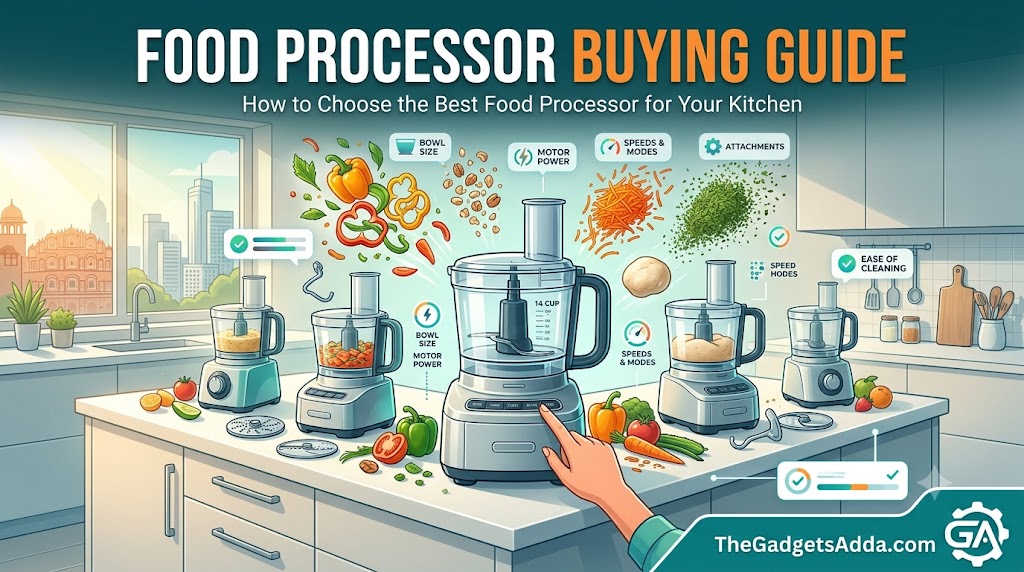
This comprehensive Food Processor Buying Guide provides clear, objective insights based on rigorous testing and mechanical analysis. It will help you cut through marketing buzzwords and identify the precise machine configuration required for your specific cooking style, household scale, and culinary budget.
What is a Food Processor?
A food processor is a motorized kitchen appliance designed to execute a wide array of high-speed food preparation tasks with minimal liquid. Utilizing a flat, broad work bowl, interchangeable cutting discs, and specialized bottom-mounted blades, it processes solid or semi-solid ingredients through mechanical shear rather than fluid vortexes.
Unlike traditional blenders, which rely on a tapered jar and a fixed blade assembly to liquefy ingredients with gravity and liquid circulation, a food processor excels at dry or low-moisture tasks. It slices, shreds, grinds, dices, minces, and emulsifies, maintaining distinct structural integrity in the food rather than reducing it to a homogeneous purée.
Why a Premium Food Processor Matters
Investing in a high-quality machine alters the dynamics of meal preparation by dramatically condensing labor times and improving culinary consistency.
Unmatched Speed and Prep Efficiency
A commercial-grade motor can slice a pound of Brussels sprouts in under ten seconds, julienne carrots for a large family salad in twenty seconds, or grate a hard block of Parmesan cheese without manual fatigue. Tasks that require twenty to thirty minutes of disciplined knife work are completed in fractions of a minute.
Superior Consistency for Even Cooking
When vegetables are sliced or diced to uniform dimensions, they cook at the identical rate. This uniformity prevents the common kitchen mishap where small vegetable pieces burn while larger chunks remain raw in the center.
Expanded Kitchen Capabilities
Certain high-density recipes are exceptionally difficult to achieve by hand. A robust food processor provides the mechanical sheer necessary to grind raw nuts into oily, ultra-smooth nut butters, emulsify stable mayonnaise or hollandaise sauce within two minutes, and cut cold butter into flour for perfectly flaky pastry dough before the warmth of your hands can melt the fat.
How a Food Processor Works
Understanding the engineering principles behind a food processor clarifies why cheap models fail under stress and what makes premium units long-term kitchen fixtures.
Motor Mechanics: Induction vs. Universal
The heart of the appliance is its motor, which generally falls into one of two engineering categories:
- Induction Motors: Found in premium, heavy-duty machines. These motors run on alternating current (AC) and use electromagnetic fields to spin the drive shaft. They lack carbon brushes, meaning they experience minimal internal friction, run quietly, and deliver immense, steady torque. Induction motors turn at a lower, more controlled RPM but maintain their speed even when cutting through dense bread dough or heavy root vegetables. They are incredibly durable, often lasting for decades.
- Universal Motors: Commonly found in entry-level or compact models. These lightweight motors run on direct or alternating current via carbon brushes. They spin at very high RPMs but offer significantly lower torque. When subjected to heavy resistance-such as dense doughs-universal motors slow down, strain, whine loudly, and can overheat quickly, causing internal thermal safety switches to trip.
The Power of Torque Over Wattage
Appliance manufacturers frequently leverage wattage as a primary marketing metric, implying that a higher wattage automatically translates to a better machine. This is a common misconception. Wattage merely measures how much electrical energy the motor consumes, not how effectively it transfers that energy into cutting power. A high-efficiency induction motor rated at 600 watts will easily outperform a poorly engineered 1,200-watt universal motor because it converts that electricity into mechanical torque rather than wasted heat and loud acoustic energy.
Safety Interlock Engineering
Because these machines spin sharp steel blades at high speeds, modern units feature integrated mechanical or electronic safety interlocks. The electrical circuit that powers the motor cannot close unless:
- The work bowl is locked securely onto the motorized base.
- The bowl cover or lid is fully turned and clicked into its corresponding slot on the handle column.
- On models with extra-large feed chutes, the heavy plastic pusher is inserted into the tube to actuate a physical safety pin.
If any component is misaligned by even a millimeter, the machine remains inert, protecting the user from accidental blade exposure.
Benefits and Limitations
To maintain objectivity, a smart buyer must weigh the immense utility of a food processor against its inherent mechanical boundaries.
Core Benefits
- Labor Reduction: Drastically minimizes physical strain for individuals with arthritis, limited mobility, or demanding meal prep schedules.
- Batch Versatility: Streamlines large-scale cooking, preserving, canning, or meal prepping for the week ahead.
- Precision Processing: Delivers exact, adjustable millimeter slicing thicknesses that are difficult to reproduce uniformly by hand.
Inherent Limitations
- Liquid Capacity Constraints: While a bowl may hold 14 cups of dry ingredients, its true liquid capacity is often half that amount. Liquid can leak over the top of the central inner spindle if filled above the max liquid line, creating a mess inside the motor housing.
- Friction Heat Transfer: The high-speed rotation of steel blades generates physical friction, transferring heat directly into the ingredients. This can warm up pie doughs or yeast doughs prematurely, requiring strategic adjustments like using ice-cold water or chilling the work bowl.
- Small Batch Inefficiency: An extra-large 14- or 16-cup bowl cannot effectively mince a single clove of garlic or chop a quarter of an onion; the blade will simply fling the small fragments against the spacious walls of the bowl, out of reach of the cutting edge.
Types of Food Processors
Selecting the right category depends heavily on the volume of food you prepare and the physical space available on your countertops.
| Category | Typical Bowl Capacity | Motor Type | Best Suited For |
| Mini Chopper / Prep Processor | 2 to 5 Cups | Universal | Mincing herbs, making small batches of pesto, emulsifying single dressings, chopping single onions. |
| Mid-Sized Workhorse | 7 to 10 Cups | Universal or Light Induction | Small families (2-4 people), everyday vegetable chopping, occasional light baking or dough mixing. |
| Full-Sized / Professional | 11 to 16+ Cups | Heavy-Duty Induction | Large families, serious batch cooking, frequent bread or pastry dough production, nut butters. |
| Combination / Hybrid Units | Varied (Includes Blender Jar) | High-Speed Universal | Multi-use kitchens with strictly limited counter space looking for an all-in-one blending and basic chopping solution. |
Core Features to Evaluate Before Buying
When comparing specific models, look past aesthetics and evaluate these critical structural components.
1. Motor Power and Construction
For a full-sized machine (11 to 14 cups), seek a motor with a minimum rating of 600 to 700 watts. Ensure the base unit possesses significant physical weight. A heavy base-ideally constructed with a solid metal housing or dense, high-impact polymers-acts as an anchor. When the machine processes unbalanced loads, like a rotating ball of pizza dough, a heavy base prevents the unit from walking across your counter or tipping over.
2. Bowl Capacity and Material Quality
Look for work bowls molded from premium, impact-resistant polymers such as BPA-free Tritan co-polyester. This material withstands the repetitive impacts of hard ingredients like ice, nuts, and frozen fruits without cracking, clouding, or absorbing stubborn food odors. Premium models often include nested bowls-a smaller 4-cup bowl that fits inside the main 14-cup bowl using the same drive shaft-giving you two machine sizes in a single footprint.
3. Controls and Interface
Complex digital control panels with dozens of specialty presets are generally unnecessary and prone to electronic failure over time. The most reliable and intuitive interface consists of simple tactile switches or robust buttons providing three functions:
- On (Continuous Run): For tasks requiring prolonged processing, such as puréeing soups, making nut butters, or emulsifying dressings.
- Off: Stops the motor immediately.
- Pulse: Provides instantaneous manual control over the motor runtime. Pressing it applies full power instantly; releasing it stops the blade immediately. This is the single most important control for preventing overprocessing and achieving uniform chops.
4. Feed Tube Dimensions
The architecture of the feed tube determines how much prep work you must perform before using the processor.
- Standard Tubes: Narrow and crescent-shaped. They require you to slice large potatoes, whole carrots, and blocks of cheese down into small chunks so they fit inside the opening.
- Wide-Mouth / Continuous Feed Tubes: Exceptionally wide, accommodating whole russet potatoes, full blocks of cheddar cheese, or entire tomatoes without preliminary knife work. These tubes feature a multi-part pusher mechanism where a smaller tube rests inside a larger one, safely accommodating both large and narrow ingredients.
5. Essential vs. Superfluous Attachments
Do not let an overwhelming array of plastic accessories sway your choice. A truly functional kitchen relies on a core group of high-performance attachments:
- The Stainless Steel S-Blade: The baseline cutting tool. Featuring two curved blades offset vertically on a central plastic hub, it chops, minces, mixes, and purées. Ensure the blades extend to the outer edges of the work bowl walls to prevent ingredients from slipping past unsliced.
- Shredding/Grating Disc: A metal disc that mounts to the top of the central drive spindle. It grates cheese, shreds cabbage, or grinds potatoes down into fine or coarse threads. Dual-sided reversible discs offer fine grating on one side and medium grating on the reverse.
- Slicing Disc: Another top-mounted disc that cuts clean slices of vegetables or meats. High-end units offer an adjustable slicing disc, which allows you to change the slicing depth from 1mm up to 6mm via an external dial or a turning mechanism on the shaft, replacing the need for multiple separate discs.
- Dough Blade: A blunt, often plastic blade with short, paddle-like wings. It stretches and turns flour and water into cohesive dough without cutting the gluten strands, preventing tough textures in baked goods.
5 Common Food Processor Mistakes to Avoid
Even an exceptional appliance will deliver poor results if operated incorrectly. Avoid these common operational pitfalls:
1. Overfilling the Work Bowl
Packing a food processor to the brim with vegetables results in an uneven grind. The ingredients at the bottom near the blade will be reduced to a wet slurry or paste, while the items at the top remain completely untouched. Work in balanced batches, filling the bowl no more than one-half to two-thirds full for dry goods.
2. Overprocessing via Continuous Run
When chopping aromatics like onions, celery, or garlic, do not turn the machine to “On” and walk away. The high speed will quickly liquify them. Instead, utilize short, rhythmic, one-second bursts of the Pulse button. This coaxes the ingredients to drop down into the path of the blade evenly, resulting in a clean, uniform dice.
3. Using the Wrong Blade for Bread and Pizza Dough
While the metal S-blade can mix dough in an emergency, its sharp edge cuts through gluten networks and can generate excessive heat, killing yeast or melting butter. For elastic, long-knead doughs like pizza or sandwich bread, swap the metal S-blade out for the blunt plastic dough blade.
4. Washing Bowls and Blades in High-Heat Dishwashers
While many manufacturers label their work bowls as “dishwasher safe,” repetitive exposure to high-heat drying cycles and aggressive detergent surfactants can turn clear plastic cloudy, cause micro-fractures around the handle locks, and dull the keen edge of stainless steel blades. Hand-washing with warm, soapy water and a bottle brush prolongs the machine’s lifespan.
5. Pouring Boiling Liquids into the Bowl
Processing steaming-hot soups or sauces directly from the stove can cause the air inside the sealed work bowl to expand rapidly. This pressure can force hot liquid out through the lid seams or center spindle, creating severe burn hazards. Let cooked ingredients cool down below 150°F before processing.
Step-by-Step Guide: Matching a Food Processor to Your Lifestyle
To determine the ideal specifications for your household, follow this analytical selection framework:
1.Assess Volume and Household Size:Prerequisite Phase.
Determine your true volume needs. If cooking strictly for one or two people, or primarily mincing small portions of garlic and herbs, a 3- to 5-cup mini-chopper is optimal. For families of three to five, or those who bake regularly, a 9- to 11-cup model balances capacity and footprint. If you routinely host gatherings, double recipes, or batch-prep weekly ingredients, opt exclusively for a 14- or 16-cup professional unit.
2.Measure Countertop and Cabinet Clearance:Spatial Check.
Heavy-duty induction food processors can stand between 15 and 19 inches tall and weigh upwards of 15 to 20 pounds. Measure the clearance between your kitchen countertops and the bottom of your upper cabinetry (standard clearance is typically 18 inches). Ensure you select a machine that either fits comfortably beneath your cabinets or has a designated home where its physical weight will not require frequent, strenuous lifting.
3.Select Your Ideal Motor Mechanism:Engineering Choice.
Evaluate your recipe repertoire. If your processing needs are restricted to soft vegetables, pestos, salsa, and casual purees, a lighter universal motor will suffice. However, if your kitchen relies heavily on grinding whole nuts, shredding firm blocks of root vegetables, or kneading dense yeast doughs for bread and pizza, prioritize a heavy AC induction motor.
4.Audit the Attachment Array:Accessory Filtering.
Do not buy a model solely because it includes a dozen specialized storage cases, citrus juicers, or whipping discs you will rarely use. Confirm the kit contains a high-quality stainless steel S-blade, a reversible shredding disc, and an adjustable slicing disc. Only pay extra for advanced dicing kits or julienne discs if those specific cuts comprise a significant portion of your weekly diet.
5.Verify Budget vs. Longevity Expectations:Financial Alignment.
Establish your cost-to-value threshold. Budget models ($50-$100) are excellent for occasional or light prep work but have shorter lifespans under heavy loads. Mid-tier options ($150-$250) offer a balance of power and versatility for daily cooking. Premium investment pieces ($300-$500+) feature durable induction motors backed by extended 5- to 10-year warranties, delivering a lower total cost of ownership over a lifetime of use.
Advanced Kitchen Best Practices & Expert Tips
Maximize the performance of your selected appliance with these advanced, chef-tested techniques:
- The Cheese Shredding Strategy: Soft cheeses like Mozzarella or Fontina can turn into a sticky, gummy mess if shredded at room temperature. To prevent this, place the block of cheese inside your freezer for fifteen to twenty minutes before processing. This firms up the fats and structures, allowing the shredding disc to cut clean, distinct strands without clogging.
- The Emulsification Funnel Trick: Most food pushers feature a tiny pinhole molded directly into the bottom plastic. This is not a manufacturing defect-it is a calibrated gravity feed funnel for making stable emulsions like mayonnaise or Caesar dressing. Fill the main bowl with your egg yolks and acid, turn the machine on, and pour your oil directly into the pusher tube. The oil will drip down into the spinning blades at a perfectly controlled rate, ensuring a flawless emulsion every time.
- The Flaky Pastry Secret: When making pie dough, cold temperatures are critical. To prevent the friction of the blades from warming your butter, place your flour, sugar, salt, and steel S-blade directly inside the food processor bowl and chill the entire assembly in your refrigerator for thirty minutes before adding your ice-cold fats.
Real-World Recipe Applications
To help visualize how these features translate to daily cooking, consider these foundational processing examples:
Ultimate Bulk Mirepoix (Onions, Carrots, Celery)
- Attachment: Stainless Steel S-Blade
- Technique: Cut the vegetables into rough two-inch pieces. Place them in the work bowl, ensuring it is no more than half full. Apply five to seven quick, sharp, one-second pulses. The ingredients will drop uniformly into the blade paths, yielding a flawless, evenly sized dice ready for stock bases or slow braises without sweating or bleeding liquid.
Perfect Homemade Almond Butter
- Attachment: Stainless Steel S-Blade
- Technique: Pour sixteen ounces of roasted almonds into a high-capacity bowl. Turn the machine to continuous “On.” Initially, the nuts will reduce to a dry flour, then progress to a thick, gritty paste. Continue running the induction motor steadily for five to eight minutes. The continuous mechanical shear coaxes the natural oils out of the nuts, transforming the mixture into a glossy, smooth, pourable almond butter without requiring additional oils.
Key Takeaways
- Prioritize Torque Over Watts: Look for solid, heavy bases housing high-torque AC induction motors if you intend to knead doughs or process tough ingredients regularly.
- Match Size to Lifestyle: A 14-cup model is excellent for batches and large families, while an 8- to 11-cup model serves as an ideal daily all-rounder for typical households.
- Emphasize Simple Controls: A reliable pulse button is your best tool for maintaining texture control and avoiding overprocessed food.
- Check the Footprint: Ensure you have enough physical counter space and overhead clearance beneath your cabinets to house the unit comfortably.
Frequently Asked Questions
What is the difference between a food processor and a food chopper?
A food chopper is a compact, small-capacity appliance (typically 2 to 5 cups) engineered for basic, straightforward tasks like mincing a single onion or chopping a handful of nuts. A true food processor is a larger machine (7 to 16 cups) equipped with a robust motor base that accepts interchangeable discs and specialized blades, allowing it to slice, shred, dice, and knead heavy doughs.
Can a food processor replace a high-performance blender?
Not completely. Food processors are engineered for dry, low-moisture tasks, uniform slicing, shredding, and heavy dough manipulation. Blenders rely on a narrow vortex and a high-speed blade layout to completely pulverize ingredients into liquid states, making them irreplaceable for silky smoothies, hot puréed soups, or crushed-ice beverages.
What wattage should I look for when buying a food processor?
For a full-sized machine (11 to 14 cups), seek a motor rated between 600 and 1,000 watts. However, if the machine uses a premium induction motor, a lower wattage rating (like 600W) will easily outperform a 1,200-watt universal motor because it produces far superior continuous torque.
Can you knead bread dough in any food processor?
No. Kneading stiff bread, pizza, or bagel dough places massive physical strain on an appliance. You should only attempt heavy dough production in machines equipped with robust motors (ideally induction) and a heavy base that prevents the unit from moving across the counter. Always utilize the designated blunt plastic dough blade rather than the sharp metal S-blade to preserve the dough’s gluten structure.
Why does my food processor leak when I make soup?
Food processor work bowls feature a hollow central tube or spindle that allows power to transfer from the base motor up to the blades. If you fill the bowl with liquids above this center opening’s seal line, the fluid will spill straight down into the drive shaft housing. Always check your manual for the designated max liquid capacity line, which is usually much lower than the dry ingredient capacity.
Are food processor blades supposed to be loose on the spindle?
Yes. S-blades and attachment discs are designed to slide onto the center drive shaft easily without tight mechanical fasteners. When the motor engages, the centrifugal force locks the attachment into position securely. This intentional design feature allows you to lift the blades out cleanly for washing or ingredient access without fighting complex locking systems.
How do I stop my food processor from overheating?
Overheating occurs when a low-torque universal motor strains against an overfilled bowl or dense ingredients. To prevent this, slice hard root vegetables or dense cheeses into smaller portions before inserting them, work in moderate batches, and utilize short pulses rather than prolonged, continuous run cycles.
Can you slice raw meat in a food processor?
Yes, but you must prep the meat first to achieve clean, safe results. Place the raw beef, chicken, or pork onto a baking sheet and freeze it for twenty to thirty minutes until it is quite firm to the touch but not completely frozen solid. This prevents the meat from tearing or shredding into ragged pieces when passed through the slicing disc.
How often should I sharpen my food processor blades?
Under average home kitchen use conditions, high-quality stainless steel S-blades will maintain their cutting integrity for several years. If you notice the machine is tearing herbs or bruising vegetables rather than slicing them cleanly, you can sharpen the edges using a fine diamond file or contact the manufacturer for a direct replacement blade assembly.
Is Tritan plastic safe for food processing?
Yes. Tritan is a premium, high-impact co-polyester polymer that is completely free of BPA (Bisphenol A), BPS, and other bisphenol compounds. It provides the clarity and elegance of glass with the lightweight durability of plastic, and it withstands high mechanical impacts without cracking or leaching chemicals into your ingredients.
Final Verdict
Choosing the perfect model comes down to a clear understanding of your cooking style. If your kitchen prep involves routine large-scale baking, regular hosting, or extensive vegetable prep, investing in a full-sized 14-cup processor powered by an AC induction motor is a decision you will appreciate for decades. It offers the heavy torque, wide-mouth feeding capability, and rugged construction necessary to handle demanding kitchen tasks with ease.
Conversely, if you primarily prepare meals for a smaller household and need assistance with daily chopping, slicing, or quick dressings, a well-engineered 7- to 11-cup mid-sized processor with a reliable pulse interface offers excellent utility without occupying excessive counter space. Assess your physical kitchen space, honor your actual batch sizes, and invest in a machine that turns meal prep from a chore into a seamless, efficient process.