
Waking up with a dull ache in your lower back or tossing and turning at 3:00 AM is rarely an administrative issue; it is almost always a structural one. Your body spends roughly a third of its life resting on a surface that directly impacts spinal alignment, blood circulation, and muscular recovery. Yet, shopping for a new bed presents a frustrating paradox: despite thousands of online brands and retail showrooms, finding clear, unvarnished information is incredibly difficult.
The industry frequently hides behind confusing marketing jargon, proprietary material names, and misleading sales tactics. A bed labeled “Luxury Ultra-Plush Orthopedic” might simply contain cheap, low-density polyfoam that sags within twenty-four months.
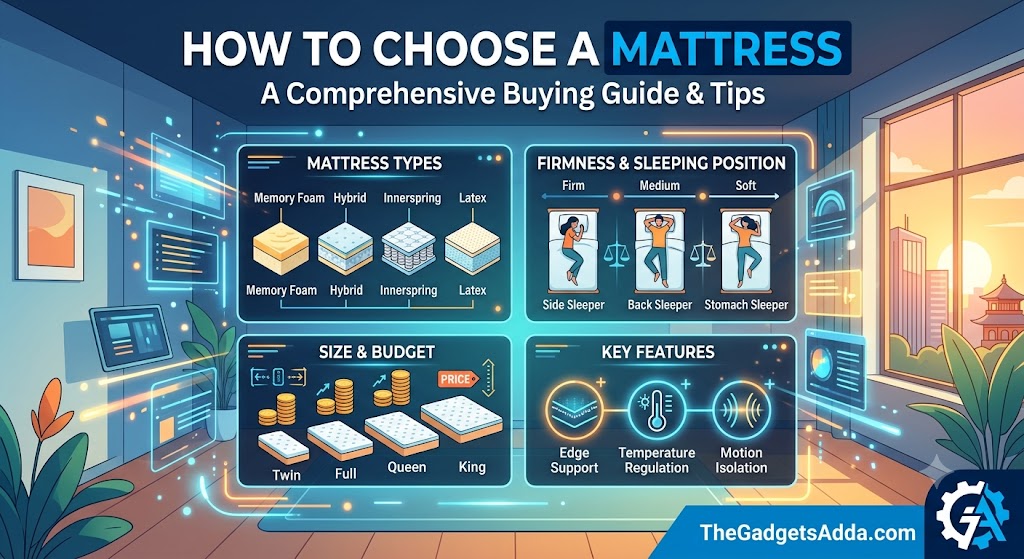
Choosing the right sleep surface requires moving past emotional marketing copy and focusing entirely on material specifications, structural engineering, and human ergonomics. This guide clarifies the mattress selection process, providing the raw technical data, structural breakdowns, and body-weight formulas required to identify the exact mattress construction for your specific sleep profile.
What is a Modern Mattress?
At its core, a modern mattress is an engineered support system designed to distribute body weight evenly, minimize pressure points, and hold the human spine in a neutral alignment. Every mattress is divided into two primary functional components: the comfort system and the support core.
- The Comfort System: This comprises the top layers of the mattress, usually stretching between two to five inches deep. It utilizes materials like memory foam, natural latex, polyfoam, or micro-coils to contour to the body’s curves, cushion prominent joints (hips, shoulders), and damp motion transfer.
- The Support Core: This is the structural foundation of the bed, typically making up sixty to eighty percent of its total height. Constructed from heavy-duty pocketed coils, high-density polyfoam, or vulcanized rubber air chambers, the support core keeps your heavy midsection from sinking too deep, preventing spinal distortion.
Why Mattress Engineering Matters to Your Health
Sleeping on an incorrect or degraded mattress causes measurable physiological strain. When a support core fails or a comfort layer softens excessively, your heavy pelvic region sinks out of alignment with your thoracic and cervical spine. This structural drop forces your paraspinal muscles, tendons, and ligaments to remain active throughout the night to protect the spinal cord from hyperextension. Instead of resting and repairing, your musculature is working a continuous night shift, leaving you with morning stiffness and chronic lower back pain.
Furthermore, sleep surfaces dictate the quality of your sleep architecture. When a mattress creates high pressure points-exceeding thirty-two millimeters of mercury ($32\text{ mmHg}$), the threshold for capillary occlusion-it restricts localized blood flow. Your brain receives a distress signal, triggering an involuntary roll or repositioning. Every time you toss and turn to relieve a compressed shoulder or hip, you risk dropping out of deep slow-wave sleep or REM sleep, undermining cognitive restoration and cellular repair.
How a Mattress Supports Your Body
A mattress works via two distinct but complementary mechanical forces: pressure relief and support.
The comfort layers provide pressure relief through localized deflection. When your shoulders and hips press down, these materials compress, conforming to your body shape and spreading your physical weight across a wider surface area. This reduces the localized force exerted against your skin.
Simultaneously, the support core applies a reactive upward force. According to Newton’s third law, the mattress must push back with an equal force to hold your body in place. An engineered support core ensures this counter-pressure is distributed proportionally, giving more resistance under heavy zones (the pelvis) and less resistance under lighter zones (the lower back and legs).
Deep-Dive Analysis of Mattress Types
The modern bedding market is divided into five primary design categories. Each relies on different materials and mechanical principles to support the body.
1. Memory Foam Mattresses
Originally engineered by NASA to improve seat cushioning during liftoff, memory foam-technically known as viscoelastic polyurethane foam-reacts directly to ambient temperature and localized body heat. As it warms, the material softens, shifting from an elastic response to a viscous fluid response that conforms meticulously to your physical shape.
- Density Metrics (The Truth Indicator): The durability and support of memory foam are determined by its weight, measured in pounds per cubic foot (PCF).
- Low Density (under 3.5 PCF): Inexpensive, conforms quickly, but degrades fast, forming permanent body impressions within a few years.
- Medium Density (3.5 to 4.5 PCF): Offers a balanced ratio of contouring, durability, and ease of movement.
- High Density (5.0 PCF or higher): Exceptionally durable, provides pressure relief for deep tissue, but exhibits a distinct slow-response feeling and traps more body heat.
- Open-Cell vs. Closed-Cell Structures: Traditional memory foam features a closed-cell matrix that traps warm air around the body. Modern viscoelastic formulations use an open-cell architecture or introduce conductive gel particles, copper fibers, or graphite flakes to help conduct thermal energy away from the sleeping surface.
2. Latex Mattresses
Natural latex is derived from the sap of the Hevea brasiliensis (rubber tree). It is highly resilient, immediately bouncing back to its original shape when pressure is removed. Unlike memory foam, latex pushes back against body weight rather than contouring around it, creating a buoyant feeling of sleeping “on top of” rather than “sunk into” the bed.
- Dunlop vs. Talalay Processing:
- Dunlop Latex: The liquid sap is whipped, poured into a mold, and baked. Sediment settles slightly toward the bottom, resulting in a denser, firmer structure that works perfectly for support cores and foundational layers.
- Talalay Latex: The sap is poured into a mold, vacuum-sealed to extract air, and flash-frozen before baking. This produces an open, highly consistent cellular matrix with a softer, springier feel, making it an excellent choice for comfort layers.
3. Innerspring Mattresses
Innerspring mattresses rely completely on a steel wire coil configuration for their support and shape. While traditional open-coil styles are becoming less common in high-end models, they remain widely available in budget lines.
- Coil Types:
- Bonnell Coils: Hourglass-shaped coils laced together with thin helical wires. They are cheap to manufacture but transfer motion across the entire surface and break down quickly under heavy loads.
- Offset Coils: Hourglass coils with flattened tops that pivot under weight. They conform better than Bonnell coils and offer quiet, heavy-duty support.
- Continuous Wire Coils: Made from a single, interwoven network of steel wire. They are stiff and durable but offer poor pressure relief and significant motion transfer.
4. Hybrid Mattresses
Hybrids integrate the heavy-duty support of an innerspring core with the pressure-relieving benefits of thick foam or latex layers. To meet the hybrid classification, a mattress must feature an pocketed coil system paired with at least two inches of specialty comfort material (memory foam, latex, or advanced polyfoam).
- Pocketed Coils (Marshall Coils): Each individual barrel-shaped coil is wrapped in its own fabric sleeve, allowing it to compress independently without dragging down adjacent coils. This independent action provides precise body contouring, excellent motion isolation, and targeted pressure point relief.
- Coil Gauge and Counts: Coil counts are easily manipulated by marketing teams through the use of smaller micro-coils. Instead of focusing only on count, look closer at the coil gauge (the thickness of the steel wire). A low gauge number (e.g., 12 to 13 gauge) indicates thick, unyielding steel built for firm support and heavier weights. A high gauge number (e.g., 15 to 16 gauge) indicates thin, flexible wire that delivers a plush, contouring response.
5. Airbeds
Airbeds are high-end mattresses that use adjustable vulcanized rubber or polyvinyl chloride (PVC) air chambers as their primary support core, managed by an integrated electric pump system. These beds should not be confused with temporary camping air mattresses; they are encased in high-quality quilted covers and topped with thick comfort layers of latex or memory foam.
- Adjustability Mechanics: Airbeds allow users to alter the internal pressure of the support core in real-time, adapting the firmness setting to changing sleep positions, body weights, or injuries. Dual-chamber configurations allow couples to customize each side of the mattress independently.
Side-by-Side Mattress Technology Comparison
The table below summarizes how each mattress category handles key performance metrics.
| Performance Metric | Memory Foam | Natural Latex | Pocketed Coil Hybrid | Traditional Innerspring | Adjustable Airbed |
| Spinal Alignment | Excellent (Slow contouring) | Very Good (Buoyant lift) | Excellent (Zoned response) | Fair (Tends to sag over time) | Dynamic (Customizable pressure) |
| Pressure Relief | Maximum (Deep tissue cradling) | Moderate (Surface cushioning) | High (Balanced comfort) | Low (Creates localized resistance) | Highly Variable (Depends on top layers) |
| Motion Isolation | Industry Leading (Damps energy) | High (Localizes springiness) | Very Good (Isolated coils) | Poor (Transfers lateral force) | High (Isolated internal air bladders) |
| Temperature Control | Low to Moderate (Retains heat) | High (Naturally breathable) | High (Open air paths between coils) | Maximum (Unrestricted ventilation) | Moderate to High (Depends on top layers) |
| Edge Support | Poor to Fair (Perimeter compresses) | Moderate (Consistent material density) | High (Thick perimeter coils) | Maximum (Heavy border wire frame) | Very Good (Usually reinforced with foam) |
| Expected Lifespan | 6 to 8 Years (Depends on PCF) | 10 to 15 Years (Highly resilient) | 7 to 10 Years (Coil & foam wear) | 5 to 7 Years (Coils fatigue) | 8 to 12 Years (Mechanical parts may require replacement) |
Finding Your Ideal Firmness: The Sleep Profile Formula
Mattress firmness is not standard across brands, but the industry generally operates on a unified 1-to-10 scale, where a 1 represents an incredibly soft surface and a 10 represents a rigid, unyielding platform.
[1]---------[2]---------[3]---------[4]---------[5]---------[6]---------[7]---------[8]---------[9]---------[10]
   Ultra-Soft      Soft      Luxury Plush      Medium       Medium-Firm       Firm        Extra-Firm
Choosing your placement on this scale requires balancing your preferred sleeping position with your overall body weight.
1. Sleep Position Ergonomics
Side Sleepers (Requires Firmness 4 to 6)
When sleeping on your side, your body weight concentrates on the prominent lateral points of your shoulder and hip. If the mattress is too firm, these areas face high counter-pressure, cutting off capillary circulation and twisting your spine horizontally. Side sleepers require a thick comfort layer with deep contouring properties to swallow these protrusions while keeping the lumbar spine supported.
Back Sleepers (Requires Firmness 5 to 7)
Back sleepers need a balanced, medium-firm surface. The mattress must offer enough surface give to let the shoulder blades and gluteal curve sink in slightly, while maintaining an upward, supportive force to keep the lumbar spine from collapsing downward into a U-shape.
Stomach Sleepers (Requires Firmness 7 to 9)
Stomach sleeping is tough on human spinal anatomy. If the sleep surface is too soft, your heavy midsection sinks deep into the support core, hyperextending the lower back into a position called lumbar lordosis. This position places severe mechanical stress on the intervertebral discs. Stomach sleepers require a firm, level surface to keep their pelvis and shoulders aligned on a flat plane.
Combination Sleepers (Requires Firmness 5 to 6.5)
If you shift positions throughout the night, look for a mattress with a fast responsive time. Materials with a high elastic recovery rate, such as natural latex or pocketed coil hybrids, allow you to roll over easily without feeling stuck in a deep foam contour.
2. The Weight Multiplier
Your body weight dictates how deeply you press into the comfort layers and engage the support core.
- Lighter Sleepers (under 130 lbs): Smaller bodies exert less force on the mattress materials. A bed that feels medium-firm to an average adult can feel rigid to a lighter sleeper. If you fall into this group, look for a softer mattress (firmness 3 to 5) with plush top layers to achieve adequate pressure relief.
- Average Sleepers (130 to 230 lbs): This weight range aligns well with standard industry testing. Most average-weight sleepers get excellent results from a true medium to medium-firm mattress (firmness 5 to 7), choosing based on their position preferences.
- Heavier Sleepers (over 230 lbs): Larger bodies exert heavy mechanical force down through the comfort layers, quickly bottoming them out against the support core. If you are in this weight tier, look for a firm bed (firmness 7 to 9) built with thick, high-density foams (more than 4.5 PCF) or thick-gauge pocketed steel coils (12 to 13 gauge) to avoid sinking and prevent premature mattress sagging.
Interactive Mattress Match Tool
Use this configuration matrix to determine the optimal mattress setup based on your sleeping position, weight profile, and physical pain concerns.
Critical Manufacturing Certifications
When evaluating the chemical construction and safety of a mattress, skip the vague marketing terms like “eco-friendly” or “all-natural.” Look for verified certifications issued by independent testing bodies.
- CertiPUR-US: This certification applies strictly to polyurethane foams. It guarantees the foam is manufactured without ozone depleters, PBDE flame retardants, heavy metals (mercury, lead), formaldehyde, and regulated phthalates. It also verifies that emissions of volatile organic compounds (VOCs) are low, keeping indoor air quality safe.
- OEKO-TEX Standard 100: A global testing system that checks textile components (including covers, threads, and zippers) for hundreds of harmful substances, ensuring the product is safe for close contact with human skin.
- Global Organic Textile Standard (GOTS): This is the top standard for organic textiles worldwide. It requires a mattress to contain at least ninety-five percent certified organic fibers, managed under strict environmental and social criteria across the entire supply chain.
- Global Organic Latex Standard (GOLS): This certification ensures that latex products are made from organic raw materials, requiring at least ninety-five percent certified organic latex in the finished component.
Common Mattress Buying Mistakes
Avoiding structural and operational mistakes during your purchase is just as important as picking the right materials.
1. Falling for the Showroom Illusion
Testing a mattress in a retail showroom for five to ten minutes while fully dressed tells you very little about its long-term comfort. Under showroom lights, your body doesn’t drop into deep, relaxed states, and your muscles remain slightly tense. Short showroom tests often lead people to buy beds that are too soft, as plush materials feel comforting during a brief trial but fail to support your body over an eight-hour night.
2. Overlooking Foundation Compatibility
A high-quality mattress requires a flat, non-yielding foundation to work properly. Putting a new memory foam or hybrid mattress on an old, sagging box spring or a bed frame with wide-set slats (separated by more than three inches) destroys its performance. Without solid support underneath, the mattress core bows downward under your weight, cracking internal foam structures and causing premature dipping that voids your manufacturer warranty.
3. Misunderstanding Warranty Loop-Holes
A mattress warranty protects you against manufacturing defects, not natural wear and tear or gradual softening. Almost all warranties include a clause stating that a mattress is only considered defective if it shows a visible, permanent impression that measures a specific depth (usually between 0.75 and 1.5 inches) when no weight is resting on it. If your bed feels soft and lacks support but springs back up when you get out of it, a standard warranty will not cover a replacement.
Step-by-Step Guide to Buying a Mattress
Follow this sequence to research, test, and buy your sleep system.
1.Calculate Your Sleep Profile Baseline:Prerequisite Analysis.
Document your exact body weight, primary sleep position, and any chronic physical pain areas. Use these data points to establish your target firmness number on the 1-to-10 industry scale.
2.Select Your Ideal Structural Type:Material Allocation.
Choose your mattress category based on your physical needs. Pick high-density memory foam for deep pressure relief and motion dampening, natural latex for responsive cooling and durability, or a pocketed coil hybrid for a balance of bounce and edge support.
3.Inspect the Underlying Mattress Base:Foundation Validation.
Measure the distance between the support slats on your current bed frame. If the gap is wider than three inches, purchase a rigid foundation or solid bunkie board to ensure your new mattress has a flat surface to rest on.
4.Review the Sleep Trial and Return Policy Provisions:Risk Mitigation.
Confirm that the manufacturer offers a sleep trial of at least one hundred nights. Carefully read the fine print to check for return shipping fees, mandatory break-in periods (often thirty days), or restocking penalties.
5.Unpack, Unroll, and Allow for Off-Gassing:Installation Protocol.
Place the compressed mattress onto its frame and open the plastic seal. Allow the bed to expand completely for twenty-four to forty-eight hours in a well-ventilated room, giving manufacturing gasses time to dissipate before you sleep on it.
Decoding Mattress Costs: What Are You Actually Paying For?
Mattress prices range from budget-friendly options to high-end investment systems. Understanding these price brackets helps you see exactly where your money goes.
$150 - $600       [ Budget Tier: Low-density polyfoams, basic continuous coils ]
$600 - $1,500     [ Value Tier: Pocketed coil hybrids, open-cell memory foams ]
$1,500 - $3,000   [ Premium Tier: High-density memory foam, zoned coils, organic latex ]
$3,000+           [ Luxury Tier: Adjustable airbeds, rare natural fibers (cashmere, horsehair) ]
Budget Tier ($150 to $600)
Mattresses in this price bracket typically rely on entry-level materials, such as conventional low-density polyfoam layers wrapped around thin Bonnell coils. While they function fine for guest bedrooms, children’s beds, or temporary apartments, the comfort layers tend to soften rapidly under everyday adult use, often showing early indentation signs within two to three years.
Value Tier ($600 to $1,500)
This price bracket is home to the majority of high-quality online bed-in-a-box brands. At this level, you can find durable pocketed coil support cores paired with medium-density memory foams or open-cell cooling layers. These mattresses deliver excellent performance and durability for the average adult sleeper.
Premium Tier ($1,500 to $3,000)
Beds in this category feature premium materials and advanced structural design. You will find targeted, zoned lumbar coil systems, thick layers of natural Dunlop or Talalay latex, high-density specialized foams (above 5.0 PCF), and covers made from performance fabrics like cooling phase-change materials or organic Tencel. This tier is built for superior ergonomics and an extended lifespan.
Luxury Tier (Above $3,000)
This pricing level includes complex adjustable airbed systems, smart mattresses with biometric tracking sensors, and luxury handmade models that substitute synthetic foams for natural fiber layers like horsehair, organic wool, cashmere, and long-staple cotton. While these materials offer exceptional durability and natural climate control, you hit a point of diminishing returns regarding orthopedic support compared to the premium tier.
Summary Checklist for Mattress Shoppers
Use these clear checkpoints before confirming your mattress purchase:
- [ ] Foam Density Check: If buying memory foam, ensure the comfort layers are at least 3.5 to 5.0 PCF for long-term durability.
- [ ] Coil Gauge Check: For hybrid or innerspring beds, ensure the coil core uses 12 to 15-gauge steel wire based on your desired firmness.
- [ ] Slat Spacing Check: Verify that your bed foundation slats are spaced less than three inches apart to prevent mattress sagging.
- [ ] Return Policy Verification: Confirm the return policy features a $0 restocking fee and provides full reimbursement during the trial period.
- [ ] Warranty Requirement Check: Read the fine print to see if the warranty requires a specific indentation depth (such as 1.5 inches) to approve a defect claim.
Frequently Asked Questions
What is the most common sign that I need a new mattress?
The clearest sign is waking up with consistent lower back pain or stiffness that fades within an hour of moving around. Other reliable indicators include seeing visible sags or body hollows greater than one inch, waking up frequently from heat retention, or realizing you sleep significantly better when staying at hotels or in guest beds.
How often should I flip or rotate my new mattress?
Most modern mattresses are built with a top-down structural layout, meaning the soft comfort layers sit permanently on top of a heavy support core. These beds should never be flipped upside down. However, you should rotate the mattress 180 degrees every six months to balance out wear patterns and prevent your body weight from over-compressing the same exact spots.
Can a mattress protector alter how a bed feels?
Yes. Thick, inexpensive plastic waterproof protectors trap air, making your sleep surface run hot and creating a noisy crinkling sound. They can also create a “balloon effect” that limits how well the comfort layer contours to your shape. To preserve the intended feel of your mattress, look for thin, breathable protectors made from polyurethane membranes bonded to tencel or cotton terry fabrics.
Why do some online mattresses smell strange right after unpacking?
This smell is called off-gassing. It happens when newly manufactured polyurethane foams release volatile organic compounds (VOCs) that were trapped inside their cell structures during production. While the scent can be unpleasant, choosing foams with a CertiPUR-US certification ensures these emissions are low and entirely non-toxic. The smell typically clears within 48 hours if left in a well-ventilated room.
Which mattress style is best for couples who wake each other up?
Look for an all-foam mattress built with high-density memory foam, or a premium hybrid that uses independently pocketed coils wrapped in thick comfort foam layers. These materials excel at dampening kinetic energy, absorbing motion locally so that one partner tossing or turning won’t transfer movement across the bed.
How deep should a mattress be to provide adequate support?
For most healthy adults, a mattress needs a total profile depth of at least ten to twelve inches. This thickness provides enough vertical room for a multi-layered design: two to four inches of pressure-relieving comfort materials on top, backed by a six to eight-inch heavy-duty support core. Beds under ten inches deep often bottom out under average adult body weights.
Is an extra-firm mattress the best solution for chronic back pain?
No, this is a common misconception. A rigid, extra-firm mattress cannot conform to the natural curves of your body, which leaves a gap under your lower lumbar spine and forces your muscles to stay tense all night. Clinical sleep studies show that a medium-firm mattress (ranking 5 to 7 on the firmness scale) provides the optimal balance of surface contouring and upward structural support for reducing back pain.
What is the difference between a box spring and a platform foundation?
A traditional box spring contains internal wire coils built to absorb shock for old-school innerspring beds. A platform foundation is a rigid, flat frame made from solid wood or steel slats. Modern memory foam, latex, and hybrid mattresses need the unyielding support of a platform foundation; placing them on an old, flexible box spring causes sagging and will void your manufacturer warranty.
How long does it take for a body to adapt to a new mattress?
It typically takes your body’s musculoskeletal system between twenty-one and thirty days to break old structural habits and adjust to the alignment of a new sleep surface. During this initial break-in period, you may experience mild muscle soreness or stiffness as your posture realigns. This is why most brands require you to try their bed for thirty nights before processing a return.
Do cooling gel components permanently stop a bed from trapping heat?
No. Cooling gels work by absorbing thermal energy from your skin when you first lie down, creating an initial cooling sensation. However, once the gel matches your body temperature, its cooling effect stops. For long-term temperature regulation throughout the night, focus on structural ventilation-such as the open air channels found in pocketed coil hybrids or the natural breathability of open-cell latex.