Running out of ice during a dinner party or finding your morning iced coffee diluted by cloudy, fast-melting refrigerator ice is incredibly frustrating. While built-in refrigerator freezers are fine for basic needs, they rarely keep up with high-demand households, hosting duties, or specific beverage preferences. Relying on gas station ice runs or annoying plastic trays is a temporary fix that quickly becomes a hassle.
Investing in a dedicated appliance solves this issue permanently, but finding the right model requires navigating complex technical factors. Choosing a unit involves evaluating plumbing connections, drainage mechanics, physical clearance spaces, and ice geometries. This guide breaks down the engineering behind residential ice production, outlines your options, and provides a clear roadmap to selecting the perfect system for your space.
What Is a Dedicated Ice Maker?
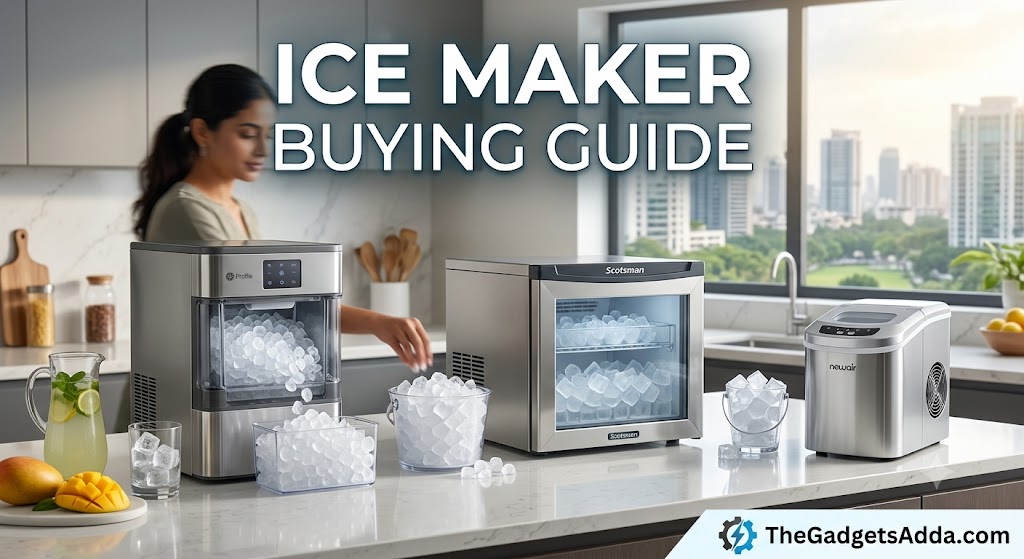
A dedicated ice maker is a standalone appliance engineered solely to freeze water and harvest ice efficiently. Unlike standard refrigerator ice makers-which share an evaporator coil and compressor with the fresh food and freezer sections-a dedicated ice machine uses an isolated refrigeration system optimized exclusively for rapid freezing cycles.
These units are categorized by their installation configuration:
- Countertop (Portable): Compact, manually filled machines that sit on your counter and require no permanent water line.
- Undercounter (Built-in): Heavy-duty units designed to slide flush into a standard 15-inch or 18-inch lower kitchen cabinet opening, requiring dedicated plumbing and drainage.
- Freestanding: Independent units with fully finished sides that can stand anywhere power and water utilities are accessible.
Why a Dedicated Unit Matters
Standard refrigerator ice makers share their ambient air with frozen foods. This shared airflow means the ice absorbs volatile organic compounds (VOCs) and odors from surrounding items, resulting in a distinct, stale taste over time. Furthermore, typical refrigerator ice molds freeze water rapidly from all sides simultaneously, trapping dissolved minerals, gases, and air bubbles in the center. This creates structural weak points and causes the ice to melt rapidly, diluting premium spirits or specialty coffees.
A high-quality standalone unit remedies these issues by controlling both water movement and freezing directions. This specialized process ensures consistent purity, structural density, and tailored textures, transforming ice from a mere cooling agent into a functional ingredient that enhances your beverages.
How It Works: The Internal Mechanics
Understanding how these machines work requires looking past the collection bin and examining the evaporator assembly. The production process depends heavily on the specific type of ice being harvested.
Clear Ice Mechanics
Clear ice production relies on directional freezing, a process where water cascades continuously over a chilled vertical copper plate called an evaporator grid. As water flows over the sub-zero grid, pure water molecules freeze first, while dissolved minerals, air pockets, and impurities are continuously washed away into a lower reservoir. Once the slab reaches a precise thickness, the machine initiates a harvest cycle, warming the plate slightly with hot gas from the compressor to release the ice onto a heated wire grid that cuts it into perfect cubes.
Nugget Ice Mechanics
Nugget ice, also known as sonic, chewable, or pellet ice, uses a completely different mechanical assembly. Water enters a cylindrical freezing chamber surrounded by cooling coils. A stainless steel auger-essentially a large screw-rotates continuously inside the cylinder, shaving away the thin layer of ice as it forms on the inner walls. The auger pushes these loose flakes upward through a restrictive brass or steel extruding head. This compression forces the moisture out, compacting the ice flakes into dense, soft, chewable cylinders that are snapped off into small nuggets before dropping into the storage bin.
Benefits of a Standalone Machine
- Unmatched Production Velocity: Standard refrigerator modules generate roughly 3 to 4 pounds of ice per day. In contrast, an entry-level countertop unit produces up to 26 pounds daily, while undercounter residential models can easily yield 50 to 80 pounds every 24 hours.
- Preserved Beverage Profiles: Because dedicated units isolate their air circulation or melt away old ice continuously, the cubes remain completely neutral in smell and taste.
- Controlled Dilution: High-density clear cubes minimize surface-area-to-volume exposure, ensuring drinks cool down quickly without turning watery.
- Tailored Textures for Every Need: Whether you need soft, flavor-absorbing nugget ice for carbonated sodas or dense spheres for high-end spirits, standalone machines deliver the specific structural properties you want.
Limitations and Trade-offs
- No Active Refrigeration in Most Storage Bins: A common point of confusion is that residential undercounter and countertop ice bins are insulated coolers, not freezers. To maintain a constant supply of fresh, loose ice that doesn’t freeze into a solid block, the machine allows the bottom layer of ice to melt slowly, draining the runoff water and triggering new freezing cycles.
- Utility Costs: These appliances run continuous compression, harvest, and water-fill cycles, which increases your monthly electricity and water consumption.
- Rigorous Cleaning Schedules: Because these units handle standing water and constant humidity, mold and scale buildup can accumulate rapidly if you don’t clean them regularly.
- Complex Spatial and Plumbing Needs: Undercounter units require a direct water line, a nearby electrical outlet, and a dedicated drainage path, which can make installation difficult.
Types of Ice Makers
Choosing the right machine starts with selecting the physical footprint that fits your home layout.
Countertop (Portable) Units
Countertop machines are small, plug-and-play appliances that are roughly the size of a large espresso maker. They feature an integrated water reservoir below the collection bin that you must fill manually.
Because they recycle water from melted ice back into the reservoir, they do not require an external drain line. While convenient, their small footprint limits insulation thickness, meaning ice melts faster and the machine must run more frequently to replace it.
Undercounter Built-In Systems
These heavy-duty models are engineered to slide directly between lower base cabinets. They feature front-breathing ventilation grilles at the base, allowing them to operate efficiently without overheating in fully enclosed cabinetry spaces. They require a permanent cold-water connection and a dedicated drainage solution.
Freestanding Units
Freestanding units are similar to undercounter models but feature fully finished side walls. This finish allows you to place them at the end of a kitchen island, inside a utility room, or within a garage without needing custom surrounding woodwork.
Understanding Ice Geometries
The shape of your ice dictates how it interacts with liquids. Choosing a geometry should depend on what you primarily drink.
Nugget Ice
- Physical Profile: Semi-soft, layered, porous cylinders containing roughly 70% to 80% ice and 20% to 30% air and pocketed water.
- Best For: Fountain sodas, blended smoothies, sweet tea, and everyday hydration.
- Performance: Because nugget ice is highly porous, it absorbs the flavor of the beverage you pour over it. However, this high surface area also causes it to melt quickly in warm environments.
Clear Gourmet/Top Hat Cubes
- Physical Profile: Crystal-clear, heavy, cylindrical or octagonal solid blocks with zero internal air pockets.
- Best For: Premium spirits, neat pours, and high-end craft cocktails.
- Performance: This shape provides the lowest surface-area-to-mass ratio, ensuring excellent cooling with minimal dilution. It is highly resistant to melting but cannot be chewed safely.
Bullet Ice
- Physical Profile: Hollow, dome-topped cylinders produced primarily by portable countertop machines.
- Best For: Quick chilling, filling coolers, or blending frozen mixed drinks.
- Performance: Bullet ice is formed by plunging chilled metal prongs directly into a water bath. This creates ice quickly-often in under 9 minutes-but the hollow centers cause it to melt rapidly.
Crescent Ice
- Physical Profile: Hard, half-moon shaped pieces.
- Best For: Everyday kitchen use, high-volume catering, and filling coolers.
- Performance: The curved shape prevents the ice from nesting or clustering together in the storage bin, ensuring a smooth scoop every time.
Key Features to Evaluate
To make an informed purchase, look beyond aesthetic finishes and analyze the core technical and mechanical specifications of the unit.
Daily Production vs. Storage Capacity
It is critical to distinguish between how much ice a machine can produce in 24 hours and how much it can store at any given moment. For example, a premium undercounter unit might produce up to 65 pounds of ice daily but feature a storage bin capped at 25 pounds. If you host large gatherings, prioritize a larger storage bin capacity so you have plenty of ice ready to go when guests arrive.
Drainage Architecture: Gravity vs. Drain Pump
Because undercounter ice bins allow ice to melt slowly to keep the supply fresh, managing water runoff is a vital installation step.
| Feature | Gravity Drain | Built-In Drain Pump |
| Mechanics | Relies entirely on downhill slope for water evacuation. | Mechanically pumps wastewater upward and outward. |
| Required Utilities | Must have a floor-level drain directly beneath or within 2 feet of the machine. | Can route wastewater up into an under-sink p-trap or wall drain up to 10 feet high. |
| Slope Constraint | Requires a strict drop of 1/4-inch for every 12 inches of horizontal pipe run. | No structural slope required; handles vertical elevation changes easily. |
| Noise Level | Completely silent operation. | Emits a brief, distinct hum when the internal pump reservoir empties. |
Condenser Cooling Configurations
- Air-Cooled: These systems pull ambient air through a front grille to cool the refrigeration coils, much like a standard refrigerator. They are highly efficient in normal household temperatures but need adequate external clearance to maintain proper airflow.
- Water-Cooled: These specialized units use a continuous stream of cold water to cool the internal condenser coils, discharging the warmed water down the drain. While they run quietly and operate efficiently in hot environments like garages or outdoor patios, they consume a significant amount of water and require a dedicated water line loop.
Common Buying Mistakes to Avoid
- Ignoring Clearance and Ventilation Boundaries: Installing an air-cooled countertop machine flush into a tight corner, or sliding a non-vented unit tightly between cabinets, traps hot exhaust air. This forces the compressor to work harder, dramatically reducing ice production and causing premature component failure.
- Underestimating Cleaning Requirements: Failing to factor in maintenance is a common pitfall. Hard water minerals cause scale buildup on evaporator plates, which slows down ice release cycles and can eventually cause the machine to freeze over or shut down completely.
- Skipping Water Filtration: Using unfiltered tap water introduces chlorine, sediment, and minerals into your ice. This ruins the flavor of your beverages and accelerates internal scale buildup, which can void your manufacturer warranty.
Step-by-Step Installation Guide
Setting up an undercounter ice maker requires careful planning around plumbing and electrical lines. Follow these steps to ensure a safe, efficient installation.
1.Measure Space Clearances:Pre-Install Validation.
Verify the rough-in opening dimensions. Standard undercounter openings require a 15-inch or 18-inch width, a 24-inch depth, and a 34-inch height. Ensure there is at least 6 inches of open clearance behind the rear wall for water line loops and electrical plugs if the unit is not explicitly front-venting.
2.Establish Plumbing Utility Access:Water Line Routing.
Run a 1/4-inch dedicated copper or braided stainless steel cold-water supply line from your home’s water main. Install an easily accessible, dedicated shut-off valve behind or adjacent to the cabinet cutout area.
3.Configure Wastewater Management:Drain Line Connection.
For gravity systems, route the flexible 5/8-inch drain line downward into a floor drain, maintaining a steady slope. For pump-assisted models, secure the discharge hose to your under-sink drain pipe using a dedicated branch tailpiece, ensuring you install an air gap or check valve to prevent wastewater backflow.
4.Integrate Water Filtration:Inline Filter Setup.
Install an inline sediment and scale-inhibiting water filter system along the incoming 1/4-inch water line before it connects to the water inlet valve. This shields the internal evaporator components from mineral deposits.
5.Electrical Connection and Leveling:Final Alignment.
Plug the power cord into a dedicated, grounded 115V, 15-amp electrical outlet. Slide the machine into the cabinet enclosure, then adjust the threaded leveling legs until the top frame sits perfectly level along both axes to ensure even water flow across the internal freezing plate.
Best Practices for Operational Efficiency
- Sanitize Regularly: Clean the water reservoir, evaporator plate, and storage bin every six months using an approved citric acid ice-machine cleaner. Run the integrated self-cleaning cycle to strip away scale and slime.
- Discard the First Batches: After installing the unit or replacing a filter cartridge, throw away the first three full harvests of ice. This clears out any manufacturing residues or loose carbon fines from the new water line.
- Maintain the Ambient Room Temperature: Keep undercounter machines in spaces between 50°F and 90°F. Operating an air-cooled machine in an uninsulated garage during a hot summer severely limits its daily ice output and places excessive strain on the compressor.
Expert Insights for Long-Term Maintenance
Pro Tip on Scale Management: If you live in an area with hard water (high calcium and magnesium content), your ice maker will require frequent maintenance. Minerals accumulate quickly on sub-zero metal surfaces, forming an insulating barrier that slows down ice production. To protect your machine, install a dedicated polyphosphate scale-inhibiting filter on the incoming line. This filter binds with mineral ions, preventing them from crystallizing inside the evaporator grid.
Real-World Scenarios
Scenario A: The Dedicated Outdoor Entertainer
A homeowner wants to install an ice maker inside a backyard kitchen island next to a pool. Because the outdoor kitchen is located lower than the main home plumbing lines and lacks a floor drain, a standard gravity-drain machine will not work.
The Solution: The owner chooses an outdoor-rated, air-cooled undercounter machine equipped with an integrated drain pump. The pump forces the melted ice runoff up through a 10-foot vertical line, routing it securely into the outdoor sink drain system.
Scenario B: The Craft Cocktail Enthusiast
An amateur mixologist wants crystal-clear ice for serving high-end bourbon and craft cocktails at a home bar.
The Solution: Instead of a nugget ice machine-which produces soft, fast-melting ice that quickly dilutes spirits-the enthusiast installs a 15-inch clear gourmet ice maker. The vertical cascade system pushes out air bubbles, delivering dense, transparent cubes that keep drinks cold for a long time without watering them down.
Key Takeaways
- Match Your Beverage Preferences: Choose clear gourmet ice for spirits and cocktails to minimize dilution; choose nugget ice for soft drinks, smoothies, and easy chewing.
- Check Your Drainage Layout: Always verify your installation location’s drainage path before buying. If you don’t have a floor drain directly beneath the unit, you must purchase a model with an integrated drain pump.
- Insulation vs. Freezing: Keep in mind that residential standalone ice bins function as insulated coolers, not active freezers. The ice is designed to melt slowly and recycle or drain away to keep the supply fresh.
- Factor in Ambient Space: Ensure your installation location has adequate airflow ventilation and stays within safe temperature limits to prevent early compressor failure.
Frequently Asked Questions
What is the difference between clear ice and cloudy ice?
Cloudy ice forms when water freezes rapidly from all sides simultaneously, trapping air, gases, and minerals in the center of the cube. Clear ice uses directional freezing, passing water continuously over a chilled plate so it freezes layer by layer, which forces air and impurities out.
Does a standalone ice maker keep ice frozen forever?
No. Most residential undercounter and countertop ice makers feature insulated collection bins rather than active freezers. The ice melts slowly over time, drains out, and triggers the machine to start a new cycle to keep the bin full of fresh ice.
Do I need a professional plumber to install an undercounter model?
If you already have a cold-water line and an appropriate drain line in place, installation is straightforward. However, if you need to tap into your main water lines or route water into an under-sink p-trap without an existing floor drain, hiring a licensed plumber ensures your setup complies with local building codes.
Why is my ice maker making less ice than its official rating?
Ice production ratings are calculated under ideal laboratory conditions, typically an ambient room temperature of 70°F and an incoming water temperature of 50°F. If your machine is installed in a hot garage or has limited ventilation clearance, its daily ice yield will drop significantly.
Can I use an extension cord with a countertop ice machine?
It is not recommended. Ice makers draw significant electrical current when the compressor kicks on. Using an extension cord can cause voltage drops, which strains the motor and creates a potential fire hazard. Always plug the unit directly into a grounded wall outlet.
How often should I run a cleaning cycle?
You should deep-clean and descale your machine every six months. If you live in an area with hard water or use the machine constantly, cleaning it every three months will extend its lifespan and keep your ice tasting clean.
What happens if I don’t install a drain line?
If you try to run an undercounter unit without a proper drain line, the meltwater will fill the bottom of the storage bin and flood your kitchen floor. Only countertop portable models can operate without a drain line by recycling their meltwater.
Is nugget ice bad for your teeth?
No, nugget ice is actually safe to chew. Because it is highly porous and made of compressed flakes rather than a solid frozen mass, it breaks apart easily under light pressure. This is why it is the preferred choice for anyone who loves chewing on ice.
Are undercounter ice makers noisy?
They produce more sound than a standard refrigerator. You will occasionally hear water cascading over the evaporator plate, the hum of the compressor, the clatter of ice dropping into the plastic bin, and the brief activation of the drain pump.
What is an ADA-compliant ice maker?
An ADA-compliant ice maker features a modified height-usually under 32 inches-allowing it to slide beneath lowered countertops designed to meet the accessibility standards of the Americans with Disabilities Act.
Final Verdict
Choosing the right ice maker comes down to matching your primary beverage habits with your home’s structural layout. If you want a quick, budget-friendly setup for casual weekend hosting or iced coffees, a countertop nugget or bullet machine offers excellent convenience without requiring permanent plumbing.
However, if you are designing a permanent home bar or upgrading a busy kitchen, a dedicated undercounter clear ice system delivers premium quality and high production volumes. Just remember to check your drainage options beforehand so you select the correct gravity or pump configuration for your space.