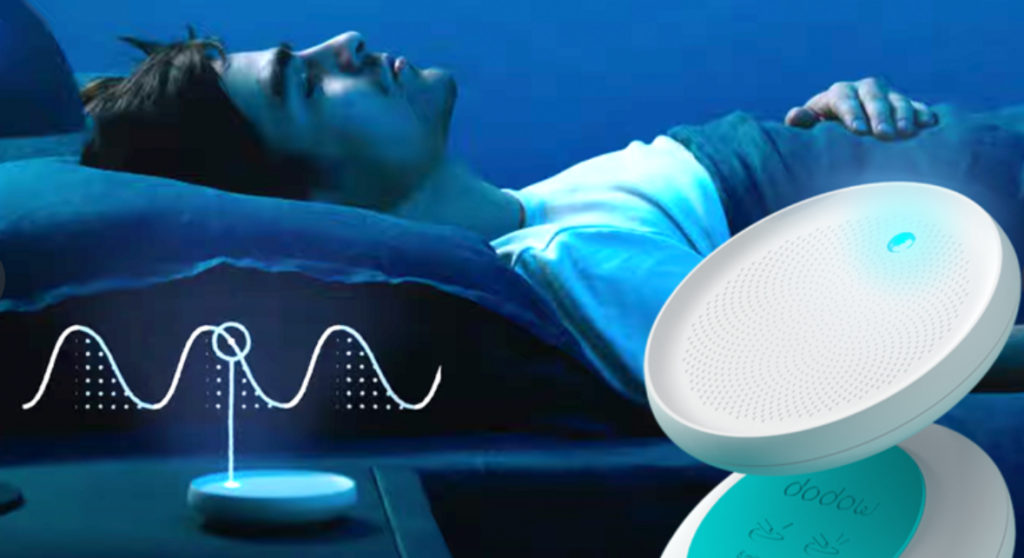
If your problem at bedtime is a mind that refuses to slow down, Dodow takes an unusually simple approach: instead of playing audio, tracking sleep, or putting another app on your phone, it projects a pulsing light onto the ceiling and asks you to breathe along with it.
The basic idea is easy to understand. You tap the device, the light expands and contracts, and you inhale and exhale in rhythm with it. Dodow offers 8-minute and 20-minute sessions and gradually slows the breathing pace toward about six breaths per minute. That part is real.
The more difficult question is whether buying the $59.90 device adds enough benefit beyond simply practicing slow breathing yourself. The evidence is much less definitive there.
My assessment, based on the evidence I could verify, is that Dodow is best viewed as a guided relaxation and paced-breathing tool, not a proven treatment for insomnia. The underlying slow-breathing technique has a growing research base, but I could not verify strong device-specific clinical evidence supporting the company’s marketing claim that users fall asleep 2.5 times faster.
Quick Verdict of Dodow Sleep Aid Device
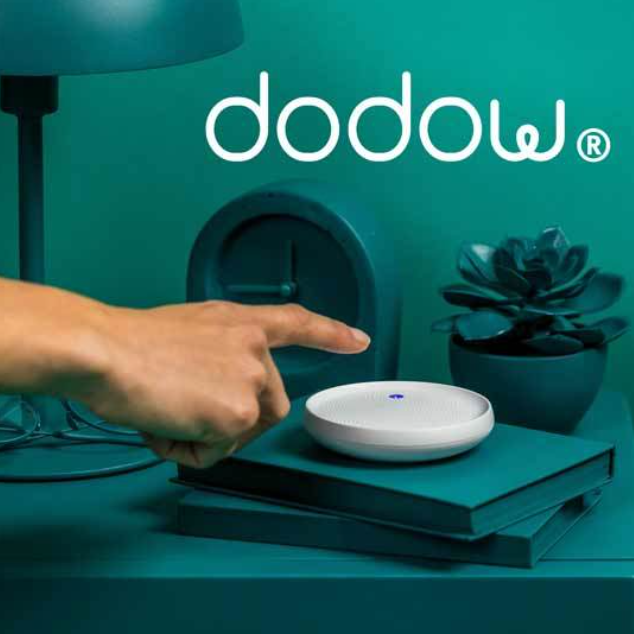
The Dodow Sleep Aid Device is a small, battery-powered light metronome designed to guide slow breathing at bedtime. You tap the top, watch the expanding and contracting light projected toward the ceiling, and synchronize your breathing with it. It offers 8-minute and 20-minute sessions and does not require a phone, app, subscription, or charger.
The interesting part is that the underlying technique has some scientific support, but Dodow itself has a more limited evidence base. A 2026 systematic review of slow breathing before bed found improvements in self-reported sleep duration and quality, while objective measures such as actigraphy and polysomnography were inconclusive.

So the buying question is less “Is Dodow a scientifically proven insomnia treatment?” and more:
Do you want a dedicated, screen-free tool that makes paced breathing easier to follow?
For that use case, Dodow has a sensible design. For someone expecting a clinically proven treatment for chronic insomnia, the evidence is not strong enough to make that claim.
What Is the Dodow Sleep Aid Device?
Dodow is a small sleep-aid device made by LIVLAB. It works as a visual breathing guide, rather than a sound machine, wearable, medication, or sleep tracker.
The device uses a projected blue light that expands and contracts on the ceiling. The idea is straightforward: breathe in as the light expands and breathe out as it contracts. Over the course of the session, Dodow slows the breathing rhythm toward approximately six breaths per minute.

LIVLAB currently lists the device as measuring about 9 × 9 × 1.8 cm, weighing about 180 g, using three AAA batteries, and having a white ABS housing.
That simplicity is intentional. There is no phone setup, Bluetooth pairing, wearable sensor, audio track, or account to manage.
Dodow at a glance
| Feature | What the available evidence shows |
|---|---|
| Product type | Light-guided breathing/sleep aid |
| Manufacturer | LIVLAB |
| Sessions | 8 minutes or 20 minutes |
| Guidance | Expanding/contracting projected light |
| Power | 3 AAA batteries |
| Material | White ABS |
| Dimensions | Approx. 9 × 9 × 1.8 cm |
| Weight | Approx. 180 g |
| Screen/app required | No |
| Current U.S. price | Around $59–$59.90 on LIVLAB pages checked |
| Current trial/return claim | 100-day refund window stated by LIVLAB |
| Warranty | 2 years stated on current product documentation |
How Does Dodow Sleep Aid Device Work?
Dodow’s method combines two things:
paced breathing and an external visual focus point.
Tap the top once and the 8-minute mode starts. Tap twice for the 20-minute mode. The projected light expands and contracts, and you’re instructed to inhale while it grows and exhale while it contracts. The rhythm gradually slows toward about six breaths per minute.
That mechanism has a reasonable physiological rationale.
Slow breathing has been studied for its effects on autonomic nervous-system activity. A 2018 systematic review found that slow breathing can influence cardiovascular and autonomic measures, including heart-rate variability.
More importantly for this review, a newer systematic review published in 2026 specifically examined slow breathing before bedtime. Across nine studies involving 457 participants, the researchers found that self-reported sleep duration and sleep quality improved, but objective sleep measurements were inconclusive. The authors called for more high-quality, longer-duration research.
That is a useful distinction:
There is evidence for the technique. There is not equally strong evidence proving that the Dodow hardware itself produces the claimed results.
What does Dodow Sleep Aid Device actually do?
There are two different claims to separate.
The practical function
Dodow gives you an external visual signal for breathing.
Instead of counting breaths yourself, watching a clock, or opening an app, you simply follow the light.
That can be useful for someone who struggles to maintain a slow breathing pattern long enough to relax.
The broader physiological claim
Slow breathing can influence autonomic activity and heart-rate variability. A 2026 systematic review covering nine studies and 457 participants found improvements in self-reported sleep duration and sleep quality after slow breathing before bed, but objective sleep measurements were inconclusive. The authors called for better and longer studies.
That is encouraging, but it is not the same thing as proving Dodow itself treats insomnia.
The distinction is important because the manufacturer connects Dodow to a much broader literature on “cardiac coherence,” heart-rate variability, baroreflex activity and slow breathing. Those physiological mechanisms have scientific literature behind them, but that does not automatically establish the effectiveness of this particular consumer product for every sleep problem.
Dodow Sleep Aid Device Features
1. Two Session Modes
Dodow provides two basic sessions:
- 8-minute mode
- 20-minute mode
The 8-minute mode starts with one tap, while two taps activate the longer mode. The device automatically switches off when the selected session finishes.
The benefit is convenience. You don’t need to monitor a timer or keep checking your phone.
The limitation is equally simple: if you remain awake after the session, the device stops rather than continuing indefinitely.
2. Visual Breathing Guidance
Instead of relying on spoken instructions, Dodow uses the projected light as a visual metronome.
This may appeal to people who find audio distracting at bedtime, especially when sharing a bedroom.
3. Screen-Free Design
Dodow doesn’t require a smartphone or app to operate.
That can be useful because nighttime phone use creates its own problems: notifications, scrolling, checking the clock and exposure to bright displays can all make winding down harder. The NIH recommends creating a sleep-friendly environment and avoiding electronic-device light near bedtime.
Of course, “screen-free” does not automatically mean “better than every app.” It simply removes some of the distractions associated with using a phone in bed.

4. Battery Powered
The device uses three AAA batteries rather than a rechargeable battery or USB charger. Current documentation lists the batteries as included.
That’s convenient at the bedside but creates an ongoing, minor consumable cost.
5. Three Brightness Levels
Dodow provides three brightness levels. Independent testing from Reviewed found that the brightest setting could feel excessive, while the lowest setting provided a more comfortable balance for the tester.
That’s worth knowing before buying because the product’s whole premise requires you to look toward its light.
What Are the Potential Benefits of Dodow Sleep Aid Device?
The strongest potential benefit isn’t that Dodow contains some special sleep technology.
It’s that the device makes paced breathing easier to perform consistently.
A 2026 systematic review found that slow breathing before bedtime was associated with improvements in subjective sleep quality and duration, although objective sleep outcomes were less conclusive.
For a buyer, that means Dodow may be most interesting when your difficulty falling asleep is connected to:
- mental overactivity at bedtime,
- difficulty winding down,
- a preference for relaxation exercises,
- difficulty maintaining a slow breathing rhythm without external guidance,
- or a desire for a dedicated device instead of another phone-based routine.
Those are reasonable use cases.
They should not be confused with evidence that Dodow can treat every cause of insomnia.
My testing / research methodology
I did not independently test Dodow.
This review is based on current product documentation, the published user manual, LIVLAB’s customer-support information, independent product coverage, and scientific literature on slow breathing and insomnia.
That limitation matters because claims about comfort, brightness, build quality, battery life, and personal effectiveness are difficult to establish from a manufacturer’s specifications alone.
Independent reviewers have reported different experiences. Reviewed.com, for example, described the device as straightforward to use and noted that it projects a blue orb onto the ceiling, while another independent reviewer reported difficulty with the battery compartment and found the light relatively bright. Those are useful consumer observations, but they represent individual testing rather than a controlled clinical result.
Does Dodow Sleep Aid Device Really Work?
The fairest answer is:
The breathing method has supporting evidence, but Dodow itself has not been established to the same standard as a clinical insomnia treatment.
Independent review evidence is mixed but interesting.
Reviewed tested Dodow and reported that its tester found the breathing rhythm calming and useful for winding down. The same review also noted that it was more naturally suited to someone lying on their back because the light is projected onto the ceiling.
Illuminate Labs’ more recent review similarly reported a positive tester experience but specifically noted that Dodow did not appear to have device-specific clinical testing.
This matters because many affiliate articles blur two different claims:
“Slow breathing can help relaxation and sleep.”
and
“This particular $59 device has been clinically proven to improve sleep.”
Those statements are not interchangeable.
The available evidence supports the first much better than the second.
The Blue-Light Question
One of the more legitimate criticisms of Dodow is also one of the easiest to miss.
Dodow uses a blue projected light.
Blue-rich light exposure in the evening can influence circadian biology and melatonin, particularly at higher intensities. Research on evening short-wavelength light has repeatedly shown that light exposure can affect the sleep-wake system.
LIVLAB’s position is that Dodow is different because the projected light is very dim. The company states that the light reaching a person lying in bed is less than 1 lux at maximum intensity and that exposure lasts only 8–20 minutes. LIVLAB therefore argues that the circadian effect should be very small.
That’s a plausible product-specific argument, but it is still a manufacturer claim, not proof that every sleeper will respond identically.
Independent testing also shows why personal preference matters. One tester described the blue light as brighter than expected and found the concept somewhat awkward given broader concerns around blue-light exposure at bedtime.

Practical takeaway
The light issue does not make Dodow automatically unsuitable.
It does mean that people who strongly prefer a completely dark room may prefer a non-light-based breathing technique.
Is Dodow Sleep Aid Device Easy to Use?
The basic operation is very simple.
Place Dodow on a bedside surface where the projected light is visible, then tap once for eight minutes or twice for twenty. Follow the light as it expands and contracts.
However, independent testing identified some small usability quirks, including confusion about adjusting brightness and opening the battery compartment.
That isn’t a major drawback, but it illustrates an important point: simple hardware does not always mean perfectly intuitive hardware.
Is Dodow Sleep Aid Device Good for Side Sleepers?
This is one area where expectations should be realistic.
Because Dodow projects its guidance onto the ceiling, the experience is most natural when you’re positioned so you can comfortably see it.
Reviewed specifically found it easier to use while lying on the back and less convenient for people who sleep primarily on their side or stomach.
A side sleeper can still use the device, but the interaction may be less natural.
This is a meaningful consideration that generic affiliate reviews often overlook.
Dodow Sleep Aid Device Pros and Cons
Dodow Sleep Aid Device Pros
- Simple, screen-free operation
- No subscription or app required
- Uses a genuine relaxation technique rather than medication
- 8- and 20-minute sessions
- Compact bedside design
- Automatically shuts off
- Current LIVLAB U.S. store advertises a 100-day refund window
- Current documentation lists a two-year warranty
Dodow Sleep Aid Device Cons
- Around $59 is a meaningful price for a single-purpose device
- The core breathing technique can be practiced without buying hardware
- Dodow itself has limited device-specific clinical evidence
- Blue light may not appeal to people who prefer darkness
- The ceiling projection is less convenient for some side and stomach sleepers
- Battery replacement is required
- The automatic 8/20-minute shutdown may not suit every sleeper
Dodow Sleep Aid Device vs. Free Breathing Apps
This is probably the most important comparison for a skeptical buyer.
A phone or breathing app can reproduce the basic concept: provide a paced visual or audio breathing rhythm and guide you toward slower breathing.
So what are you actually paying for with Dodow?
You’re paying for a dedicated object that lives beside your bed and lets you leave the phone out of the routine.
| Consideration | Dodow | Free breathing app |
|---|---|---|
| Cost | About $59 | Usually $0 |
| Dedicated device | Yes | No |
| Phone required | No | Usually |
| Screen-free | Yes | Not always |
| Notifications | None | Possible |
| Guided breathing | Yes | Yes |
| Battery/charging | AAA batteries | Phone battery |
| Portability | Good | Excellent |
| Long-term cost | Batteries | Usually minimal |
For someone comfortable using a phone-free breathing method, Dodow’s premium is difficult to justify purely on the basis of the breathing technique.
Its strongest differentiator is convenience and ritual.

Dodow vs. CBT-I
This is not really an apples-to-apples comparison, and readers should understand why.
CBT-I is a structured treatment for insomnia. Dodow is a consumer relaxation device.
The NIH says CBT-I is usually recommended as the first treatment option for long-term insomnia. The American Academy of Sleep Medicine similarly identifies CBT-I as first-line treatment for chronic insomnia in adults.
That does not mean Dodow has no place in a bedtime routine.
It means the device should not be marketed as a replacement for evidence-based treatment when someone has persistent or clinically significant insomnia.
A useful way to think about it:
Dodow: relaxation tool.
CBT-I: structured insomnia treatment.
Dodow vs. White-Noise Machines
These devices target different problems.
A white-noise machine is primarily useful when external sounds are making sleep difficult.
Dodow addresses something different: the user’s attention and breathing.
Someone living beside a busy road could potentially benefit more from noise masking than from a breathing light. Someone with a quiet room but a racing mind may find paced breathing more relevant.
Neither automatically solves every sleep problem.
Who Should Consider the Dodow Sleep Aid Device?
Dodow makes the most sense for someone who:
- prefers a non-drug, screen-free bedtime routine;
- enjoys breathing or relaxation exercises;
- wants a dedicated device rather than another app;
- is comfortable looking toward a dim projected light;
- mainly sleeps in a position where the ceiling projection is easy to follow;
- understands that the device is a relaxation aid rather than proven treatment for chronic insomnia.
LIVLAB markets Dodow to a broad range of users, but those marketing claims should not be treated as clinical indications.
Who Should Probably Skip Dodow Sleep Aid Device?
Dodow may be a poor fit if:
You want completely dark conditions.
The projected light may bother you even at a lower setting.
You don’t like guided breathing.
The breathing rhythm is the entire point of the product.
You sleep almost entirely on your stomach.
The ceiling projection becomes less convenient.
You want a clinically established insomnia treatment.
Dodow is not a substitute for CBT-I or medical evaluation.
You already have a breathing app you genuinely use.
You may be paying roughly $59 for convenience rather than a fundamentally different technique.
What I like about Dodow Sleep Aid Device
The strongest design decision is that Dodow removes friction.
Many sleep products ask users to do more: open an app, select content, wear a device, charge something, review data, or listen to a program.
Dodow does the opposite.
You tap the device and follow the light.
For somebody whose biggest obstacle is mental chatter, that can be appealing because the light provides a single thing to focus on. The manufacturer specifically describes the goal as redirecting attention away from intrusive thoughts while progressively slowing breathing.
That is a much more defensible description than treating Dodow like a sedative.
What concerns me
The marketing sometimes runs ahead of the evidence
The manufacturer says users fall asleep up to 2.5 times faster and gain more than 100 hours of sleep per year. Those are manufacturer-reported user claims, not figures I could independently verify from a high-quality device-specific clinical trial.
That distinction should appear clearly in any trustworthy review.
Blue light deserves a nuanced discussion
Dodow uses blue light, yet evening blue-light exposure is often discussed as something that can affect circadian physiology and melatonin.
Research supports the general fact that short-wavelength light can influence circadian biology, but it does not follow that every small blue light has the same impact as a bright phone or tablet screen. Reviews of blue-light interventions have produced mixed results, especially for real-world sleep outcomes.
So I would not describe Dodow’s blue light as either “harmful” or automatically “sleep promoting.”
It is better to say that light sensitivity varies, the device allows brightness adjustment, and some sleepers may find the projection relaxing while others may prefer darkness.
Dodow Sleep Aid Device Price: How Much Does It Cost?
The current LIVLAB U.S. storefront shows Dodow at approximately $59 to $59.90, depending on the page currently being served. One current U.S. product page displayed $59.00, while another LIVLAB U.S. storefront page displayed $59.90.
Because those pages are not displaying exactly the same amount, I would check the final checkout price before publishing a specific price claim.
The U.S. storefront currently advertises:
- Free delivery on orders over $45
- PayPal installment payments
- A 100-day refund window
- Two-year warranty information in the product documentation
Terms can change, so readers should confirm the policy at checkout.
Is $59 reasonable for Dodow Sleep Aid Device?
That depends largely on whether the dedicated hardware changes your behavior.
For someone who already does paced breathing successfully with a free tool, $59 buys convenience rather than a completely new therapeutic technique.
For someone who repeatedly picks up the phone at bedtime, gets distracted, or struggles to maintain a breathing rhythm without an external cue, the dedicated format may provide more practical value.
Shipping, returns and warranty
LIVLAB currently lists the United States as a Dodow shipping destination. Its U.S. storefront shows express delivery information and free shipping above the stated order threshold on the current product page.
The current Dodow product page also advertises 100 days to test the product and receive a refund if unsatisfied.
However, there is an important caveat.
LIVLAB’s general terms currently describe a statutory withdrawal period and explicitly mention 100 days for HoomBand, not Dodow, while requiring returned products to be in specified condition with packaging and accessories.
Because these pages are not perfectly aligned, buyers should confirm the exact Dodow return terms at checkout or through LIVLAB support before ordering.
The current product page lists a 2-year warranty, and LIVLAB’s support documentation says defective devices within the warranty period can be replaced.
Is Dodow Sleep Aid Device legit?
There is enough verifiable information to establish that Dodow is a real, identifiable product sold by a real company.
LIVLAB identifies itself as the manufacturer, provides a legal notice, publishes product specifications, supplies a user manual, lists customer support information, and currently sells the product through its own storefront.
That establishes the product’s identity.
It does not, however, prove every performance claim made in advertising.
The strongest evidence-backed conclusion is therefore:
Dodow is a real commercial breathing-guidance product, but the evidence supporting slow breathing should not be confused with proof that Dodow itself delivers a specific clinical level of benefit.
That is the key distinction buyers should understand.
What do Dodow Sleep Aid Device reviews say?
Consumer experiences are mixed, which is normal for a behavioral relaxation tool.
An independent Reviewed.com test described Dodow as straightforward to operate and confirmed its core design of projecting an expanding and contracting light onto the ceiling.
Illuminate Labs reported that its tester found Dodow calming and useful for sleep onset but also found the light relatively bright and experienced some difficulty with the battery compartment.
Third-party retailers also contain positive and negative individual reviews. For example, Cult Beauty’s customer reviews include one user praising the product’s concept but another reporting that the light cycle did not match their breathing comfortably.
Those experiences illustrate the main point: comfort with visual pacing is personal.
I would therefore avoid publishing an artificial star rating based on scattered retailer reviews.
How to use Dodow Sleep Aid Device
A basic session looks like this:
- Put Dodow on a stable surface near the bed so the projected light can be seen on the ceiling.
- Tap once for 8 minutes or twice for 20 minutes.
- Watch the projected light.
- Inhale as it expands.
- Exhale as it contracts.
- Allow the breathing rate to slow naturally rather than forcing deeper or harder breaths.
- Let the device shut off automatically when the session ends.
The published guidance recommends starting on your back because that can make following the projection easier.
If you are not asleep when the cycle finishes, that does not necessarily mean the session failed. The immediate purpose is relaxation and paced breathing, not guaranteed unconsciousness within a fixed number of minutes.
Does Dodow Sleep Aid Device treat insomnia?
It should not be presented that way.
Dodow is marketed as a sleep aid and relaxation product. Its own documentation states that it is not a medical device.
For chronic insomnia, CBT-I has substantially stronger clinical support.
A systematic guideline review found a strong recommendation for multicomponent CBT-I in adults with chronic insomnia, based on a large body of clinical evidence.
That means Dodow can reasonably be considered a bedtime relaxation aid, but it should not replace assessment or treatment when insomnia is persistent, severe, or linked to another medical or sleep disorder.
Is Dodow Sleep Aid Device Safe?
For most healthy adults, Dodow is presented as a non-drug consumer relaxation device.
But “drug-free” does not mean “appropriate for every health situation.”
The manufacturer’s manual includes a medical disclaimer for people with serious medical conditions or following certain surgeries, and it identifies Dodow as a non-medical product.
More importantly, persistent insomnia deserves appropriate attention because sleep problems can have many different causes.
The NIH notes that chronic insomnia is generally defined as symptoms occurring at least three nights per week for more than three months and not being fully explained by another problem.
Dodow should therefore be treated as a sleep-support tool, not as a diagnostic device or substitute for professional evaluation.
A Note About Health Claims
Several Dodow marketing statements go beyond the simple claim that the device helps guide breathing.
For example, LIVLAB connects its breathing method with baroreflex activity, autonomic regulation, heart-rate variability and stress reduction.
Some of those underlying physiological concepts are legitimate areas of research.
The mistake would be assuming that evidence for a physiological mechanism proves a particular consumer product will produce the same outcome in every person.
That is why this review does not claim that Dodow:
- cures insomnia,
- treats anxiety,
- replaces sleep medication,
- prevents sleep disorders,
- or guarantees that someone will fall asleep within eight minutes.
Those claims are not supported strongly enough by the evidence reviewed here.
Frequently Asked Questions About Dodow
What is the Dodow Sleep Aid Device?
Dodow is a small battery-powered device that projects an expanding and contracting light onto the ceiling to guide slow breathing before sleep.
How does Dodow work?
You synchronize your breathing with the projected light. The device gradually slows the breathing rhythm toward approximately six breaths per minute.
Does Dodow really work?
The evidence for slow breathing as a sleep-support technique is more convincing than the evidence for Dodow specifically. A 2026 systematic review found improvements in self-reported sleep outcomes but inconclusive objective sleep measurements.
How long do you use Dodow?
Dodow provides 8-minute and 20-minute sessions. It automatically turns off after the selected session.
Does Dodow use blue light?
Yes. The device projects blue light onto the ceiling. LIVLAB says the light reaching the user is very low intensity and used only for a short period.
Is Dodow clinically proven for insomnia?
I did not find strong independent evidence showing that Dodow itself has been clinically established as an insomnia treatment. Independent review evidence has specifically noted the lack of device-specific clinical testing.
Can I use Dodow if I sleep on my side?
You can, but the ceiling projection is naturally easier to follow while lying on your back. Independent testing has identified this as a limitation for some side and stomach sleepers.
Is Dodow worth it?
It depends on whether you value the dedicated hardware. The underlying paced-breathing exercise can be performed without Dodow, so its main benefit is convenience and consistency rather than access to a unique physiological treatment.
What is the best alternative to Dodow for chronic insomnia?
For chronic insomnia, the relevant evidence-based alternative is CBT-I rather than simply another relaxation gadget. NHLBI describes CBT-I as the usual first treatment option for long-term insomnia.
How much does Dodow cost?
The current LIVLAB U.S. pages I checked displayed approximately $59–$59.90. Prices can vary by page or promotion, so confirm the live checkout price.
Does Dodow have a return period?
LIVLAB’s current U.S. product page says customers have 100 days to test Dodow and can receive a refund if dissatisfied. Check the current terms for the exact return conditions.
Is Dodow a replacement for CBT-I?
No. CBT-I is an established first-line treatment for chronic insomnia, while Dodow is a consumer relaxation device.
Final Verdict: Is Dodow Worth Buying?
Dodow is an interesting, narrowly focused sleep gadget-not a proven cure for insomnia.
Its strongest case is convenience.
The underlying idea is simple: use visual pacing to make slow breathing easier to perform at bedtime. Research published in 2026 suggests that slow breathing before sleep can improve self-reported sleep quality and duration, although objective sleep evidence remains less certain.
The biggest reason to hesitate is also straightforward: you can practice slow breathing without buying a $59 device.
Dodow becomes more compelling when a buyer values the dedicated hardware, wants to stay away from phone screens, likes visual guidance, and finds it difficult to maintain a breathing rhythm independently.
It becomes less compelling when someone already has an effective free breathing routine, dislikes nighttime light, sleeps mainly on their stomach, or needs treatment for persistent insomnia.
The most accurate way to view it is:
Dodow is a convenience-focused breathing aid with a plausible mechanism, useful design features, and limited device-specific clinical evidence.
That is a much more defensible buying proposition than promising that it will put every user to sleep in eight minutes.